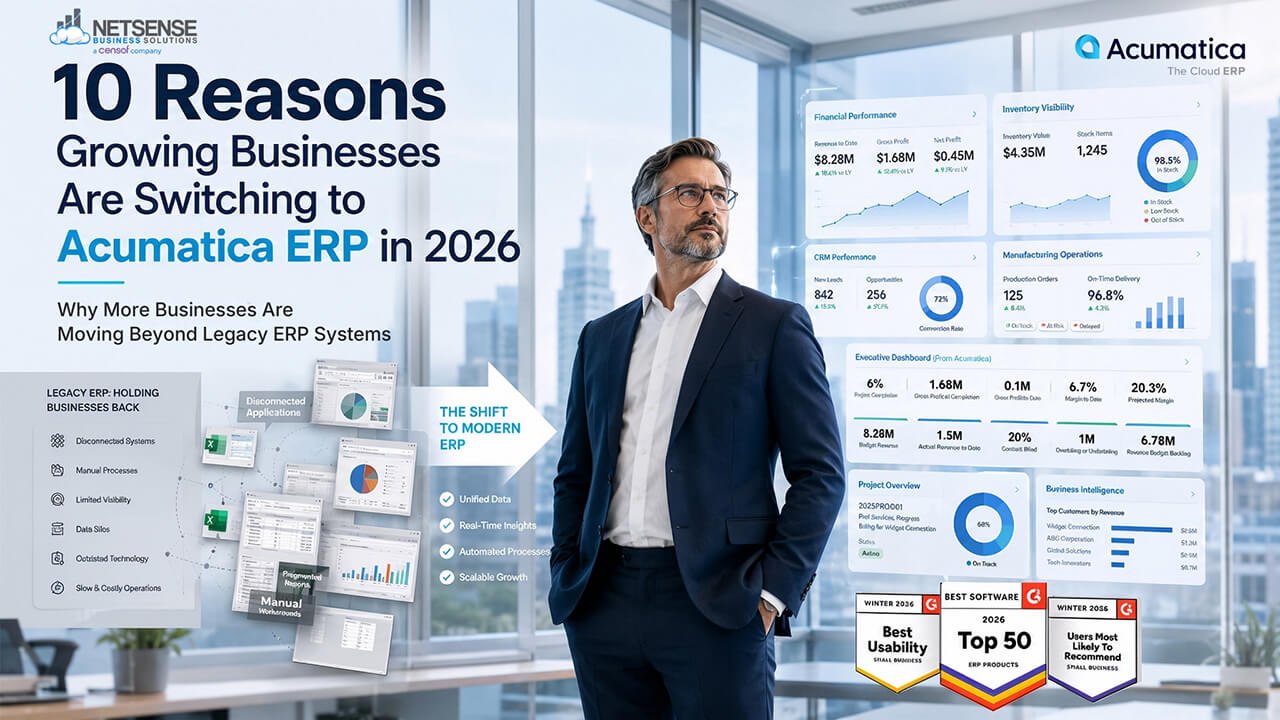
Many businesses outgrow their ERP systems long before they realize it.
What once worked well for a small or mid-sized organization can gradually become a barrier to growth as operations become more complex, teams expand, and customer expectations increase. Spreadsheets multiply, disconnected applications become the norm, reporting takes longer, and decision-makers struggle to get a clear, real-time view of business performance.
The challenge is not simply about having outdated software. It is about whether the current system can support the next stage of business growth.
In 2026, successful businesses are no longer viewing ERP as a back-office tool used solely for accounting or operational record-keeping. Modern ERP has become a strategic platform that connects finance, sales, inventory, procurement, customer management, manufacturing, and business intelligence into a single source of truth. The ability to access accurate data in real time, automate processes, and scale efficiently has become a competitive advantage rather than a luxury.
This shift is particularly important for growing businesses in Malaysia and across Southeast Asia. As organizations expand into new markets, manage distributed teams, and face increasing operational complexity, many legacy ERP systems struggle to keep pace. Limited integration capabilities, high maintenance costs, poor visibility, and inflexible architectures often prevent businesses from operating with the agility required in today’s market.
As a result, companies are not switching ERP systems because they want new software. They are switching because their existing systems can no longer support modern business requirements.
This is one of the key reasons why more organizations are turning to Acumatica ERP. Designed as a cloud-native business management platform, Acumatica provides the flexibility, scalability, and real-time visibility that growing businesses need to adapt, compete, and thrive in a rapidly changing business environment.
In this article, we’ll explore the top 10 reasons why growing businesses are making the move to Acumatica ERP in 2026 and how the platform is helping organizations build a stronger foundation for long-term growth.
Table of contents
- Why Malaysian Businesses Are Rethinking Legacy ERP
- A Cloud-Native ERP Built for Modern Business
- Designed for Usability and Adoption
- Built to Scale Alongside Business Growth
- Modern Architecture That Supports Innovation
- A Licensing Model Designed for Collaboration
- Open API Integrations for a Connected Business Environment
- Real-Time Business Intelligence and Visibility
- More Than an ERP System
- 10 Reasons Growing Businesses Are Switching to Acumatica ERP in 2026
- 1) Access Your Business Anytime, Anywhere
- 2) No User-Based Licensing Restrictions
- 3) One Connected Platform Instead of Multiple Disconnected Systems
- 4) Real-Time Financial Visibility for Faster Decision-Making
- 5) Integrated CRM for Better Customer Relationships
- 6) Built to Scale as Your Business Grows
- 7) Modern Architecture and Open API Integrations
- 8) Better Business Intelligence and Reporting
- 9) Flexible Deployment Options
- 10) Cost-Effective ERP with Strong Long-Term ROI
- How Acumatica Supports Growth Across Different Industries
- Why This Matters for Businesses in Malaysia and Southeast Asia
- Why Choose Netsense Business Solutions for Acumatica ERP Implementation
- Frequently Asked Questions (FAQs)
- Key Takeaways
- Ready to Explore Acumatica ERP for Your Business?
Why Malaysian Businesses Are Rethinking Legacy ERP
Across Malaysia, growing businesses are facing a common challenge: the systems that once supported their operations are no longer keeping pace with their growth.
As companies expand their customer base, add new product lines, open additional locations, or adopt hybrid working models, operational complexity increases significantly. Unfortunately, many legacy ERP systems were not designed to support the level of flexibility, connectivity, and real-time visibility that modern businesses require.
One of the biggest issues is fragmented systems. Over time, organizations often accumulate multiple software applications for accounting, inventory management, CRM, procurement, reporting, and customer service. While each tool may solve a specific problem, the lack of integration creates data silos, duplicate work, and inconsistent information across departments.
For example, finance teams may rely on one system, sales teams on another, and operations teams on entirely different platforms. As a result, employees spend valuable time manually consolidating data instead of focusing on strategic initiatives that drive business growth.
Remote access has also become a major consideration. Today’s workforce is increasingly mobile, with employees, managers, and executives expecting secure access to business information from anywhere. Traditional on-premises systems often struggle to deliver the accessibility and user experience required by modern organizations, creating bottlenecks that slow down decision-making and collaboration.
Scalability is another growing concern. Many businesses discover that their existing ERP solution works well at a certain size but becomes increasingly difficult and expensive to manage as operations expand. Whether supporting multiple entities, handling larger transaction volumes, managing additional warehouses, or entering new markets, legacy systems frequently require costly customizations and infrastructure upgrades to keep up with growth.
At the same time, business leaders are under increasing pressure to make faster, data-driven decisions. Without real-time visibility into financial performance, inventory levels, operational efficiency, and customer activity, organizations risk missing opportunities and reacting too slowly to market changes.
This is why many businesses in Malaysia are reassessing their ERP strategy in 2026. The conversation is no longer simply about replacing old software—it is about building a technology foundation that can support long-term growth, operational agility, and digital transformation.
Modern cloud ERP platforms such as Acumatica are gaining attention because they address many of the limitations associated with traditional ERP systems. By providing a unified, cloud-native platform with real-time visibility, integrated business processes, and scalable architecture, Acumatica enables organizations to operate more efficiently while preparing for future growth.
For growing businesses that want to remain competitive in an increasingly digital economy, rethinking legacy ERP is no longer an IT decision alone—it has become a strategic business decision.
Why Acumatica Stands Out Among Modern ERP Platforms
The ERP market is filled with solutions that promise better efficiency, improved visibility, and streamlined operations. However, as businesses evaluate their options in 2026, the decision is no longer based solely on features. Organizations are looking for ERP platforms that can support long-term growth, adapt to changing business requirements, and deliver measurable business value.
This is where Acumatica stands out.
Rather than being designed around outdated infrastructure or rigid licensing models, Acumatica was built for the realities of modern business. Its cloud-native architecture, flexible deployment options, scalable platform, and user-centric design make it a strong choice for organizations seeking a future-ready ERP solution.
A Cloud-Native ERP Built for Modern Business
Unlike traditional ERP systems that were later adapted for the cloud, Acumatica was developed as a cloud-native platform from the ground up. This allows businesses to access critical data, workflows, and business applications securely from anywhere with an internet connection.
For organizations operating across multiple locations, supporting remote teams, or managing distributed operations, cloud accessibility has become essential. Acumatica enables employees, managers, and executives to stay connected to the business without being tied to a specific office or device.
Designed for Usability and Adoption
One of the biggest challenges in ERP implementation is user adoption. Even the most powerful ERP solution can fail to deliver value if employees find it difficult to use.
Acumatica focuses heavily on usability, providing an intuitive and modern user experience that helps teams work more efficiently. Information is easier to access, workflows are more streamlined, and users can personalize dashboards based on their specific roles and responsibilities.
This reduces training requirements, improves productivity, and encourages wider adoption across the organization.
Built to Scale Alongside Business Growth
Growing businesses need technology that can evolve with them.
Whether a company is expanding into new markets, opening additional branches, increasing transaction volumes, or adding new business units, Acumatica provides the scalability required to support that growth. Businesses can start with the capabilities they need today and expand their ERP environment as operational requirements become more complex.
This flexibility allows organizations to avoid the costly and disruptive system replacements that often occur when businesses outgrow their existing ERP platforms.
Modern Architecture That Supports Innovation
Technology continues to evolve rapidly, and ERP systems must be able to keep pace.
Acumatica is built on a modern architecture that supports continuous innovation and long-term adaptability. Businesses can leverage new capabilities, adopt emerging technologies, and respond to changing market demands without being constrained by legacy infrastructure.
This modern foundation helps organizations remain agile while protecting their technology investments for the future.
A Licensing Model Designed for Collaboration
Many traditional ERP solutions charge licensing fees based on the number of users accessing the system. As organizations grow, these costs can increase significantly, creating barriers to collaboration and limiting system adoption.
Acumatica takes a different approach. Its licensing model is designed to encourage organization-wide access rather than penalize growth. This allows businesses to extend ERP capabilities across departments and teams without constantly worrying about additional user costs.
For growing organizations, this can create greater operational alignment and stronger collaboration across the business.
Open API Integrations for a Connected Business Environment
Modern businesses rarely operate using a single software application. CRM platforms, e-commerce solutions, business intelligence tools, payment gateways, and industry-specific applications often play critical roles in daily operations.
Acumatica’s open architecture and API-first approach make integration significantly easier. Businesses can connect Acumatica with existing systems, automate data flows, and create a more unified technology ecosystem.
This reduces manual data entry, improves data accuracy, and helps organizations eliminate costly information silos.
Real-Time Business Intelligence and Visibility
Business leaders need more than historical reports. They need real-time insights that support faster and more confident decision-making.
Acumatica provides built-in dashboards, reporting tools, and business intelligence capabilities that allow organizations to monitor key performance indicators, track operational performance, and identify trends as they happen.
With access to accurate, real-time information, decision-makers can respond more quickly to opportunities, mitigate risks, and drive better business outcomes.
More Than an ERP System
What makes Acumatica particularly attractive to growing businesses is that it goes beyond traditional ERP functionality. It serves as a connected business platform that brings together finance, operations, inventory, customer management, reporting, and automation within a single environment.
As organizations continue their digital transformation journeys, they need technology that enables agility, visibility, and scalability. Acumatica delivers these capabilities through a modern cloud ERP platform designed specifically for businesses that are focused on sustainable growth and long-term success.
This combination of cloud-native technology, user-friendly design, scalability, integration flexibility, and real-time intelligence is why Acumatica continues to gain momentum among businesses in Malaysia and across Southeast Asia in 2026.
10 Reasons Growing Businesses Are Switching to Acumatica ERP in 2026
1) Access Your Business Anytime, Anywhere
Modern businesses are no longer confined to a single office location. Employees work remotely, managers travel frequently, and decision-makers often need access to critical information outside traditional business hours.
Unfortunately, many legacy ERP systems were designed for on-premises environments, making remote access difficult, slow, or heavily dependent on VPN connections and IT support. This can create delays in approvals, disrupt workflows, and reduce operational responsiveness.
Acumatica solves this challenge with its cloud-native architecture. Employees can securely access business data, approve transactions, monitor operations, and collaborate with colleagues from virtually anywhere using a web browser or mobile device. Whether teams are working from headquarters, a branch office, home, or on the road, Acumatica helps keep operations moving without interruption.
For growing businesses, this level of accessibility supports business continuity, improves productivity, and enables greater operational agility.
2) No User-Based Licensing Restrictions
As businesses grow, collaboration becomes increasingly important. More employees need access to business data, reports, workflows, and customer information to perform their jobs effectively.
Many traditional ERP solutions charge additional fees for every new user added to the system. Over time, these costs can increase significantly, forcing organizations to limit access and creating information bottlenecks between departments.
Acumatica takes a different approach. Instead of charging businesses based on the number of users, its licensing model is designed to support broader organizational access. This allows finance teams, sales representatives, operations managers, warehouse staff, and executives to work within the same system without concerns about escalating user license costs.
The result is better collaboration, greater transparency, and a technology investment that can scale more effectively alongside business growth.
3) One Connected Platform Instead of Multiple Disconnected Systems
Many growing organizations operate with a patchwork of business applications. Finance uses one system, sales relies on another, inventory is tracked elsewhere, and reporting often requires manually combining data from multiple sources.
This fragmented approach creates data silos, increases administrative workloads, and reduces visibility across the organization.
Acumatica brings critical business functions together within a single integrated platform, including:
- Financial Management
- CRM
- Distribution
- Procurement
- Inventory Management
- Manufacturing
- Field Services
- Project Accounting
With departments operating from a shared source of truth, organizations can reduce duplication, improve data accuracy, streamline workflows, and make better-informed decisions across the business.
4) Real-Time Financial Visibility for Faster Decision-Making
In a rapidly changing business environment, relying on outdated financial information can lead to missed opportunities and delayed responses.
Many organizations struggle with reporting processes that require manual consolidation and reconciliation before meaningful insights can be generated. By the time reports are completed, the information may already be outdated.
Acumatica provides real-time visibility into financial performance, allowing decision-makers to monitor key metrics such as:
- Cash flow
- Revenue
- Expenses
- Profitability
- Budget performance
- Financial compliance
With immediate access to accurate financial data, leaders can make faster decisions, identify potential issues earlier, and respond proactively to changing market conditions.
5) Integrated CRM for Better Customer Relationships
Customer expectations continue to rise, making visibility across the customer lifecycle more important than ever.
When customer information is spread across separate CRM, accounting, and service platforms, teams often struggle with incomplete data, inconsistent communication, and inefficient processes.
Acumatica includes a fully integrated CRM that connects sales, marketing, customer service, and financial information within a unified system. Teams can track leads, manage opportunities, monitor customer interactions, and access relevant account information without switching between applications.
This unified view improves sales pipeline visibility, enhances customer experiences, and helps organizations build stronger long-term relationships with their customers.
6) Built to Scale as Your Business Grows
One of the most common reasons businesses replace their ERP systems is that they eventually outgrow them.
What works for a small operation may become increasingly difficult to manage as transaction volumes increase, new locations are added, and operational requirements become more complex.
Acumatica is designed with scalability in mind. Organizations can start with the capabilities they need today and expand the platform as their business evolves. Whether supporting multiple branches, warehouses, legal entities, or international operations, Acumatica provides the flexibility needed to accommodate growth.
This allows businesses to focus on expansion without worrying about whether their ERP system can keep up.
7) Modern Architecture and Open API Integrations
Technology ecosystems continue to evolve. Businesses increasingly rely on specialized applications for e-commerce, payment processing, business intelligence, logistics, customer engagement, and industry-specific operations.
Legacy ERP systems often struggle to integrate effectively with modern technologies, resulting in manual processes, duplicate data entry, and disconnected workflows.
Acumatica’s modern architecture and open API framework make integration significantly easier. Organizations can connect Acumatica with third-party applications and automate information sharing across systems.
This creates a more connected digital environment while helping businesses future-proof their technology investments. As operational needs change, organizations can continue to adopt new technologies without replacing their core ERP platform.
8) Better Business Intelligence and Reporting
Business leaders need more than raw data—they need actionable insights.
Without clear visibility into performance metrics, organizations often make decisions based on assumptions rather than facts. This can increase risk and reduce strategic effectiveness.
Acumatica includes built-in dashboards, reporting tools, KPI monitoring, and business intelligence capabilities that provide real-time operational visibility. Executives can track performance across departments, identify trends, monitor targets, and respond quickly when issues arise.
By transforming data into actionable insights, Acumatica helps businesses make more informed decisions and drive continuous improvement across the organization.
9) Flexible Deployment Options
Every organization has unique operational, regulatory, and IT requirements.
While many businesses are embracing cloud technologies, some industries still require specific deployment approaches based on internal policies, security requirements, or business preferences.
Acumatica offers deployment flexibility that allows businesses to choose the model that best aligns with their strategy. Whether organizations prefer cloud deployment, private cloud environments, or other supported configurations, Acumatica provides the flexibility needed to support different operational requirements.
This adaptability gives businesses greater control over how they manage their ERP environment while maintaining access to modern ERP capabilities.
10) Cost-Effective ERP with Strong Long-Term ROI
ERP investments should be evaluated based on long-term business value, not just initial software costs.
Many organizations underestimate the ongoing expenses associated with legacy systems, including hardware maintenance, infrastructure upgrades, IT support, custom development, and operational inefficiencies.
Acumatica helps reduce many of these costs through its cloud-based architecture, scalable licensing model, and integrated platform approach. By consolidating systems, automating processes, improving productivity, and providing greater visibility into operations, businesses can generate meaningful efficiency gains over time.
The result is a stronger return on investment, lower total cost of ownership, and an ERP platform capable of supporting sustainable business growth for years to come.
How Acumatica Supports Growth Across Different Industries
One of the reasons Acumatica continues to gain traction among growing businesses is its ability to support a wide range of industries without requiring organizations to rely on multiple disconnected systems.
Also Read: Acumatica vs SAP Business One: Which ERP Fits Growing Companies Better?
While many ERP solutions are designed around generic business processes, Acumatica provides industry-specific capabilities that help companies address operational challenges unique to their sector. Whether managing complex supply chains, controlling production processes, improving customer experiences, or coordinating field operations, businesses can leverage a unified platform that supports both current needs and future growth.
Manufacturing: Improving Visibility and Production Efficiency
Manufacturers operate in increasingly competitive environments where efficiency, accuracy, and real-time visibility are critical to profitability.
Many manufacturing businesses struggle with disconnected production data, inventory inaccuracies, manual planning processes, and limited insight into operational performance. These challenges can lead to production delays, higher costs, and reduced customer satisfaction.
Acumatica Manufacturing Edition helps organizations streamline production planning, manage bills of materials (BOMs), monitor shop floor activities, track inventory levels, and improve demand forecasting. With real-time visibility across manufacturing operations, decision-makers can identify bottlenecks faster, optimize resource allocation, and make more informed production decisions.
For growing manufacturers, this creates a scalable foundation that supports operational excellence and long-term business expansion.
Distribution: Gaining Control Over Inventory and Supply Chains
Distribution businesses depend on accurate inventory management and efficient supply chain operations to maintain profitability and customer satisfaction.
As organizations expand, managing inventory across multiple warehouses, suppliers, and sales channels becomes increasingly complex. Without real-time visibility, businesses risk stock shortages, excess inventory, delayed deliveries, and reduced operational efficiency.
Acumatica enables distributors to centralize inventory management, automate purchasing processes, monitor warehouse performance, and improve supply chain visibility. Real-time data helps organizations make smarter inventory decisions while maintaining the flexibility required to respond quickly to changing customer demand.
This level of control allows distributors to improve service levels while supporting sustainable growth.
Retail: Connecting Operations and Customer Experiences
Today’s retail businesses must manage multiple sales channels, customer touchpoints, inventory locations, and fulfillment processes simultaneously.
Consumers expect seamless experiences whether they are purchasing online, visiting a physical store, or interacting through other channels. Meeting these expectations requires accurate, real-time information across the entire business.
Acumatica helps retailers unify inventory management, financial operations, customer data, purchasing, and reporting within a single platform. By eliminating disconnected systems and improving operational visibility, retailers can make faster decisions, reduce inventory challenges, and deliver more consistent customer experiences.
As retail operations grow and evolve, Acumatica provides the flexibility needed to support both omnichannel strategies and long-term business expansion.
Field Services: Enhancing Productivity in the Field
Field service organizations face unique challenges related to scheduling, resource management, service delivery, and customer communication.
When teams rely on manual processes or disconnected applications, service requests can be delayed, technicians may lack critical information, and operational efficiency often suffers.
Acumatica Field Service Management helps businesses coordinate service operations more effectively by connecting scheduling, dispatching, inventory, customer information, and financial data within a single system. Managers gain greater visibility into field activities, while technicians can access the information they need to perform their work efficiently.
This improves service quality, increases workforce productivity, and helps organizations scale their field operations without increasing administrative complexity.
A Single ERP Platform for Diverse Business Models
Regardless of industry, growing businesses share many of the same objectives: improving visibility, increasing efficiency, reducing manual processes, and building a scalable foundation for future growth.
Acumatica addresses these goals through a modern cloud ERP platform that connects critical business functions across finance, operations, inventory, customer management, reporting, and automation. Rather than managing multiple disconnected systems, organizations can operate from a single source of truth that supports better decision-making and stronger business performance.
This versatility is one of the key reasons why manufacturers, distributors, retailers, and field service organizations across Malaysia and Southeast Asia are increasingly choosing Acumatica as their ERP platform of choice in 2026.
Why This Matters for Businesses in Malaysia and Southeast Asia
The business landscape across Malaysia and Southeast Asia is evolving rapidly. Companies are expanding into new markets, managing increasingly complex operations, and embracing digital transformation initiatives to remain competitive in a fast-changing economy.
As a result, the requirements for business management systems have changed significantly. Organizations no longer need ERP software that simply records transactions—they need platforms that provide real-time visibility, support operational scalability, and enable faster decision-making across the entire business.
For many growing businesses in Malaysia, one of the biggest challenges is managing operations across multiple locations, departments, and business units. Finance teams need accurate financial reporting, sales teams require visibility into customer activities, operations teams depend on inventory accuracy, and executives need access to reliable performance data. When these functions operate in separate systems, inefficiencies quickly emerge.
This challenge becomes even more significant for organizations with regional operations across Southeast Asia. Managing multiple warehouses, branch offices, distribution centers, manufacturing facilities, or service teams often requires a level of coordination that traditional ERP systems struggle to support.
Without a centralized platform, businesses frequently encounter issues such as:
- Limited visibility across departments
- Inconsistent reporting and data accuracy
- Manual processes that slow productivity
- Delayed decision-making
- Difficulties scaling operations efficiently
- Challenges managing multi-location growth
As businesses continue to grow, these inefficiencies can directly impact profitability, customer satisfaction, and long-term competitiveness.
This is where modern cloud ERP solutions are becoming increasingly important.
Acumatica ERP provides organizations with a unified platform that connects finance, inventory, procurement, customer management, reporting, manufacturing, and operational workflows within a single system. Instead of relying on disconnected applications, businesses gain access to real-time information that supports better collaboration and more informed decision-making.
For organizations evaluating Acumatica Malaysia solutions, one of the platform’s greatest strengths is its ability to support growth without introducing unnecessary complexity. Whether a company is expanding to additional locations, launching new business units, increasing transaction volumes, or entering new regional markets, Acumatica provides the scalability needed to support those objectives.
The platform’s cloud-native architecture also allows employees, managers, and executives to access business-critical information securely from anywhere. This flexibility is particularly valuable for organizations with distributed teams, remote workers, field service operations, or multi-country business structures throughout Southeast Asia.
Perhaps most importantly, Acumatica helps businesses move beyond reactive management. With real-time visibility into financial performance, inventory levels, customer activity, operational metrics, and key business indicators, leaders can identify opportunities and address challenges before they become larger issues.
As digital transformation continues to accelerate across Malaysia and Southeast Asia, businesses need technology platforms that support agility, efficiency, and sustainable growth. Acumatica ERP is increasingly becoming the platform of choice for organizations seeking to modernize operations, improve visibility, and build a stronger foundation for long-term success in an increasingly competitive regional market.
Why Choose Netsense Business Solutions for Acumatica ERP Implementation
Selecting the right ERP platform is only part of the equation. The success of any ERP initiative ultimately depends on how well the solution is implemented, adopted, and aligned with business objectives.
Many ERP projects fail to deliver expected results not because of the software itself, but because organizations lack the right implementation strategy, industry expertise, and long-term support. A successful ERP deployment requires more than technical configuration—it requires a partner who understands business processes, operational challenges, and growth objectives.
As an official Acumatica Gold Partner in Malaysia, Netsense Business Solutions helps organizations successfully plan, implement, and optimize Acumatica ERP to support sustainable business growth.
Business-First ERP Consulting
Every organization operates differently. A manufacturing company has different priorities from a distributor, retailer, or field service provider. This is why a one-size-fits-all ERP approach rarely delivers optimal results.
Netsense begins each engagement by understanding the organization’s current processes, operational challenges, reporting requirements, and growth plans. Rather than simply deploying software, the focus is on designing an ERP solution that aligns with the way the business operates and where it wants to go in the future.
This business-first approach helps ensure that technology investments deliver measurable operational and financial value.
End-to-End Acumatica Implementation Services
ERP implementation involves much more than software installation. Organizations must consider process redesign, data migration, user adoption, system integration, testing, and change management.
Netsense provides end-to-end implementation services that guide businesses through every stage of the ERP journey, including:
- Business process assessment
- ERP solution design
- System configuration
- Data migration
- Third-party integrations
- User training
- Go-live support
- Post-implementation optimization
By managing the entire implementation lifecycle, Netsense helps reduce project risks while accelerating time-to-value.
Supporting Business Growth with Scalable Cloud ERP
Growing businesses require technology that can evolve alongside changing operational requirements.
Whether an organization is expanding into new markets, opening additional locations, increasing transaction volumes, or adding new business units, Acumatica provides the scalability needed to support growth. Netsense helps businesses configure and optimize the platform to ensure it can continue supporting future expansion without requiring disruptive system replacements.
This allows organizations to focus on growth initiatives rather than technology limitations.
Industry Expertise Across Key Sectors
Different industries face different operational challenges.
Netsense works with organizations across sectors such as:
- Manufacturing
- Distribution
- Wholesale Trade
- Retail
- Professional Services
- Field Services
This experience enables the team to recommend best practices, streamline implementation processes, and help businesses maximize the value of their ERP investment based on industry-specific requirements.
Long-Term Support Beyond Go-Live
ERP implementation is not a one-time project. As businesses grow and evolve, their operational requirements continue to change.
Netsense provides ongoing support and advisory services to help organizations continuously improve their ERP environment, optimize business processes, and leverage new Acumatica capabilities as they become available.
This long-term partnership approach helps ensure businesses continue to generate value from their ERP investment well beyond the initial implementation phase.
Helping Businesses Accelerate Digital Transformation
Today’s businesses need more than operational efficiency. They need greater visibility, stronger collaboration, better decision-making, and the flexibility to adapt to changing market conditions.
By combining Acumatica’s modern cloud ERP platform with deep implementation expertise, Netsense Business Solutions helps organizations modernize operations, eliminate process inefficiencies, improve business visibility, and create a stronger foundation for long-term growth.
For businesses in Malaysia and across Southeast Asia that are evaluating modern ERP solutions, partnering with an experienced Acumatica Gold Partner can make the difference between simply deploying software and achieving meaningful business transformation.
Frequently Asked Questions (FAQs)
Is Acumatica suitable for growing businesses?
Yes. Acumatica is specifically designed to support growing businesses that require greater operational visibility, scalability, and flexibility. Unlike many traditional ERP systems that become difficult to manage as organizations expand, Acumatica enables businesses to add users, locations, business units, and operational capabilities without requiring a complete system replacement. Its scalable architecture makes it a strong fit for companies planning long-term growth.
Is Acumatica available in Malaysia?
Yes. Acumatica ERP is available in Malaysia through authorized implementation partners such as Netsense Business Solutions, an official Acumatica Gold Partner. Businesses in Malaysia can leverage Acumatica’s cloud ERP capabilities while receiving local consultation, implementation services, training, and ongoing support tailored to regional business requirements.
Why are businesses switching from traditional ERP systems to Acumatica?
Many organizations are moving away from traditional ERP systems because legacy platforms often struggle to support modern business requirements. Common challenges include limited remote access, fragmented data, expensive infrastructure, poor scalability, and complex integrations. Acumatica addresses these issues through a cloud-native platform that provides real-time visibility, integrated business processes, flexible deployment options, and a modern user experience.
Is Acumatica a cloud-based ERP system?
Yes. Acumatica is a cloud-native ERP platform built to support modern business operations. Users can securely access the system from virtually anywhere using a web browser or mobile device. This enables organizations to support remote work, multi-location operations, and real-time collaboration while reducing the infrastructure and maintenance costs typically associated with traditional on-premises systems.
Can Acumatica support manufacturing and distribution businesses?
Absolutely. Acumatica offers industry-specific capabilities for manufacturers and distributors, including inventory management, supply chain visibility, production planning, warehouse management, procurement, demand forecasting, and real-time reporting. These capabilities help organizations improve operational efficiency, increase visibility across the supply chain, and support scalable business growth.
How does Acumatica compare with legacy ERP systems?
The biggest difference is that Acumatica was designed for modern business environments. While many legacy ERP systems were built around older technologies and later adapted to support cloud functionality, Acumatica was developed as a cloud-native platform from the beginning. This allows businesses to benefit from greater flexibility, easier integrations, real-time visibility, improved user experiences, and stronger scalability. For organizations pursuing digital transformation initiatives, Acumatica often provides a more agile and future-ready alternative to traditional ERP platforms.
How long does an Acumatica ERP implementation typically take?
Implementation timelines vary depending on business size, process complexity, customization requirements, and data migration needs. For many small to mid-sized organizations, implementation can take several months, while larger or more complex deployments may require additional time. Working with an experienced Acumatica implementation partner helps ensure the project is planned effectively and delivered with minimal disruption to business operations.
What industries commonly use Acumatica ERP?
Acumatica is used across a wide range of industries, including manufacturing, distribution, wholesale trade, retail, professional services, construction, and field services. Its flexible architecture and industry-specific functionality make it suitable for organizations seeking a modern ERP platform that can adapt to their unique operational requirements.
Is Acumatica a good choice for businesses planning future expansion?
Yes. One of Acumatica’s key strengths is its ability to scale alongside business growth. Whether a company is expanding into new markets, opening additional locations, increasing transaction volumes, or adding new product lines, Acumatica provides the flexibility and visibility needed to support evolving business requirements. This makes it a strategic investment for organizations focused on long-term growth and operational agility.
Key Takeaways
As businesses continue to grow in 2026, many are discovering that their existing ERP systems are no longer capable of supporting modern operational demands. What was once sufficient for managing day-to-day activities can quickly become a barrier to scalability, visibility, and business agility.
Here are the key insights from this article:
- Growing businesses often outgrow their ERP systems faster than they expect. As operations become more complex, disconnected systems, manual processes, and limited visibility can slow growth and reduce efficiency.
- Modern ERP is no longer just about operational management. Today’s ERP platforms play a strategic role in helping businesses improve agility, make faster decisions, and adapt to changing market conditions.
- Acumatica ERP stands out because of its scalability, flexibility, and cloud-native architecture. Organizations can support growth, improve collaboration, and gain real-time visibility without the limitations commonly associated with legacy ERP systems.
- Integrated business processes create better operational performance. By connecting finance, inventory, CRM, procurement, reporting, manufacturing, and field services within a single platform, businesses can eliminate data silos and improve decision-making.
- Malaysian and Southeast Asian businesses need ERP platforms designed for growth. As organizations expand across locations, departments, and markets, having a scalable and future-ready ERP system becomes essential for long-term success.
- Successful ERP transformation requires the right implementation partner. Beyond selecting the right software, businesses need experienced guidance to ensure ERP investments deliver measurable business outcomes and sustainable value.
Ultimately, businesses are not switching to Acumatica simply because they want new software. They are making the move because they need a modern ERP platform that can support growth, increase visibility, improve efficiency, and provide the agility required to compete in an increasingly digital business environment.
If your organization is evaluating ERP solutions for 2026 and beyond, Acumatica offers a strong foundation for operational excellence, digital transformation, and long-term business growth.
Ready to Explore Acumatica ERP for Your Business?
Choosing the right ERP is one of the most important technology decisions a growing business can make. The right platform can help streamline operations, improve visibility, support scalability, and create a stronger foundation for long-term growth.
As an official Acumatica Gold Partner in Malaysia, Netsense Business Solutions helps businesses successfully evaluate, implement, and optimize modern cloud ERP solutions tailored to their operational goals and growth strategies.
Whether you’re struggling with disconnected systems, limited reporting visibility, manual processes, or an ERP platform that no longer supports your business requirements, our team can help you identify the right path forward.
Why Work With Netsense?
- Official Acumatica Gold Partner in Malaysia
- Experienced ERP consulting and implementation team
- Industry expertise across manufacturing, distribution, retail, and field services
- End-to-end project delivery, from planning to post-go-live support
- Focus on business outcomes, operational efficiency, and long-term scalability
Start Your ERP Transformation Journey
If you’re evaluating ERP solutions or considering a move from a legacy system, now is the perfect time to explore how Acumatica can help your business operate more efficiently and scale with confidence.
Contact Netsense Business Solutions today to schedule a consultation and discover how Acumatica ERP can support your digital transformation goals in 2026 and beyond.