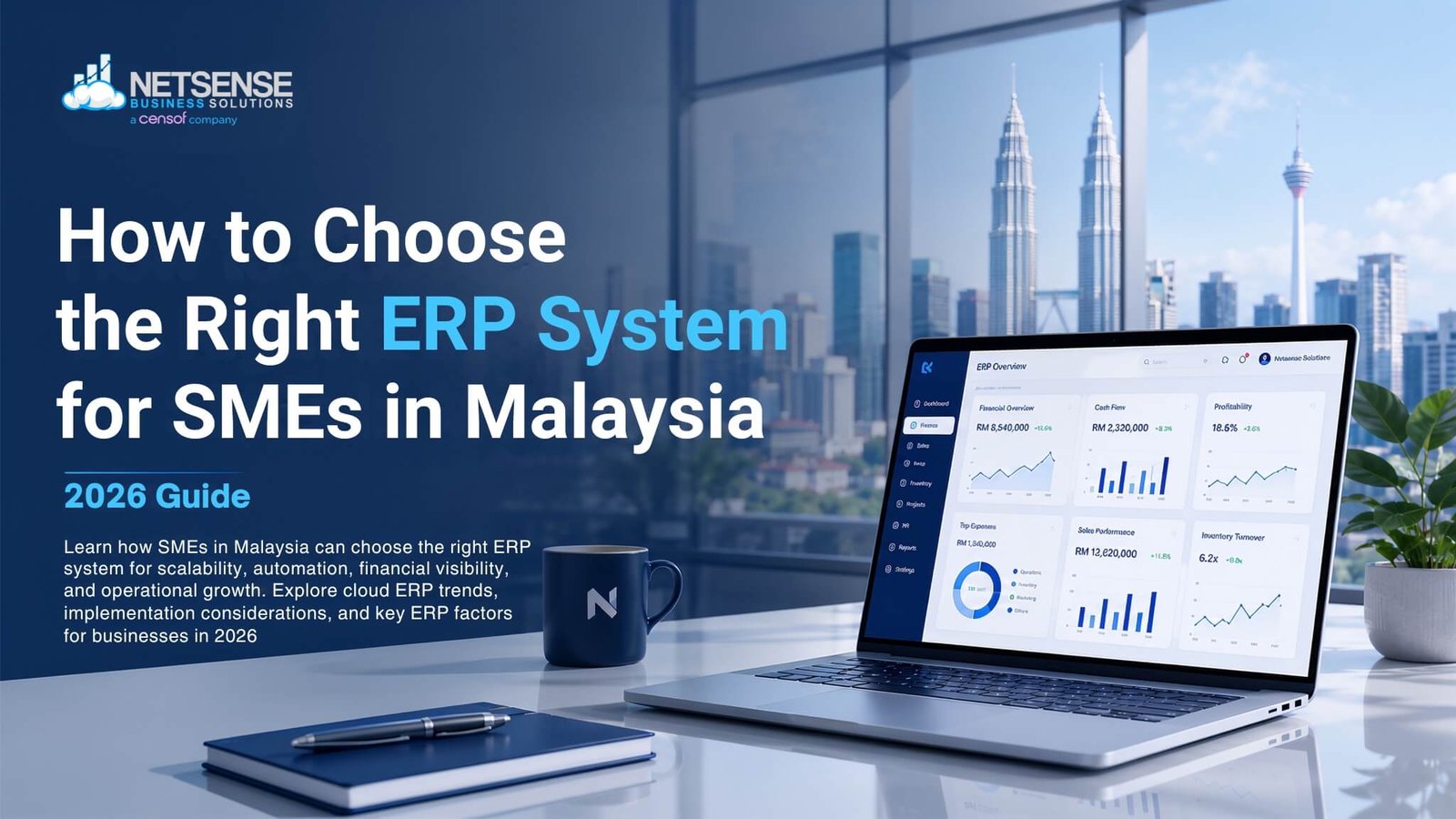
As Malaysian SMEs continue to expand across multiple sales channels, business units, and operational processes, managing operations through spreadsheets and disconnected systems is becoming increasingly inefficient. Many growing businesses are now facing challenges such as delayed financial reporting, inventory inaccuracies, manual data duplication, and limited operational visibility across departments.
At the same time, digital transformation initiatives across Malaysia are accelerating due to increasing competition, e-Invoicing requirements, rising customer expectations, and the growing demand for real-time business insights. This is one of the main reasons why more businesses are investing in modern cloud ERP systems to improve efficiency, automate workflows, and support long-term scalability.
Choosing the right ERP system is no longer just about selecting software with the most features. Businesses must evaluate factors such as scalability, cloud accessibility, local compliance, reporting capabilities, implementation support, and industry-specific functionality to ensure the ERP can support future operational growth.
As cloud ERP adoption continues to grow across Malaysia and Asia, many businesses are increasingly exploring modern ERP platforms such as Acumatica to improve financial management, inventory control, reporting visibility, and multi-entity business operations. Selecting the right ERP solution can help SMEs build a stronger operational foundation for long-term business growth and digital transformation.
Table of contents
Why SMEs in Malaysia Need ERP Systems?
Many SMEs in Malaysia still rely on disconnected software, spreadsheets, and manual processes to manage daily operations. While these methods may work during the early stages of business growth, they often become inefficient as operations become more complex.
As businesses expand across multiple departments, branches, warehouses, or sales channels, managing data separately can lead to reporting delays, duplicated information, inventory inaccuracies, and limited visibility across the organization. This makes it increasingly difficult for management teams to make fast and informed business decisions.
One of the most common challenges faced by growing SMEs is the lack of centralized operational data. Finance, inventory, sales, purchasing, and customer information are often stored in different systems that do not communicate with each other properly. As a result, employees spend significant time manually consolidating reports, updating spreadsheets, and correcting data inconsistencies.
Manual reporting processes can also create operational bottlenecks. Business owners and management teams may struggle to obtain accurate real-time insights into cash flow, stock availability, project costs, or overall business performance. In fast-moving industries, delayed information can directly affect profitability, customer satisfaction, and operational efficiency.
This is why more businesses are adopting modern ERP systems to centralize operations and improve visibility across departments. A properly implemented ERP system helps SMEs streamline workflows, automate repetitive tasks, improve reporting accuracy, strengthen inventory management, and support long-term scalability.
Also Read: Why Acumatica Is Becoming the Preferred ERP for Modern Businesses in Southeast Asia
Modern cloud ERP platforms such as Acumatica are becoming increasingly popular among businesses in Malaysia and Singapore because they provide real-time access to operational data, flexible scalability, multi-entity management, and improved collaboration across teams and business locations.
Key Factors to Consider When Choosing an ERP System
Selecting the right ERP system is a critical business decision that can directly impact operational efficiency, financial visibility, scalability, and long-term business growth. For SMEs in Malaysia, choosing the wrong ERP platform can lead to implementation challenges, reporting limitations, poor user adoption, and costly operational inefficiencies in the future.
Before selecting an ERP solution, businesses should carefully evaluate their operational requirements, growth plans, industry workflows, and long-term digital transformation objectives. The following are some of the most important factors SMEs should consider when evaluating ERP software in Malaysia.
Understand Your Business Requirements
Before comparing ERP vendors or software features, businesses should first identify their operational challenges and business priorities. Some SMEs may struggle with inventory management and warehouse visibility, while others may face issues related to financial reporting, project costing, procurement, customer management, or multi-branch operations.
Understanding the organization’s pain points helps businesses choose an ERP system that aligns with their operational needs rather than selecting software based solely on popularity or pricing. A clear understanding of business requirements also helps reduce unnecessary customization and implementation complexity.
Cloud ERP vs On-Premise ERP
One of the most important decisions businesses must make is whether to adopt a cloud ERP solution or a traditional on-premise ERP system.
Cloud ERP
Cloud ERP systems are hosted online and accessed through the internet. They are becoming increasingly popular among SMEs in Malaysia due to their flexibility, lower upfront infrastructure costs, and easier scalability.
Benefits of cloud ERP include:
- Lower initial investment
- Remote accessibility
- Automatic updates and maintenance
- Faster deployment
- Reduced IT infrastructure requirements
- Better scalability for growing businesses
Cloud ERP is often ideal for SMEs that require operational flexibility, multi-location access, and reduced dependency on internal IT resources.
On-Premise ERP
On-premise ERP systems are installed and managed on a company’s internal servers and infrastructure. Some businesses prefer on-premise ERP for greater infrastructure control, internal hosting requirements, or highly customized operational environments.
However, on-premise ERP typically involves:
- Higher upfront infrastructure costs
- Internal server maintenance
- Dedicated IT management
- Longer deployment timelines
For many growing SMEs, modern cloud ERP solutions are increasingly becoming the preferred option due to scalability, operational flexibility, and lower maintenance complexity.
Scalability and Future Growth
An ERP system should not only support current business operations but also accommodate future growth. Businesses should evaluate whether the ERP platform can scale alongside operational expansion, additional users, new business entities, warehouses, or regional operations.
A scalable ERP system helps businesses avoid costly system migration projects in the future and provides greater long-term operational flexibility.
Modern ERP platforms such as Acumatica are increasingly adopted by growing businesses because they support scalable cloud-based operations, multi-entity management, and flexible module expansion across different business functions.
Ease of Use and User Adoption
Even the most powerful ERP system can fail if employees struggle to use it effectively. SMEs should prioritize ERP platforms with intuitive user interfaces, user-friendly workflows, and accessible training resources.
Strong user adoption is critical for successful ERP implementation. Complicated systems often lead to low employee engagement, inefficient processes, and increased dependency on manual workarounds.
Businesses should also evaluate whether the ERP vendor or implementation partner provides:
- onboarding support
- user training
- implementation guidance
- ongoing technical assistance
Reporting and Business Intelligence
Modern businesses require real-time access to operational and financial information in order to make faster and more accurate decisions. A modern ERP system should provide centralized reporting, dashboard visibility, and business intelligence capabilities across departments.
Key reporting capabilities may include:
- financial reporting
- inventory visibility
- project costing
- sales performance analysis
- operational dashboards
- purchasing insights
- cash flow monitoring
Real-time reporting enables management teams to identify operational issues earlier and improve strategic decision-making.
Local Compliance in Malaysia
Businesses operating in Malaysia should ensure that their ERP system can support local operational and regulatory requirements, including:
- SST compliance
- e-Invoicing requirements
- multi-currency transactions
- local financial reporting
- taxation requirements
Choosing an ERP vendor or implementation partner with local market experience can significantly improve implementation efficiency and ongoing support quality.
Industry-Specific ERP Features
Different industries often require specialized workflows and operational functionality. A manufacturing company may require production planning and material requirements management, while a construction business may prioritize project costing and subcontractor management.
Businesses should evaluate whether the ERP system can support industry-specific operational processes such as:
- manufacturing management
- inventory and warehouse control
- project management
- construction workflows
- field service operations
- distribution and supply chain management
Industry-specific ERP functionality can reduce customization requirements and improve implementation success.
Also Read: Top 5 Acumatica ERP Features That Streamline Field Service in Malaysia
Vendor Support and Implementation Expertise
Choosing the right ERP software is important, but selecting the right implementation partner is equally critical. ERP implementation success often depends on the vendor’s ability to understand business operations, configure workflows correctly, provide training, and support long-term system adoption.
Businesses should evaluate:
- implementation experience
- industry expertise
- regional support availability
- customer support responsiveness
- long-term partnership capability
For businesses in Malaysia and Singapore, working with an experienced cloud ERP partner can help reduce implementation risks and improve long-term operational outcomes.
Why Cloud ERP Adoption Is Growing in Malaysia and Asia?
Cloud ERP adoption is growing rapidly across Malaysia and Asia as businesses increasingly prioritize operational flexibility, scalability, automation, and real-time access to business data. As organizations expand across multiple departments, locations, and regional markets, traditional disconnected systems are becoming more difficult to manage efficiently.
Many SMEs and mid-sized businesses are also accelerating their digital transformation initiatives in response to increasing market competition, rising customer expectations, supply chain complexity, and evolving compliance requirements such as e-Invoicing and digital financial reporting. As a result, cloud ERP platforms are becoming a preferred choice for businesses seeking better operational visibility and long-term scalability.
One of the main advantages of cloud ERP is remote accessibility. Unlike traditional systems that rely heavily on internal infrastructure, cloud ERP platforms allow employees, management teams, and decision-makers to securely access operational data from anywhere with an internet connection. This flexibility is particularly important for businesses operating across multiple branches, warehouses, project sites, or regional offices.
Cloud ERP also helps reduce the burden of maintaining complex IT infrastructure. Businesses no longer need to invest heavily in on-premise servers, hardware maintenance, system upgrades, or internal infrastructure management. This allows SMEs to focus more on operational growth rather than ongoing infrastructure maintenance and technical overhead.
Another major driver of cloud ERP adoption is the increasing need for real-time operational visibility. Modern businesses require immediate access to financial reports, inventory levels, purchasing data, sales performance, project costs, and operational KPIs in order to make faster and more informed business decisions.
With centralized cloud-based data, management teams can improve collaboration across departments while reducing manual reporting delays and data duplication. This becomes increasingly valuable for businesses managing multi-location operations, regional supply chains, or distributed teams across Malaysia and Southeast Asia.
Automation is also playing a significant role in ERP modernization. Many businesses are adopting cloud ERP systems to automate repetitive processes such as:
- financial reporting
- invoice processing
- purchasing workflows
- inventory tracking
- approval management
- project monitoring
By reducing manual processes, businesses can improve efficiency, reduce operational errors, and free employees to focus on higher-value activities.
As businesses across Malaysia and Asia continue modernizing operations, modern cloud ERP platforms such as Acumatica are gaining attention for their scalability, flexible deployment, real-time reporting capabilities, and ability to support multi-entity and multi-location business operations. These capabilities make cloud ERP increasingly attractive for growing organizations seeking long-term operational agility and digital transformation readiness.
Common ERP Mistakes SMEs Should Avoid
Many ERP implementation challenges are not caused by the software itself, but by poor planning, unrealistic expectations, or selecting a system that does not align with business operations. For SMEs in Malaysia, avoiding common ERP mistakes can significantly improve implementation success, operational efficiency, and long-term return on investment.
Below are some of the most common ERP mistakes businesses should avoid when evaluating and implementing an ERP system.
1) Choosing ERP Based Only on Price
One of the most common mistakes SMEs make is selecting an ERP system purely based on the lowest upfront cost. While budget considerations are important, choosing an ERP platform that lacks scalability, flexibility, or essential business functionality can create larger operational problems in the future.
Low-cost ERP systems may result in:
- limited reporting capabilities
- poor integration support
- scalability limitations
- inefficient workflows
- expensive future migrations
Businesses should evaluate the total long-term business value of an ERP system rather than focusing only on initial licensing or subscription costs.
2) Ignoring Scalability Requirements
Some SMEs choose ERP systems that only support their current operational size without considering future business growth. As businesses expand, they may require additional users, warehouses, entities, currencies, business units, or operational workflows.
An ERP platform that cannot scale effectively may eventually require costly system replacement or extensive customization.
Businesses should evaluate whether the ERP system can support:
- future operational growth
- additional modules
- regional expansion
- multi-entity operations
- increased transaction volumes
- evolving reporting requirements
Modern cloud ERP platforms are increasingly preferred because they provide greater flexibility for long-term scalability.
3) Poor ERP Implementation Planning
ERP implementation is not simply a software installation project. It requires proper planning, workflow evaluation, data preparation, user training, and operational alignment across departments.
Poor implementation planning can lead to:
- project delays
- operational disruption
- inaccurate data migration
- employee confusion
- reduced user adoption
- reporting inconsistencies
Businesses should establish clear implementation goals, realistic timelines, internal project ownership, and collaboration between management teams and ERP consultants throughout the implementation process.
4) Weak User Adoption and Training
Even a highly capable ERP system can fail if employees do not understand how to use it effectively. Some businesses underestimate the importance of training, onboarding, and change management during ERP implementation.
Weak user adoption often leads to:
- continued spreadsheet dependency
- inconsistent data entry
- operational inefficiencies
- inaccurate reporting
- employee resistance
Successful ERP adoption requires proper training, ongoing support, and clear communication regarding how the ERP system improves operational workflows and business efficiency.
5) Choosing an ERP That Does Not Fit the Industry
Not all ERP systems are designed for every industry. Businesses sometimes select generic ERP platforms that lack industry-specific functionality, resulting in heavy customization requirements and inefficient workflows.
For example:
- manufacturers may require production planning and inventory control
- construction companies may require project costing and subcontractor management
- distributors may require warehouse and supply chain visibility
- service businesses may require project and resource management
Choosing an ERP system that aligns with industry workflows can significantly improve implementation efficiency and operational effectiveness.
6) Underestimating the Importance of Local Support
ERP implementation often requires long-term collaboration with implementation consultants and support teams. Businesses that choose vendors without regional expertise or local support availability may face slower response times and implementation challenges.
For businesses in Malaysia, it is important to work with ERP partners that understand:
- local business practices
- SST requirements
- e-Invoicing regulations
- regional operational challenges
- multi-currency business environments
Strong implementation support and local expertise can play a major role in long-term ERP success.
7) Treating ERP as Only an IT Project
ERP implementation should not be viewed purely as a technology upgrade. A modern ERP system directly affects finance, operations, inventory, procurement, reporting, and overall business processes.
Businesses that treat ERP only as an IT initiative often struggle with:
- poor executive alignment
- unclear operational goals
- limited cross-department collaboration
- low adoption rates
Successful ERP implementation requires leadership involvement, operational planning, and alignment between business objectives and system capabilities.
Avoiding these common mistakes can help SMEs improve ERP implementation success, strengthen operational visibility, and maximize long-term business value. As cloud ERP adoption continues to grow across Malaysia and Asia, businesses are increasingly focusing on scalable and flexible platforms such as Acumatica to support long-term operational growth, reporting visibility, and digital transformation initiatives.
Industries That Benefit Most from ERP Systems
Modern ERP systems are used across a wide range of industries to improve operational visibility, automate workflows, centralize business data, and support long-term business growth. While the core objective of ERP remains the same, different industries often require specialized functionality based on their operational structure, reporting requirements, and workflow complexity.
For businesses in Malaysia and across Asia, choosing an ERP platform that aligns with industry-specific operational requirements can significantly improve implementation success and long-term efficiency.
Below are some of the industries that benefit most from modern ERP systems.
Manufacturing
Manufacturing companies often manage complex operational processes involving production planning, raw materials, inventory management, procurement, warehouse operations, and quality control. As production volume increases, relying on spreadsheets or disconnected systems can create operational bottlenecks and reporting inaccuracies.
A modern manufacturing ERP system helps businesses improve:
- production planning
- bill of materials (BOM) management
- inventory visibility
- procurement workflows
- warehouse coordination
- production cost tracking
- supply chain management
Real-time visibility across production and inventory operations allows manufacturers to reduce delays, improve forecasting accuracy, and optimize resource utilization.
Construction
Construction businesses typically manage multiple moving components across projects, including budgeting, subcontractors, procurement, materials, project timelines, and financial tracking. Without centralized operational visibility, project delays and cost overruns can become difficult to control.
ERP systems designed for construction companies help improve:
- project costing
- budget tracking
- subcontractor management
- procurement coordination
- resource allocation
- progress reporting
- financial visibility across projects
For growing construction companies operating across multiple projects or locations, ERP systems provide better operational control and reporting consistency.
Distribution and Wholesale
Distribution businesses often operate in fast-moving environments that require accurate inventory tracking, warehouse visibility, purchasing coordination, and supply chain management. Manual inventory processes and disconnected reporting systems can lead to stock discrepancies, delayed fulfillment, and operational inefficiencies.
ERP systems help distributors improve:
- inventory accuracy
- warehouse management
- order processing
- purchasing workflows
- supplier coordination
- demand forecasting
- multi-location inventory visibility
Real-time inventory and supply chain visibility are increasingly important for distributors managing regional operations across Malaysia and Southeast Asia.
Retail
Retail businesses must manage inventory availability, customer demand, sales performance, promotions, and multi-channel operations simultaneously. As retail operations expand across physical stores, eCommerce platforms, and marketplaces, centralized operational visibility becomes increasingly important.
Retail ERP systems help businesses streamline:
- inventory synchronization
- sales tracking
- customer management
- purchasing workflows
- financial reporting
- multi-channel operations
- demand forecasting
By centralizing operational data, retailers can improve inventory planning, reduce stock issues, and respond more effectively to changing customer demand.
Professional Services
Professional service firms such as consulting companies, engineering firms, IT providers, and project-based organizations often require strong project visibility, resource management, time tracking, and financial control.
ERP systems for professional services help improve:
- project management
- resource allocation
- time and expense tracking
- billing management
- financial reporting
- project profitability analysis
- collaboration across teams
Centralized operational data enables service-based businesses to improve project efficiency, optimize resource utilization, and gain better visibility into business performance.
As businesses across Malaysia and Asia continue investing in digital transformation, modern cloud ERP platforms such as Acumatica are increasingly being adopted across industries due to their flexibility, scalability, real-time reporting capabilities, and ability to support complex multi-department and multi-entity operations. Selecting an ERP system that aligns with industry-specific workflows can significantly improve operational efficiency and long-term business scalability.
Modern Cloud ERP Solutions for Growing SMEs
As SMEs in Malaysia and across Asia continue expanding their operations, many businesses are moving away from traditional legacy systems and manual processes in favor of more flexible and scalable cloud ERP platforms. Modern businesses increasingly require centralized operational visibility, real-time reporting, automation capabilities, and systems that can support long-term business growth without creating additional operational complexity.
Also Read: Acumatica vs SAP Business One: Which ERP Fits Growing Companies Better?
Unlike traditional ERP systems that often require heavy infrastructure investment and complex maintenance, modern cloud ERP platforms provide greater flexibility, faster deployment, and easier scalability for growing organizations. This is particularly important for SMEs that need to manage operations efficiently while remaining agile in rapidly changing business environments.
One of the key advantages of cloud ERP is the ability to centralize multiple business functions within a single platform. Instead of relying on disconnected software for finance, inventory, procurement, customer management, and reporting, businesses can manage core operations through an integrated system with real-time data visibility across departments.
Modern cloud ERP solutions also support:
- remote accessibility
- multi-location operations
- automated workflows
- centralized reporting
- real-time dashboards
- inventory visibility
- project and financial management
- multi-entity business operations
These capabilities help businesses improve decision-making speed, reduce manual work, and strengthen operational efficiency across the organization.
As digital transformation adoption continues growing in Malaysia and Singapore, many businesses are increasingly evaluating cloud ERP platforms such as Acumatica to modernize operations and improve scalability. Acumatica has gained attention among growing businesses due to its flexible cloud architecture, real-time reporting capabilities, automation features, and ability to support complex operational environments across multiple departments and business entities.
For businesses operating in industries such as manufacturing, construction, distribution, retail, and professional services, cloud ERP platforms provide stronger operational control while supporting future expansion and evolving business requirements.
Choosing the right cloud ERP solution is not only about software functionality. Businesses should also evaluate implementation expertise, industry alignment, scalability, local support capabilities, and long-term operational fit to ensure successful ERP adoption and sustainable business growth.
FAQ
What is the best ERP system for SMEs in Malaysia?
The best ERP system for SMEs in Malaysia depends on the company’s industry, operational complexity, scalability requirements, and business goals. Businesses should evaluate factors such as financial management capabilities, inventory control, reporting visibility, cloud accessibility, local compliance support, and implementation expertise before selecting an ERP platform.
Many growing businesses in Malaysia are increasingly adopting modern cloud ERP platforms such as Acumatica because of their scalability, real-time reporting capabilities, automation features, and ability to support multi-department and multi-entity operations.
Is cloud ERP suitable for SMEs?
Yes. Cloud ERP is becoming increasingly popular among SMEs because it offers greater flexibility, lower upfront infrastructure costs, remote accessibility, and easier scalability compared to traditional on-premise systems.
Cloud ERP solutions allow businesses to access operational data from anywhere while reducing the burden of maintaining internal servers and IT infrastructure. This makes cloud ERP particularly suitable for growing SMEs that require operational agility and long-term scalability.
What is the difference between cloud ERP and on-premise ERP?
The main difference between cloud ERP and on-premise ERP is where the system is hosted and managed.
Cloud ERP systems are hosted online and accessed through the internet. They typically offer:
- lower upfront costs
- remote accessibility
- automatic updates
- faster deployment
- easier scalability
On-premise ERP systems are installed on a company’s internal servers and managed internally. They may provide greater infrastructure control but often require:
- higher upfront investment
- server maintenance
- dedicated IT resources
- longer implementation timelines
Many SMEs are increasingly choosing cloud ERP due to operational flexibility and reduced infrastructure complexity.
Is Acumatica available in Malaysia?
Yes. Acumatica Cloud ERP is available in Malaysia through authorized implementation partners such as Netsense Business Solutions. Businesses in Malaysia and Singapore are increasingly adopting Acumatica to improve operational visibility, financial management, inventory control, project management, and multi-entity business operations.
Acumatica is widely recognized as a modern cloud ERP platform that supports scalable business growth across multiple industries including manufacturing, construction, distribution, retail, and professional services.
How much does ERP implementation cost in Malaysia?
ERP implementation costs in Malaysia vary depending on several factors, including:
- business size
- number of users
- operational complexity
- customization requirements
- deployment model
- implementation scope
Cloud ERP solutions generally have lower upfront costs because they operate on subscription-based models and require less internal infrastructure investment. However, businesses should evaluate the total long-term cost of ownership, including implementation, training, support, customization, and future scalability requirements.
What industries benefit most from ERP software?
ERP systems are widely used across industries that require centralized operational visibility, workflow automation, inventory management, financial reporting, and scalable business operations.
Industries that commonly benefit from ERP systems include:
- manufacturing
- construction
- distribution and wholesale
- retail
- professional services
- field service operations
Modern cloud ERP platforms such as Acumatica are increasingly adopted across these industries because they provide real-time reporting, operational flexibility, automation capabilities, and support for multi-location business operations.
Conclusion
Choosing the right ERP system is no longer simply an IT decision for SMEs in Malaysia. As businesses continue facing increasing operational complexity, rising customer expectations, digital transformation initiatives, and evolving compliance requirements, ERP has become a critical foundation for long-term operational efficiency and sustainable business growth.
Modern businesses require more than disconnected software and manual reporting processes. They need centralized visibility across finance, inventory, procurement, sales, projects, and overall business operations to enable faster, more informed decision-making. This is one of the key reasons why cloud ERP adoption continues to accelerate across Malaysia and the wider Asia region.
When evaluating ERP solutions, businesses should focus not only on current operational requirements but also on future scalability, reporting capabilities, industry alignment, implementation expertise, and long-term flexibility. Selecting the right ERP platform can help organizations improve efficiency, strengthen operational visibility, automate workflows, and support scalable growth as the business evolves.
As more organizations modernize operations and invest in digital transformation, modern cloud ERP platforms such as Acumatica are increasingly becoming part of the conversation for businesses seeking flexible, scalable, and real-time operational management solutions.
However, successful ERP transformation is not only about selecting the right software — it also depends on choosing the right implementation partner with the expertise to align technology with business goals.
Netsense Business Solutions helps businesses across Malaysia streamline operations, improve business visibility, and accelerate digital transformation through tailored ERP implementation and consulting services. With extensive experience in cloud ERP solutions including Acumatica, Netsense supports organizations in building more agile, data-driven, and future-ready operations.
Businesses that are planning to modernize their ERP infrastructure or evaluate scalable cloud ERP solutions can connect with Netsense Business Solutions for consultation and implementation guidance:
- Website: netsense.my
- Email: sales@netsensebs.com
- Phone: +603 2788 3705