As a business grows, managing multiple companies can quickly become more complex than simply keeping up with higher transaction volumes. New entities, branches, business units, currencies and reporting requirements can create a growing web of financial information that Group Finance needs to consolidate, reconcile and understand.
For CFOs and finance leaders, the real challenge is maintaining clear financial visibility and control across the entire group. When each entity relies on separate accounting systems, disconnected applications or spreadsheets, consolidating information can become increasingly manual. Reporting may take longer, reconciliation becomes more demanding, and management may have to wait for information before making important decisions.
This approach may be manageable when a business has only a few entities. But as the organisation expands, the same processes can become a significant constraint on finance efficiency and scalability.
The key question is no longer simply whether your ERP can manage more transactions. It is whether your ERP can give Group Finance a reliable view of the business as the organisation becomes more complex—without adding more manual consolidation work.
This is where a modern cloud ERP can make a difference. Acumatica provides a connected platform that can help multi-company businesses bring financial and operational information together, improve visibility, and build a stronger foundation for managing growth.
For organisations evaluating their next ERP investment, the question is therefore not just whether Acumatica has the right features, but whether it can support the way your group needs to operate, report and scale.
Table of contents
- Why Multi-Company Businesses Outgrow Traditional Financial Systems
- What a Multi-Company ERP Needs to Support
- How Acumatica Supports Multi-Company Business Growth
- From Entity-Level Data to Group-Level Decision-Making
- How Acumatica Helps Multi-Company Businesses Scale Faster
- Is Acumatica the Right Fit for Your Multi-Company Business?
- Why ERP Implementation Matters as Much as the ERP Platform
- Frequently Asked Questions About Multi-Company ERP
- Take the Next Step: Schedule an ERP Assessment
Why Multi-Company Businesses Outgrow Traditional Financial Systems
As a business expands into multiple companies, branches or business units, the financial complexity of the organisation grows with it. Processes that once worked effectively for a single entity can become increasingly difficult to manage when finance teams need to collect, reconcile and report information across multiple parts of the business.
The issue is often not that the existing financial system has stopped working. Rather, it may no longer provide the level of connectivity, visibility and scalability required by a growing organisation.
More Entities Create More Financial Complexity
Managing one company is fundamentally different from managing a group of companies. Each entity may have its own transactions, customers, suppliers, expenses, operational processes and reporting requirements.
As the organisation grows, finance teams may need to manage:
- Multiple legal entities
- Different business units
- Multiple warehouses or operating locations
- Different currencies or markets
- Different operational processes
- Increasing transaction volumes
Without a sufficiently connected system, information can become fragmented across different applications and databases. This makes it harder for Group Finance to maintain a consistent view of financial and operational performance across the organisation.
The more entities a business adds, the more important it becomes to have a financial system that can accommodate this complexity without creating unnecessary administrative work.
Consolidation Becomes Increasingly Manual
One of the most common challenges for multi-company organisations is the effort required to bring information together for group reporting.
When entities operate through separate systems, finance teams may have to export information from different sources, standardise data, reconcile figures and consolidate the results before management reports can be prepared.
The process can involve:
- Collecting financial information from different entities
- Standardising data and reporting formats
- Reconciling figures between systems
- Consolidating information through spreadsheets
- Validating intercompany information
- Preparing management reports
As the number of entities increases, these steps can become increasingly time-consuming. More manual processes also mean more opportunities for inconsistencies, delays and additional review work.
For a CFO, the concern is therefore not simply how long it takes to produce a report. It is whether the finance team can produce reliable group-level information efficiently enough to support timely decision-making.
Group-Level Visibility Becomes Harder
Having financial information does not necessarily mean having financial visibility.
A CFO may be able to access information for individual entities, yet still find it difficult to obtain a clear and timely picture of the group as a whole. Information may need to be gathered from different systems before management can assess how the business is performing.
This can affect visibility across areas such as:
- Overall group performance
- Entity-level performance
- Profitability
- Cash flow
- Costs
- Operational performance
For Group Finance, the objective is not simply to see more data. It is to have consistent and relevant information that can be used to understand performance, identify issues and make better business decisions.
When reporting depends heavily on manual data collection and consolidation, that visibility can become slower and more difficult to maintain as the organisation grows.
Growth Can Increase Administrative Work Instead of Efficiency
Business growth should create greater capacity for the organisation to generate value. However, when financial processes remain dependent on disconnected systems and manual work, adding more companies can also mean adding more administrative effort.
Every new entity can introduce additional data sources, reporting requirements, reconciliations and processes for finance teams to manage.
This creates a scalability problem.
More entities should not automatically mean proportionally more finance administration.
At a certain point, the organisation needs an ERP foundation that can support increasing business complexity while helping Finance maintain visibility, control and reporting efficiency.
This is why multi-company businesses need to look beyond whether their existing financial systems can continue to process transactions. They also need to consider whether their ERP environment can support the organisation’s next stage of growth.
What a Multi-Company ERP Needs to Support
Choosing an ERP for a multi-company organisation requires more than checking whether the system can process financial transactions. The platform must support the way the group manages its entities, consolidates financial information, maintains control and plans for future expansion.
For CFOs and Group Finance leaders, the priority is to establish a connected financial environment that provides reliable visibility across the organisation without creating unnecessary administrative complexity. Several capabilities are particularly important when evaluating a multi-company ERP.
Centralised Financial Visibility
Finance leaders need a clear view of financial performance across the group while retaining access to information about individual entities. When data is spread across disconnected accounting systems and spreadsheets, obtaining this visibility can require considerable manual effort.
A suitable ERP should help bring relevant financial information into a more connected environment, making it easier for management to review performance, identify discrepancies and understand how individual entities contribute to the overall business.
The objective is to reduce dependence on fragmented information sources and give decision-makers a more consistent foundation for financial analysis.
Multi-Entity Financial Management
A multi-company organisation needs a system that can accommodate multiple legal entities or business units within an appropriate financial and operational structure.
Each entity may have its own transactions, reporting requirements, customers, suppliers and operating processes. At the same time, the group needs to maintain consistent financial oversight across the organisation.
When evaluating an ERP, businesses should consider how the system represents individual entities, manages their financial information and supports the relationship between entity-level operations and group-level management.
This becomes particularly important when an organisation establishes new companies, expands into additional markets or restructures its operations.
Consolidated Reporting
Group-level reporting is a critical requirement for finance teams managing multiple entities. Individual company reports may provide useful information, but they do not necessarily give management a complete picture of the organisation’s overall performance.
A suitable ERP should support the reporting requirements of both individual entities and the wider group. This helps CFOs evaluate financial results across different parts of the business while retaining the detail needed to investigate specific entities or transactions.
When assessing reporting capabilities, finance leaders should consider the information available, the effort required to prepare consolidated reports, and how easily management can move between group-level results and entity-level detail.
The goal is not simply to produce reports faster. It is to make reliable financial information available in a form that supports timely and informed decisions.
Intercompany Processes
Transactions between related companies can introduce additional complexity as a group expands. Depending on the organisation’s structure, these may include intercompany sales, purchases, charges, transfers and other financial transactions between entities.
When these processes rely on disconnected systems or manual coordination, finance teams may need to spend additional time checking entries, reconciling balances and resolving inconsistencies.
A multi-company ERP should therefore be evaluated on how it supports the organisation’s intercompany requirements and helps maintain consistency across related transactions.
The relevant capabilities will depend on the group’s operating model, transaction types and accounting requirements. Businesses should confirm that the system can accommodate their specific intercompany workflows before making a purchasing decision.
Standardised Processes With Appropriate Flexibility
Operating multiple companies does not necessarily mean every entity follows identical processes. Different business units may have distinct operational requirements, regulatory obligations, reporting structures or ways of serving customers.
However, excessive variation can make financial oversight and group reporting more difficult.
A suitable ERP should help the organisation establish consistent processes and reporting practices where appropriate, while accommodating legitimate differences between entities. This balance allows Group Finance to maintain oversight without unnecessarily restricting how individual business units operate.
For growing organisations, this is an important consideration: standardisation should simplify management, not create operational constraints.
Scalability
An ERP that supports the organisation today must also be capable of accommodating its future requirements. As the business expands, the system may need to support additional:
- Companies and legal entities
- Branches, warehouses and operating locations
- Users and finance team members
- Transactions and business processes
- Reporting requirements
- Third-party applications and integrations
Businesses should evaluate whether the ERP can accommodate this growth within a sustainable system architecture, rather than creating a need for repeated system replacements or increasingly complex workarounds.
Scalability also involves more than technical capacity. The organisation must be able to maintain appropriate financial controls, consistent processes and useful reporting as its structure becomes more complex.
Ultimately, the right multi-company ERP should help a business grow without allowing financial fragmentation and administrative effort to grow at the same pace.
These requirements provide a practical framework for evaluating potential ERP solutions. The next step is to examine how Acumatica can address the needs of multi-company businesses and support their financial visibility, operational control and long-term growth.
How Acumatica Supports Multi-Company Business Growth
For businesses managing multiple companies, the right ERP should do more than record financial transactions. It should help connect financial and operational information, simplify intercompany processes, and give management a clearer understanding of performance across the organisation.
Also Read: Why Acumatica Is Ideal for Fast-Growing SMEs in Malaysia
Acumatica Cloud ERP provides multi-entity accounting, intercompany transaction management, financial consolidation and reporting capabilities within a connected cloud platform. These capabilities can help growing organisations reduce fragmented financial processes while maintaining visibility into individual entities and the wider group. The specific configuration and functionality required will depend on the organisation’s structure and business requirements.
Connect Financial Data Across Multiple Companies
When companies operate through separate financial systems, information can become fragmented across the group. Finance teams may need to collect data from different sources before they can prepare reports or assess overall business performance.
Acumatica supports the management of multiple related companies within a single environment. Organisations can share selected financial settings and data, including charts of accounts, financial calendars and currencies, helping maintain consistency across entities where appropriate. Each company can still maintain its own financial activity and reporting requirements.
For Group Finance, this provides a more connected foundation for managing information across the organisation. Rather than relying entirely on separate systems and manual data collection, finance teams can work within an ERP environment designed to support multi-company operations.
The business value extends beyond having financial data in one place. A more connected environment can help reduce administrative overhead, improve consistency and make it easier for finance leaders to understand how individual entities contribute to overall group performance.
Simplify Financial Consolidation and Group Reporting
For CFOs, consolidated reporting is essential to understanding the financial position and performance of a multi-company organisation. Reviewing individual entity reports is useful, but management also needs a reliable view of the group as a whole.
Acumatica supports consolidated financial reporting across related companies. Its financial management capabilities include consolidated reporting, intercompany elimination and access to underlying transaction details, helping finance teams analyse group results while retaining visibility into individual entities.
This can help address several common reporting challenges:
- Group-level visibility: Review financial performance across related entities.
- Entity-level analysis: Examine individual company results when further investigation is needed.
- Reduced manual consolidation: Use the ERP’s supported consolidation processes rather than relying entirely on manually combined reports.
- Better reporting consistency: Establish more consistent financial reporting practices across the group.
- More informed decisions: Give management a clearer basis for evaluating performance and identifying areas that require attention.
The exact benefits depend on how the ERP is configured, the quality of the underlying data and the organisation’s reporting requirements. Account structures, currencies, consolidation rules and intercompany adjustments must be addressed appropriately during implementation.
For the CFO, the objective is straightforward: reduce the effort required to assemble group financial information and create more time to analyse results, evaluate performance and support strategic decisions.
Improve Intercompany Financial Control
As a business expands, transactions between related companies can become a more significant part of its financial operations. One entity may purchase goods or services from another, transfer inventory, allocate shared expenses or settle intercompany balances.
When these activities depend on manual coordination, finance teams may need to enter information more than once, reconcile balances separately and investigate inconsistencies before closing the books.
Acumatica supports intercompany accounting processes that can automatically generate corresponding due-to and due-from entries for transactions between related companies. Depending on the configured workflow, it can also connect cross-company purchasing, sales, invoicing and inventory-related activities.
For finance teams, these capabilities can help:
- Reduce repetitive manual entries.
- Improve consistency between related company transactions.
- Simplify intercompany reconciliation.
- Support more structured financial processes.
- Maintain clearer transaction records for review and audit purposes.
However, automation alone does not guarantee effective financial control. Organisations still need appropriate account mappings, approval workflows, access permissions, reconciliation procedures and clearly defined responsibilities.
The larger the group becomes, the more important it is to establish controlled and consistent processes between entities. An ERP that supports these requirements can help Finance manage increasing transaction complexity without relying exclusively on manual checks and spreadsheets.
Give Finance Teams Better Real-Time Visibility
Financial information becomes more valuable when management can access it in time to act. If finance teams must repeatedly collect data, reconcile spreadsheets and prepare reports manually, decision-makers may receive important information later than they need it.
Acumatica’s financial management and reporting capabilities provide access to financial information across the ERP, with reporting and transaction drill-down features that help users investigate results in greater detail. For multi-company organisations, consolidated reporting can provide a group-level view while allowing users to examine underlying entity-level information.
Depending on the modules implemented, data available and reporting configuration, this can support analysis of:
- Revenue and expenditure across entities.
- Costs and profitability.
- Cash and financial positions.
- Individual company performance.
- Consolidated financial results.
- Transactions requiring further investigation.
The value is not simply the availability of dashboards or reports. It is the ability to move from collecting information towards interpreting it.
When finance teams spend less time assembling data from disconnected sources, they can devote more attention to understanding variances, identifying financial risks, monitoring performance and advising management on business priorities.
For CFOs, better visibility supports a more proactive approach to financial management rather than one driven primarily by the reporting cycle.
Support Different Business Units Within One Scalable Platform
Multi-company groups do not always operate in the same way across every entity. A group might include a manufacturing company, a distribution business, a construction operation and a professional services entity. Each may have different workflows, operational requirements and reporting needs.
At the same time, Group Finance still needs to maintain oversight of financial performance across the organisation.
Acumatica offers industry-specific ERP capabilities alongside its financial management functionality, including solutions for manufacturing, distribution, construction and professional services. Its modular approach allows organisations to evaluate the capabilities relevant to their business operations.
For example:
- Manufacturing: Connect financial management with production-related processes and costs.
- Distribution: Support financial oversight across distribution operations and warehouses.
- Construction: Manage financial information associated with projects and project-based operations.
- Professional services: Connect project-related financial activities with broader financial management.
For groups operating across different industries, the appropriate solution depends on the processes required by each entity, the applications selected and how the overall environment is designed.
The objective is to balance operational flexibility with group-level consistency. Individual business units need systems that support how they work, while Group Finance needs reliable information and appropriate controls across the organisation.
Scale Without Adding Disconnected Systems
Business expansion often introduces new entities, locations, employees, transactions and applications. If every stage of growth leads to another disconnected system, the organisation may face increasing integration requirements, fragmented data and more complicated reporting processes.
A connected ERP environment offers an alternative foundation.
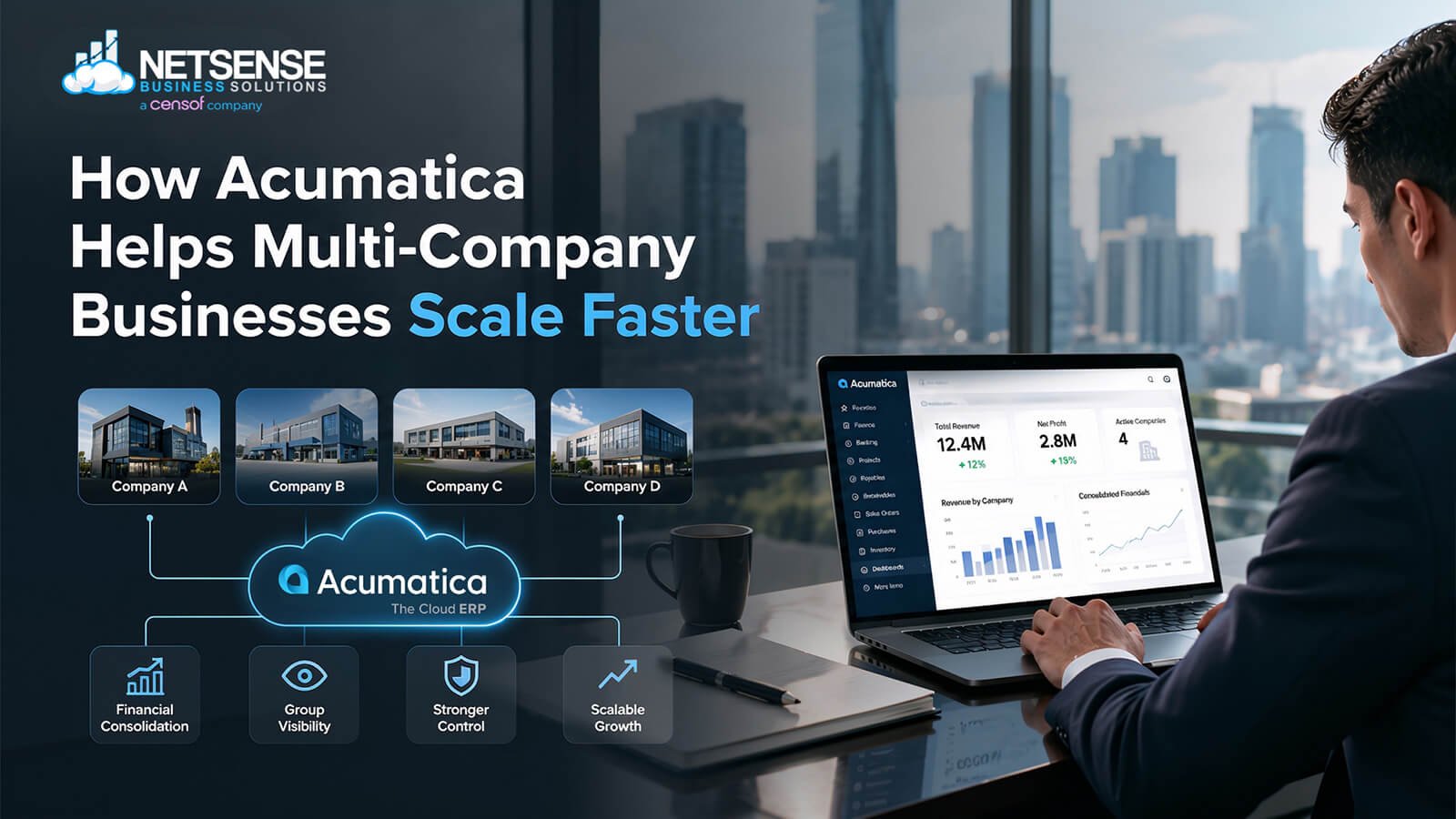
Consider the difference between two approaches.
A fragmented approach
Company A → System A
Company B → System B
Company C → System C
Separate data sources → Manual consolidation → Group reporting
A connected ERP approach
Multiple companies and business units
↓
Connected ERP environment
↓
Consolidated financial reporting and entity-level visibility
Acumatica supports managing multiple related companies within one environment, helping organisations establish a more connected approach to financial management and intercompany operations. Depending on their requirements, businesses can also evaluate integrations with other applications through available connectors and APIs.
For a growing group, this can reduce the need to manage financial processes entirely through separate systems and manual workarounds. It also provides a foundation for reviewing how new entities, locations and business processes can be incorporated as the organisation expands.
Scalability, however, is not automatic. The organisation must assess its entity structure, transaction volumes, reporting requirements, integrations, access controls and implementation scope to determine the appropriate solution.
Also Read: How to Implement Acumatica in Malaysia
Ultimately, scaling faster is not just about adding more companies. It is about increasing business capacity without allowing financial complexity to grow at the same pace. With the right ERP configuration and implementation approach, Acumatica can help multi-company businesses build a more connected foundation for financial visibility, control and sustainable growth.
From Entity-Level Data to Group-Level Decision-Making
For CFOs managing multiple companies, the value of an ERP is not measured solely by how efficiently it processes transactions. It is also measured by how effectively it turns financial information into insights that support better business decisions.
When financial data is fragmented across entities, finance teams can spend a significant amount of time collecting, validating and consolidating information before they can analyse the results. A more connected ERP environment can help reduce this administrative burden and allow Group Finance to focus more on understanding performance across the organisation.
Before: Finance Spends Time Collecting Information
In a multi-company organisation that relies on disconnected financial systems, preparing a consolidated view of the business can involve several manual steps.
Finance teams may need to collect reports from individual entities, export data into spreadsheets, standardise reporting formats, reconcile figures and investigate inconsistencies before presenting the results to management.
As the number of entities grows, these activities can become increasingly demanding. The finance team must manage not only its regular accounting responsibilities but also the additional work required to bring information together.
This creates several challenges:
- Multiple data sources: Financial information is spread across separate systems or applications.
- Manual exports: Data must be extracted and transferred before it can be consolidated.
- Spreadsheet dependency: Finance teams rely on manual calculations and adjustments to prepare group reports.
- Repeated reconciliation: Differences between records require additional investigation and validation.
- Delayed analysis: Time spent preparing reports leaves less time to interpret financial performance.
The consequence is that management may receive the information it needs only after considerable preparation. Finance becomes occupied with assembling the numbers instead of explaining what those numbers mean for the business.
After: Finance Can Focus More on Analysis
A connected ERP environment can help change how Group Finance manages financial information. By supporting multi-company financial management, consolidated reporting and access to underlying transaction details, Acumatica can provide a stronger foundation for reviewing performance across entities.
Rather than relying entirely on separate data sources and manually assembled reports, finance teams can work with information managed within a more connected system.
This can support several improvements:
- Faster access to information: Reduce the effort required to collect financial data from separate sources.
- Better financial visibility: Review performance at both entity and group levels.
- More consistent reporting: Establish common reporting practices across companies where appropriate.
- Less repetitive manual work: Reduce dependence on manual data preparation and spreadsheet-based consolidation.
- More time for decision support: Focus on financial analysis, performance monitoring and advising business leaders.
The actual improvements will depend on the organisation’s existing systems, data quality, reporting requirements and ERP configuration. A connected platform does not eliminate every manual task, but it can provide a more structured foundation for reducing unnecessary work.
For CFOs, the important shift is the opportunity to move beyond producing reports towards using financial information more actively to guide the organisation.
The Strategic Shift for Group Finance
The real value of better financial visibility emerges when finance teams can use information to answer business questions, rather than simply report historical results.
Instead of spending most of their time asking, “What are the numbers?”, CFOs and Group Finance leaders can devote more attention to a more strategic question:
“What are the numbers telling us, and what should we do next?”
For example, a clearer view of financial performance across entities can help management investigate differences in profitability, identify unexpected cost movements, evaluate the performance of individual business units and determine where further analysis is needed.
When financial information is more accessible and reporting processes are more consistent, Finance is better positioned to support conversations about resource allocation, cost management, operational efficiency and future investment.
This also changes the role of Group Finance within the organisation. Rather than functioning primarily as a reporting and control function, Finance can contribute more directly to business planning and strategic decision-making.
For a growing multi-company business, this is an important distinction. The objective is not simply to consolidate financial data more efficiently. It is to use that data to manage the group more effectively.
Acumatica can help provide the connected financial management foundation for this shift. The next consideration is how these capabilities translate into practical business outcomes, from more efficient financial reporting and stronger control to a more scalable foundation for expansion.
How Acumatica Helps Multi-Company Businesses Scale Faster
For multi-company businesses, scaling successfully means more than increasing revenue or expanding into new markets. It also means being able to manage a growing number of entities, transactions and operational requirements without losing financial visibility or control.
Acumatica Cloud ERP can help organisations establish a more connected foundation for managing financial and operational activities across multiple companies. By supporting multi-entity financial management, consolidated reporting and intercompany processes, it can help reduce the administrative burden associated with fragmented systems and give management a clearer view of the wider business.
The benefits extend beyond the finance department. When information is more accessible and processes are better connected, the organisation can improve reporting efficiency, strengthen financial oversight and prepare for future growth with a more scalable ERP foundation.
Faster Financial Reporting
As a business expands, the effort required to prepare financial reports can increase when information must be collected from multiple entities and consolidated manually.
Acumatica’s multi-company accounting and financial reporting capabilities can help streamline how finance teams access and prepare financial information across the organisation. Consolidated reporting capabilities can also help management review group performance while retaining visibility into individual entities.
By reducing reliance on disconnected information sources and repetitive data preparation, organisations can work towards more efficient reporting processes.
For CFOs, this matters because reporting efficiency affects more than the finance team’s workload. It also influences how quickly management can review financial results, investigate variances and respond to emerging business issues.
The objective is to make reliable financial information available with less unnecessary preparation, allowing Finance to spend more time analysing results and supporting business decisions.
Better Group-Level Visibility
Managing individual companies effectively does not automatically provide a clear picture of the entire group. Management needs to understand how each entity performs and how those results contribute to overall business performance.
Acumatica supports multi-company financial management and consolidated reporting, helping organisations examine financial information at both entity and group levels, subject to the solution’s configuration and reporting requirements.
This can help CFOs and business leaders assess areas such as revenue, expenses, profitability and financial performance across different parts of the organisation.
Better visibility can also help management identify where further investigation is needed. For example, differences in costs or profitability between entities may highlight opportunities to review operating expenses, resource allocation or business processes.
For a growing group, the value lies in connecting individual company performance to the bigger picture. Decisions can then be made with a clearer understanding of how different parts of the organisation are contributing to its overall objectives.
Stronger Financial Control
As the number of entities increases, maintaining consistent financial processes becomes more important. Differences in transaction handling, account structures, approval procedures and reconciliation practices can make it harder for Group Finance to maintain oversight.
Acumatica can support more structured financial management through its accounting, intercompany transaction and reporting capabilities. When configured appropriately, these capabilities can help organisations establish more consistent processes across related entities and improve the traceability of financial transactions.
This provides a foundation for reducing avoidable manual entries, improving intercompany reconciliation and maintaining more consistent financial records.
However, effective financial control still requires appropriate governance. Organisations must define responsibilities, configure permissions and approvals, establish reconciliation procedures and ensure that financial data is accurate.
The business outcome is a more controlled approach to managing financial activities across the group, helping the organisation accommodate greater complexity without relying entirely on manual oversight.
Reduced Operational Complexity
Every new company can introduce additional systems, processes, integrations and reporting requirements. If these are managed independently, the organisation may accumulate disconnected applications and manual workarounds that become increasingly difficult to maintain.
A connected ERP environment can help reduce this fragmentation by providing a common foundation for financial management and relevant operational processes.
Acumatica supports multi-company operations and offers capabilities across areas such as financial management, distribution, manufacturing, construction and professional services. The appropriate combination depends on the organisation’s business model and implementation scope.
For businesses operating across several entities or business units, this can help align financial information with relevant operational activities and reduce the need to manage every process through separate systems.
Reducing operational complexity does not mean forcing all companies to work identically. It means establishing a more manageable system environment while accommodating the differences that matter to each business unit.
As the organisation grows, this balance can help limit unnecessary administrative effort and make the overall ERP environment easier to manage.
A Stronger Foundation for Expansion
Expansion introduces new requirements. A business entering another market, acquiring a company or establishing a new operating entity may need to accommodate additional financial structures, reporting obligations, users, integrations and transaction volumes.
An ERP should therefore be evaluated not only against today’s requirements but also against the organisation’s expected growth.
Acumatica’s multi-company capabilities provide a foundation for managing related entities within a connected ERP environment. Depending on the organisation’s requirements and configuration, this can support a more structured approach to incorporating additional companies and extending financial management across the group.
Before expanding, businesses should assess whether their ERP environment can accommodate:
- New companies: Incorporate additional entities into the group’s financial management structure.
- New locations: Support additional branches, warehouses or operating sites.
- New markets: Evaluate requirements for currencies, reporting and local business processes.
- Increasing transaction volumes: Ensure that system capacity and configuration remain appropriate as activity grows.
- More complex operations: Accommodate additional workflows, integrations and reporting requirements.
Not every expansion will be straightforward. New entities may introduce different accounting practices, legacy systems, data migration requirements or regulatory obligations. These factors need to be assessed during solution design and implementation.
Nevertheless, establishing a scalable ERP foundation can help businesses plan expansion more systematically rather than repeatedly creating separate systems and manual workarounds for each new requirement.
Better Support for Strategic Growth
Ultimately, the value of a multi-company ERP is not limited to accounting efficiency. It is about helping leadership manage a larger, more complex organisation with greater confidence.
When finance teams can access more consistent information, reporting processes are more structured and intercompany activities are better controlled, management has a stronger foundation for evaluating performance and planning future investments.
For CFOs, this can mean spending less time coordinating information and more time supporting strategic priorities, including cost management, profitability analysis, resource allocation and business expansion.
For CEOs and operational leaders, it can mean having a clearer view of how different entities and business units contribute to the organisation’s performance.
Acumatica can support this transition by providing connected financial management and relevant operational capabilities within a cloud ERP environment. The results, however, depend on selecting the right configuration, aligning the system with business processes and implementing it around the organisation’s actual requirements.
ERP scalability is not simply about handling more transactions. It is about helping the organisation manage greater complexity without losing financial visibility, operational control or the ability to make informed decisions.
For multi-company businesses evaluating their next stage of growth, the key question is whether their current ERP environment can continue to support those objectives. Assessing the organisation’s entity structure, reporting needs, intercompany processes and future plans is an important step towards determining the right solution.
Is Acumatica the Right Fit for Your Multi-Company Business?
Acumatica can be worth evaluating if your organisation is managing multiple companies and needs a more connected approach to financial management, reporting and operational control. However, the right ERP depends on your business structure, current systems, reporting requirements and plans for future growth.
Also Read: How to Choose the Right ERP System for SMEs in Malaysia
For some organisations, existing financial systems may still meet their needs. For others, increasing complexity can expose limitations that make financial consolidation, intercompany processes and group-level reporting more difficult to manage.
The key is to determine whether your current ERP environment can support the way your organisation operates today and where it intends to go next.
Acumatica May Be Worth Evaluating If:
Acumatica may be a suitable candidate for further evaluation if your organisation faces one or more of the following challenges:
- Your organisation operates multiple companies or legal entities. You need to manage financial information across entities while maintaining visibility into individual company performance.
- Finance relies heavily on spreadsheets. Consolidation, reconciliation and management reporting require substantial manual preparation.
- Different entities use disconnected systems. Financial and operational information is spread across applications that are difficult to coordinate.
- Group reporting takes significant manual effort. Finance teams spend considerable time collecting, validating and consolidating information before reports can be prepared.
- Management lacks timely visibility across entities. Decision-makers struggle to obtain a consistent view of group performance without requesting information from individual companies.
- Your organisation is expanding. New companies, locations or business units are introducing additional financial and operational complexity.
- Existing ERP or accounting systems are becoming difficult to scale. Current systems no longer adequately support the organisation’s reporting, integration or process requirements.
- You need stronger integration between finance and operations. Management wants a more connected view of financial performance and relevant operational activities.
- You are planning ERP modernisation or replacement. The organisation is reviewing whether its existing systems can support its next stage of growth.
These indicators do not automatically mean that Acumatica is the right solution. They suggest that a more detailed assessment may be worthwhile to determine whether its capabilities align with your organisation’s requirements.
What to Assess Before Choosing a Multi-Company ERP
Before selecting an ERP, CFOs and business leaders should evaluate the organisation’s current environment, financial management requirements and long-term objectives. This helps ensure that the chosen platform addresses the underlying business challenges rather than simply replacing existing software.
The following areas provide a practical starting point.
1. Current Entity Structure
Document the number of companies, legal entities, branches and business units involved. Identify how they operate, how they are related and what level of financial independence or group oversight each requires.
2. Financial Reporting Requirements
Determine which financial reports are needed at entity and group levels, who uses them, how frequently they are produced and how much effort is required to prepare them.
3. Consolidation Requirements
Review how financial information is consolidated today, including the manual steps involved, the reporting structure required and any adjustments needed before management can rely on the results.
4. Intercompany Processes
Identify the transactions that occur between related entities, how they are recorded, how balances are reconciled and where manual coordination creates additional work.
5. Currency Requirements
If the group operates across currencies or markets, establish its transaction currency, reporting currency and foreign currency reporting or consolidation requirements.
6. Operational Complexity
Assess the processes that each entity needs to manage, including manufacturing, distribution, construction, project accounting or professional services, where relevant.
7. Existing Systems and Integrations
Identify the accounting systems, operational applications and third-party platforms currently in use. Determine which systems should be retained, integrated, consolidated or replaced.
8. Data Migration Requirements
Evaluate the financial and operational data that must be migrated, including historical records, opening balances, master data and information required for reporting continuity.
9. Reporting and Dashboard Requirements
Clarify the financial and operational indicators management needs to monitor. Distinguish between standard reporting requirements and any specialised dashboards or custom reports.
10. Future Growth Plans
Consider planned acquisitions, new entities, additional locations, market expansion, transaction growth and changes in the organisation’s operating model. The ERP should be assessed against these future requirements, not just today’s needs.
Evaluating these areas helps establish a clearer picture of the capabilities the organisation needs and the complexity involved in implementation.
For a multi-company business, choosing an ERP is therefore not simply a software selection exercise. It is a decision about how financial information, business processes and management oversight will work together as the organisation grows.
The next step is to assess these requirements against the capabilities of Acumatica and determine how the solution should be configured to support the group’s specific operating model. This is where a business-first ERP consulting and implementation approach becomes particularly important.
Why ERP Implementation Matters as Much as the ERP Platform
Selecting the right ERP platform is an important decision for a multi-company business, but the software alone does not determine the outcome. The way the solution is designed, configured and implemented plays an equally important role in whether it addresses the organisation’s financial and operational challenges.
For businesses managing multiple entities, implementation involves more than setting up accounting functions. It requires a clear understanding of how each company operates, how financial information should flow across the group, and how management expects to access and use that information.
Without this foundation, even a capable ERP platform may fail to deliver its intended business value. This is why multi-company organisations need an implementation approach that starts with business requirements and translates them into a solution designed around the group’s operating model.
Multi-Company ERP Requires More Than Software Configuration
Implementing an ERP across multiple companies introduces considerations that may not arise in a simpler, single-entity environment. Each company may have different processes, existing systems, reporting requirements and data structures, while the group still needs consistent financial oversight.
Several areas therefore require careful assessment before implementation begins.
- Business process analysis: Understand how each entity manages its financial and operational activities, identify process gaps and determine where improvements are needed.
- Entity structure: Define how companies should be represented within the ERP and how their financial activities and reporting requirements relate to one another.
- Reporting requirements: Establish the information required at entity and group levels, including financial reports, management reports and performance indicators.
- Data migration: Assess the quality, structure and completeness of existing data and determine how it should be transferred into the new environment.
- System integration: Identify the applications that must exchange information with the ERP and establish how those integrations will support business processes.
- User adoption: Prepare employees for new workflows through appropriate training, communication and change management.
- Process standardisation: Determine which processes should be consistent across the group and where individual entities require flexibility.
These activities are closely connected. For example, the way an organisation structures its entities can influence its reporting design, while the quality of migrated data can affect the reliability of financial results.
Addressing these considerations early helps reduce avoidable implementation complications and gives the organisation a clearer basis for evaluating whether the ERP solution meets its requirements.
A Business-First Implementation Approach
A business-first ERP implementation begins by understanding what the organisation needs to achieve before deciding how the software should be configured.
For a multi-company business, this means examining its current financial processes, reporting challenges, intercompany activities and future growth plans. The implementation team can then translate these requirements into an appropriate solution design.
Also Read: Acumatica vs Odoo: Which ERP Is Right for Your Business?
A structured approach typically follows this sequence:
Business requirements → Process design → ERP configuration → Integration → Data migration → Training → Ongoing support
Each stage serves a distinct purpose.
First, business requirements establish the organisation’s objectives and priorities. Process design then determines how the ERP should support the required workflows. Configuration and integration translate that design into a working environment, while data migration prepares the information needed for operations and reporting.
Training helps users adopt the new processes, and ongoing support helps the organisation address issues and adapt as its needs evolve.
This differs from an approach that focuses primarily on installing software, configuring basic functions and moving directly to go-live.
For CFOs and business leaders, the distinction matters because successful implementation should be measured against business requirements, not simply whether the system has been deployed.
Building an ERP Foundation for Long-Term Growth
For a multi-company organisation, implementation decisions can influence how effectively the ERP supports future expansion. An entity structure that meets today’s requirements may need to accommodate additional companies, different reporting needs or more complex intercompany processes in the future.
A well-planned implementation considers these possibilities from the outset. This includes evaluating the organisation’s anticipated growth, designing appropriate financial and operational processes, and determining how the system should accommodate additional requirements.
The objective is not to build a solution around every possible future scenario. It is to establish a practical foundation that meets current business needs while allowing the organisation to plan for change without unnecessary complexity.
This is where the experience of an ERP consulting and implementation partner becomes important.
As an Acumatica Gold Certified Partner, Netsense Business Solutions provides ERP consulting and implementation services to help businesses align their ERP environment with their operational requirements and growth objectives.
A business-first approach starts with understanding the organisation’s challenges, existing systems, reporting needs and future plans. These requirements then inform the assessment of the appropriate Acumatica capabilities, solution design, implementation scope and support arrangements.
For multi-company businesses, this helps keep the focus on the outcomes that matter: more connected financial information, more consistent processes, better visibility across entities and a scalable foundation for managing growth.
Ultimately, the goal is not simply to implement an ERP system. It is to establish an ERP environment that supports the way the business needs to operate, make decisions and grow over the long term.
Frequently Asked Questions About Multi-Company ERP
What is a multi-company ERP?
A multi-company ERP is an enterprise resource planning system that helps an organisation manage financial and operational activities across multiple companies or legal entities within a connected environment. It can support entity-level accounting, intercompany transactions, consolidated financial reporting and group-level visibility, reducing reliance on disconnected systems and manual processes.
Can Acumatica manage multiple companies?
Yes. Acumatica supports managing multiple related companies within a single ERP environment. Its multi-entity capabilities include shared financial settings, intercompany transaction automation and consolidated financial reporting, while allowing organisations to maintain financial information for individual entities. The appropriate configuration depends on the group’s structure and requirements.
How does a multi-company ERP help financial consolidation?
A multi-company ERP can help finance teams bring financial information from related entities together for group-level reporting. Depending on the system’s capabilities and configuration, it can support consolidated financial statements, intercompany eliminations and access to entity-level transaction details. This can reduce manual spreadsheet consolidation and help CFOs review group performance more efficiently.
What are the benefits of using one ERP across multiple companies?
Using one ERP environment across multiple companies can provide several benefits:
- Better visibility: Access financial information at both entity and group levels.
- Greater standardisation: Establish consistent financial processes and reporting practices where appropriate.
- Stronger control: Support structured intercompany transactions, reconciliation and access permissions.
- More efficient reporting: Reduce dependence on manually combining information from disconnected systems.
- Scalability: Establish a more connected foundation for managing additional entities and business requirements.
The actual benefits depend on the ERP configuration, implementation quality and how well the solution aligns with the organisation’s processes.
Can a multi-company ERP support different business operations?
Yes. A multi-company ERP can support different business units while maintaining connected financial management across the group. For example, a business may operate manufacturing, distribution, construction and professional services entities, each with different operational requirements. The ERP must be configured with the appropriate capabilities for each business while supporting the group’s financial reporting and control requirements.
When should a company consider moving to a multi-company ERP?
A company should consider evaluating a multi-company ERP when its existing systems struggle to support the complexity of its operations. Common indicators include business expansion, acquisitions, multiple legal entities, disconnected accounting systems, time-consuming financial consolidation and delays in group reporting. A review is also worthwhile when management needs better visibility across entities or the organisation is planning to modernise its ERP environment.
How long does a multi-company ERP implementation take?
The implementation timeline depends on the organisation’s size, number of entities, business processes, data quality, integrations, customisation requirements and project scope. A focused implementation with standard processes may take considerably less time than a complex, multi-entity rollout involving different currencies, legacy systems and extensive integrations.
The timeline should be established after assessing the organisation’s requirements, resources and implementation priorities. A phased rollout may also be appropriate when the business wants to introduce core capabilities first and expand the solution over time.
Take the Next Step: Schedule an ERP Assessment
If your organisation is managing multiple companies, expanding into new markets or spending too much time consolidating financial information, it may be time to assess whether your current ERP can support your next stage of growth.
As your business becomes more complex, maintaining financial visibility, consistent reporting and effective control across entities becomes increasingly important. The right ERP strategy should address these challenges while providing a practical foundation for future expansion.
Netsense Business Solutions can help you evaluate your current environment and identify the ERP capabilities needed to support your business objectives.
An ERP assessment can help you review:
- Your current ERP and accounting environment — Identify limitations in existing systems and processes.
- Your multi-company structure — Understand how your entities operate and what they require from a connected ERP environment.
- Financial reporting requirements — Evaluate how effectively your current systems support entity-level and group-level reporting.
- Financial consolidation processes — Identify manual work, reporting bottlenecks and opportunities to improve efficiency.
- Integration requirements — Determine how your ERP should connect with existing business applications.
- Operational complexity — Assess the processes, workflows and controls required across your organisation.
- Future scalability needs — Consider how your ERP environment should support additional companies, locations and business activities.
As an Acumatica Gold Certified Partner, Netsense combines ERP consulting and implementation expertise with a business-first approach to help organisations evaluate their requirements and plan an appropriate solution.
The objective is to understand your business first, identify the challenges that matter most and determine whether Acumatica Cloud ERP is the right fit for your organisation.
Schedule an ERP Assessment
Take the first step towards a more connected, scalable approach to managing your multi-company business.
Schedule an ERP Assessment with Netsense Business Solutions to discuss your current challenges, financial management requirements and future growth plans.