Running a manufacturing business today is more challenging than ever. Malaysian manufacturers are under increasing pressure to improve productivity, control rising operational costs, manage supply chain disruptions, and deliver products faster without compromising quality. Yet many companies still rely on spreadsheets, disconnected software, and manual processes to manage production, inventory, purchasing, and finance.
As businesses grow, these disconnected systems often create data silos, inventory inaccuracies, production delays, duplicated data entry, and limited visibility across departments. Without real-time information, decision-makers struggle to respond quickly to changing customer demand, material shortages, or production bottlenecks.
This is where a Manufacturing ERP system becomes a strategic advantage. Instead of managing each business function separately, Manufacturing ERP integrates production planning, inventory management, procurement, warehouse operations, finance, and reporting into a single platform. The result is better operational visibility, more accurate planning, and faster, data-driven decision-making.
Whether you’re a small manufacturer preparing for growth or an established company looking to modernise legacy systems, understanding how Manufacturing ERP works is the first step toward building a more efficient, scalable, and competitive business.
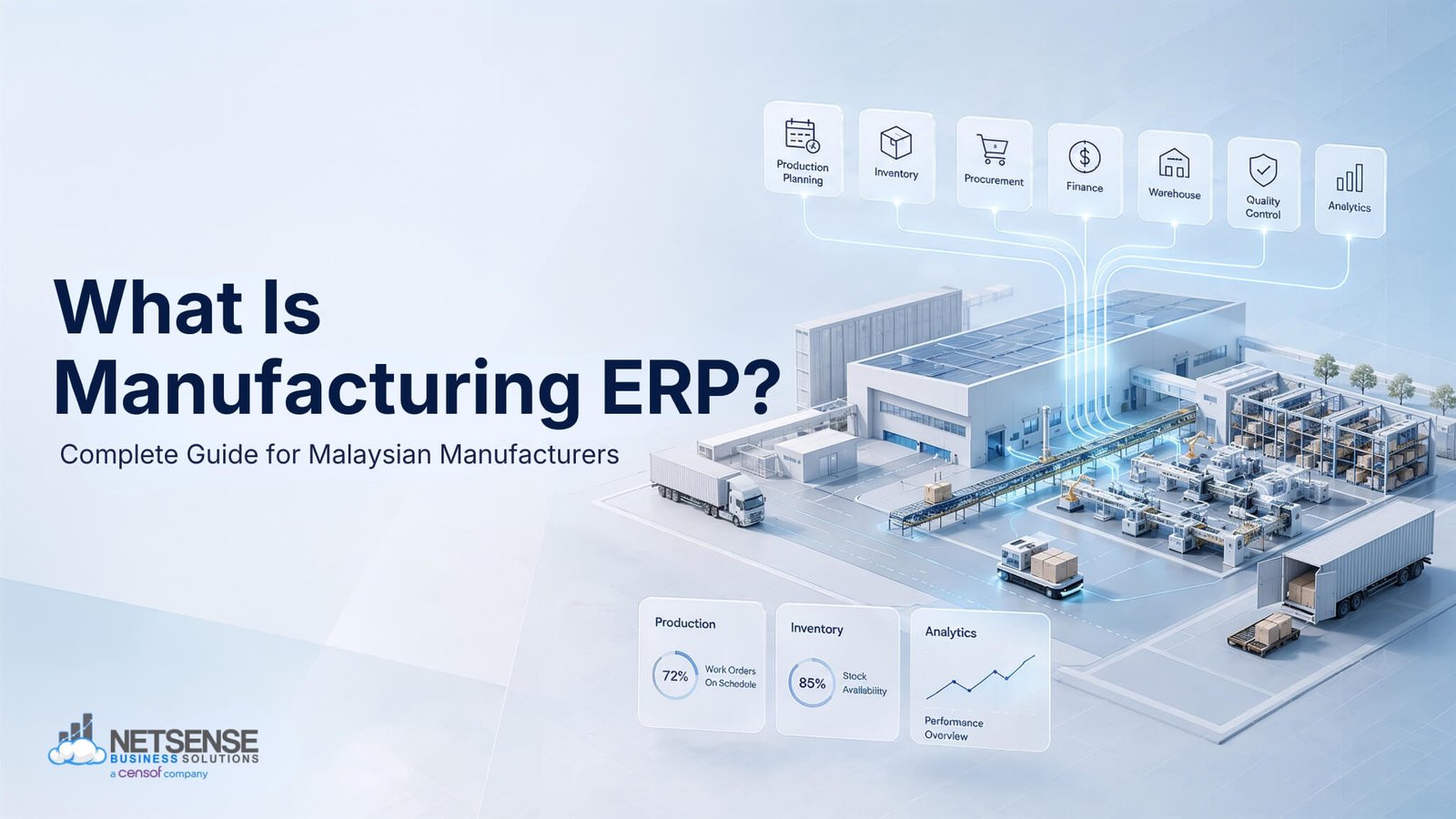
Manufacturing ERP (Enterprise Resource Planning) is an integrated business management system that helps manufacturers manage production, inventory, procurement, warehouse operations, finance, sales, and reporting from a single platform. For Malaysian manufacturers, a modern cloud Manufacturing ERP improves operational visibility, streamlines business processes, reduces manual work, and provides real-time data to support faster, more informed business decisions.
Table of contents
- What Is Manufacturing ERP?
- How Manufacturing ERP Works
- Why Malaysian Manufacturers Need Manufacturing ERP
- Top Benefits of Manufacturing ERP
- Key Features Every Manufacturing ERP Should Have
- 1. Production Planning & Scheduling
- 2. Material Requirements Planning (MRP)
- 3. Bill of Materials (BOM) Management
- 4. Shop Floor Control
- 5. Inventory Management
- 6. Procurement & Supplier Management
- 7. Warehouse Management
- 8. Quality Management
- 9. Financial Management
- 10. Customer Relationship Management (CRM)
- 11. Business Intelligence & Reporting
- 12. Mobile Accessibility
- Choosing Features That Support Long-Term Growth
- Manufacturing ERP vs Traditional Accounting Software
- Who Needs Manufacturing ERP?
- How to Choose Manufacturing ERP in Malaysia
- Frequently Asked Questions (FAQs)
- Download Your Free Manufacturing ERP Readiness Checklist
What Is Manufacturing ERP?
Manufacturing ERP (Enterprise Resource Planning) is an integrated business management system designed to help manufacturers manage and connect their core business processes within a single platform. Instead of relying on separate software for production, inventory, purchasing, finance, sales, and warehouse operations, a Manufacturing ERP system centralises data and workflows, providing a single source of truth across the entire organisation.
Unlike traditional systems that operate independently, Manufacturing ERP enables every department to work with the same real-time information. For example, when a sales order is confirmed, the system can automatically update production schedules, check raw material availability, trigger purchase requisitions if inventory is insufficient, adjust warehouse stock levels, and record the corresponding financial transactions. This level of integration reduces manual data entry, minimises errors, and improves collaboration across departments.
For manufacturers in Malaysia, adopting a modern Manufacturing ERP system is becoming increasingly important as businesses face growing operational complexity, rising customer expectations, supply chain disruptions, and increasing pressure to improve productivity. Whether managing a single factory or multiple production sites, Manufacturing ERP provides the visibility and control needed to make faster, data-driven decisions while supporting sustainable business growth.
What Does a Manufacturing ERP System Typically Include?
A comprehensive Manufacturing ERP solution typically includes modules that support every stage of manufacturing operations, including:
- Production Planning – Schedule and manage production based on demand, capacity, and available resources.
- Material Requirements Planning (MRP) – Calculate raw material requirements and ensure materials are available when needed.
- Bill of Materials (BOM) – Manage product structures, components, and manufacturing specifications.
- Inventory Management – Track raw materials, work-in-progress, and finished goods in real time.
- Procurement & Purchasing – Automate purchasing processes and supplier management.
- Warehouse Management – Improve inventory accuracy, stock movement, and warehouse efficiency.
- Quality Management – Monitor product quality and maintain compliance with manufacturing standards.
- Sales & Customer Management – Connect customer orders directly with production and fulfilment processes.
- Financial Management – Integrate accounting, budgeting, costing, and financial reporting into a unified system.
- Business Intelligence & Reporting – Provide real-time dashboards and analytics to support faster, more informed decision-making.
By integrating these functions into a single platform, Manufacturing ERP helps manufacturers eliminate information silos, streamline operations, improve production efficiency, and gain complete visibility across the business.
Key Takeaway: Manufacturing ERP is more than production management software. It is a business-wide platform that connects manufacturing operations, inventory, finance, procurement, sales, and reporting, enabling manufacturers to operate more efficiently, make better decisions, and scale with confidence.
How Manufacturing ERP Works
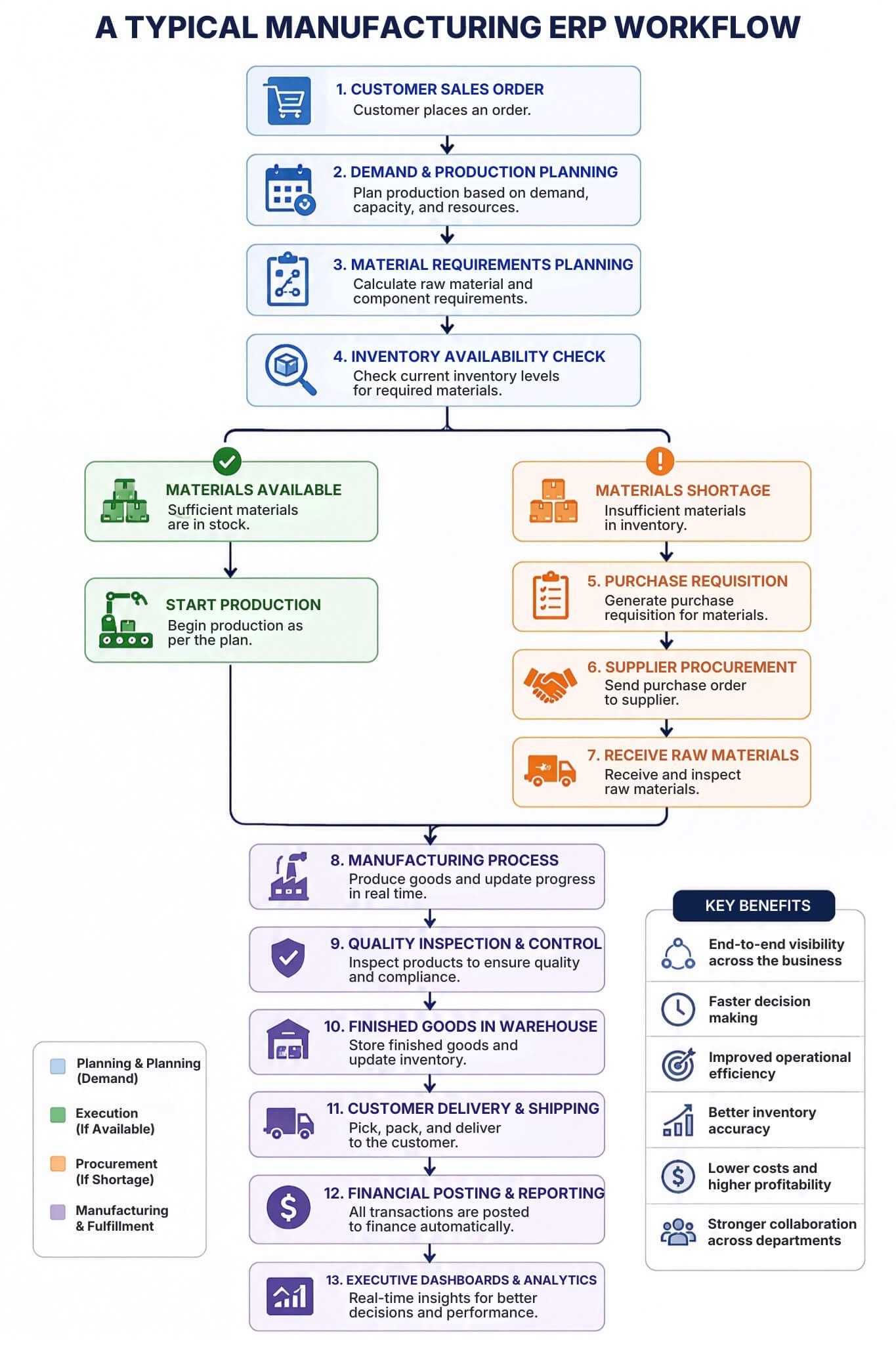
A Manufacturing ERP system connects every stage of the manufacturing process into one integrated workflow. Instead of each department operating with separate systems and disconnected data, information flows automatically across the organisation. This ensures that every team works from the same real-time data, improving collaboration, reducing manual tasks, and enabling faster business decisions.
The process typically begins when a customer places an order. Rather than manually updating multiple systems, the ERP platform automatically shares information with production, inventory, procurement, warehouse, finance, and management teams. As transactions occur, every department sees the latest information without duplicate data entry or delays.
A Typical Manufacturing ERP Workflow
Step-by-Step Explanation
1. Customer Sales Order
The process begins when a customer order is entered into the ERP system. Instead of creating work manually across different applications, the order immediately becomes visible to production, inventory, procurement, finance, and warehouse teams.
2. Demand and Production Planning
Based on incoming orders, demand forecasts, and available production capacity, the ERP system helps planners determine what products need to be manufactured, when production should begin, and how resources should be allocated.
3. Material Requirements Planning (MRP)
The system analyses Bills of Materials (BOM), production schedules, and current inventory levels to calculate exactly which raw materials and components are required. This helps manufacturers avoid both production delays caused by shortages and unnecessary excess inventory.
4. Inventory Availability Check
Manufacturing ERP automatically checks whether sufficient raw materials are available.
- If inventory is available, production can begin immediately.
- If materials are insufficient, the system generates purchasing requirements so procurement teams can replenish stock before production is affected.
5. Procurement and Supplier Management
Purchasing teams receive real-time material requirements directly from the ERP system. Purchase orders can be generated, supplier deliveries tracked, and incoming materials recorded without duplicate data entry.
6. Manufacturing Execution
Once materials are available, production begins. Throughout the manufacturing process, the ERP system tracks work orders, production progress, labour usage, machine utilisation, and material consumption, giving managers complete visibility into shop floor operations.
7. Quality Control
Quality inspections can be performed during or after production. Recording inspection results within the ERP system helps manufacturers maintain consistent product quality, improve traceability, and support regulatory compliance.
8. Warehouse and Inventory Updates
After production is completed, finished goods are automatically recorded in inventory. Warehouse teams gain real-time visibility into stock levels, making picking, packing, and shipping more efficient while improving inventory accuracy.
9. Financial Integration
Every operational transaction—including purchasing, inventory movements, production costs, and sales—is automatically reflected in the finance module. This eliminates manual reconciliation and enables finance teams to generate more accurate financial reports.
10. Real-Time Reporting and Business Intelligence
Executives and department managers can monitor production performance, inventory levels, procurement status, operational costs, and financial results through real-time dashboards. Having immediate access to reliable business data enables faster, more informed decisions and supports continuous operational improvement.
Why Integration Matters
The true value of Manufacturing ERP lies in its ability to connect departments that traditionally operate in isolation. When sales, production, procurement, inventory, warehouse, and finance all work from the same real-time information, manufacturers can respond more quickly to customer demand, reduce operational inefficiencies, minimise costly errors, and make decisions with greater confidence.
Key Takeaway: Manufacturing ERP is not simply software for managing production. It creates an end-to-end digital workflow where every department shares the same data, enabling manufacturers to improve efficiency, strengthen collaboration, and gain complete visibility across their operations.
Why Malaysian Manufacturers Need Manufacturing ERP
Malaysia’s manufacturing sector plays a vital role in the country’s economy, contributing significantly to exports, employment, and industrial growth. However, manufacturers are also facing increasing pressure to remain competitive in an environment shaped by global competition, evolving customer expectations, and rapid technological change.
Many businesses that once relied on manual processes or disconnected legacy systems are finding it increasingly difficult to maintain efficiency, control costs, and scale their operations. A modern Manufacturing ERP system helps address these challenges by connecting business functions, improving visibility, and enabling data-driven decision-making across the organisation.
Below are some of the key reasons why Malaysian manufacturers are investing in Manufacturing ERP.
1. Rising Operational Costs
Manufacturers continue to face increasing costs across raw materials, transportation, utilities, and labour. Without accurate operational data, identifying inefficiencies and controlling production costs becomes increasingly difficult.
Manufacturing ERP provides real-time visibility into production costs, inventory levels, purchasing activities, and financial performance. This enables management to identify waste, optimise resource utilisation, and make faster decisions that improve profitability.
2. Labour Shortages and Workforce Productivity
Finding and retaining skilled workers has become an ongoing challenge for many manufacturers. At the same time, relying on manual processes often increases administrative workload and reduces overall productivity.
By automating routine tasks such as production planning, inventory tracking, procurement, and reporting, Manufacturing ERP enables employees to focus on higher-value activities while improving operational efficiency with existing resources.
3. Supply Chain Disruptions
Global supply chains have become increasingly unpredictable. Delayed shipments, fluctuating material availability, and changing customer demand can quickly disrupt production schedules.
Manufacturing ERP improves supply chain resilience by providing better demand forecasting, Material Requirements Planning (MRP), supplier visibility, and inventory management. Businesses can respond more quickly to disruptions and minimise the impact on production and customer deliveries.
4. Disconnected Business Systems
Many growing manufacturers still operate with multiple standalone applications for accounting, inventory, purchasing, production, and spreadsheets. These disconnected systems often result in duplicate data entry, inconsistent information, reporting delays, and limited collaboration between departments.
Manufacturing ERP eliminates these silos by integrating all core business functions into a single platform. Everyone—from production and procurement to finance and management—works from the same real-time information, improving accuracy and decision-making.
5. Compliance and Traceability Requirements
Manufacturers must comply with various financial, quality, industry, and customer requirements. Maintaining accurate records manually can be both time-consuming and error-prone.
Manufacturing ERP helps organisations improve compliance by maintaining centralised business records, tracking inventory movements, recording production history, and providing complete audit trails. Enhanced traceability also supports faster issue resolution and stronger quality management.
6. Managing Multi-Site Operations
As manufacturers expand into multiple factories, warehouses, or distribution centres, maintaining consistent operations becomes increasingly complex.
Manufacturing ERP provides centralised visibility across multiple locations, allowing management to monitor inventory, production performance, purchasing activities, and financial results from a single system. This enables better coordination, standardised processes, and more effective business oversight.
From Operational Challenges to Business Growth
The challenges facing Malaysian manufacturers are no longer isolated issues—they are interconnected. Rising costs affect profitability, supply chain disruptions impact customer satisfaction, and disconnected systems limit business agility.
Rather than solving each problem with separate software solutions, Manufacturing ERP provides a unified platform that connects people, processes, and data across the organisation. With greater visibility, automation, and real-time insights, manufacturers can improve operational efficiency, strengthen decision-making, and build a more scalable business for long-term growth.
Key Takeaway: Manufacturing ERP is not simply an operational upgrade—it is a strategic business platform that helps Malaysian manufacturers improve efficiency, control costs, strengthen supply chain resilience, and support sustainable growth in an increasingly competitive market.
Top Benefits of Manufacturing ERP
Manufacturing ERP delivers far more than operational automation. It creates a connected digital foundation that enables manufacturers to improve productivity, reduce costs, and make better business decisions with real-time data.
Rather than solving individual operational issues with separate software applications, Manufacturing ERP integrates people, processes, and information into a single platform. This allows manufacturers to respond more quickly to market changes, optimise resources, and support sustainable business growth.
The table below highlights how Manufacturing ERP addresses common operational challenges faced by manufacturers.
| Business Challenge | How Manufacturing ERP Helps |
|---|---|
| Manual production planning | Automates production scheduling based on customer demand, available capacity, and material availability. |
| Inventory inaccuracies | Provides real-time inventory visibility across raw materials, work-in-progress, and finished goods. |
| Material shortages | Uses Material Requirements Planning (MRP) to calculate purchasing needs and reduce stock shortages. |
| Duplicate data entry | Eliminates repetitive manual input by connecting production, inventory, purchasing, sales, and finance in one system. |
| Slow management reporting | Delivers live dashboards and real-time operational reports for faster decision-making. |
| Poor production visibility | Tracks production progress, machine utilisation, and work orders in real time. |
| Rising operational costs | Identifies production inefficiencies, inventory waste, and unnecessary expenses through integrated reporting. |
| Procurement delays | Automates purchasing workflows and improves supplier collaboration. |
| Limited business scalability | Supports business growth by standardising processes across multiple factories, warehouses, and business units. |
| Disconnected departments | Creates a single source of truth where every department works from the same real-time business data. |
Key Business Benefits of Manufacturing ERP
Beyond solving day-to-day operational challenges, Manufacturing ERP enables long-term business transformation. Here are some of the most significant benefits manufacturers can expect.
Improve Operational Efficiency
Manufacturing ERP automates routine business processes that traditionally require manual effort, such as production planning, inventory updates, purchasing approvals, and financial reporting. By reducing repetitive administrative work, employees can focus on higher-value activities that improve overall productivity.
Gain Complete Business Visibility
With all departments connected through a single platform, management gains a real-time view of production performance, inventory levels, procurement status, sales orders, and financial results. This visibility enables faster responses to operational issues before they become costly problems.
Make Faster, Data-Driven Decisions
Instead of waiting for manually prepared reports, executives can access live dashboards and analytics that reflect current business conditions. Accurate, up-to-date information supports better planning, forecasting, and strategic decision-making.
Reduce Inventory Costs
Manufacturing ERP helps maintain optimal inventory levels by balancing customer demand with material availability. This reduces excess inventory, minimises stock shortages, improves cash flow, and lowers warehousing costs.
Increase Production Accuracy
Integrated production planning and Material Requirements Planning (MRP) ensure that the right materials, resources, and production schedules are aligned. This helps reduce production delays, minimise waste, and improve on-time delivery performance.
Strengthen Financial Control
Because operational and financial data are connected, finance teams gain greater visibility into production costs, purchasing expenses, profitability, and cash flow. Automated financial posting also reduces manual reconciliation and improves reporting accuracy.
Enhance Collaboration Across Departments
Manufacturing ERP removes information silos by connecting sales, procurement, production, warehouse, finance, and management within one unified system. Everyone works from the same real-time data, improving communication and reducing operational errors.
Support Future Business Growth
As manufacturers expand into new markets, product lines, or facilities, Manufacturing ERP provides the scalability needed to manage increasing operational complexity without introducing additional disconnected systems.
Key Takeaway: The greatest value of Manufacturing ERP is not simply automating manufacturing processes. It creates an integrated digital business environment where data flows seamlessly across every department, enabling manufacturers to operate more efficiently, reduce costs, improve decision-making, and scale with confidence.
Key Features Every Manufacturing ERP Should Have
Not all Manufacturing ERP solutions offer the same capabilities. While many systems provide basic accounting or inventory management, a modern Manufacturing ERP should integrate every critical business function—from production planning and procurement to finance and customer management—within a single platform.
When evaluating Manufacturing ERP software for your business, look for features that support both your current operational needs and future business growth.
1. Production Planning & Scheduling
Efficient production begins with accurate planning. A Manufacturing ERP should help manufacturers create production schedules based on customer demand, available resources, machine capacity, and workforce availability.
Key capabilities include:
- Production scheduling
- Capacity planning
- Work order management
- Demand forecasting
- Production calendar
- Resource allocation
Business Benefit: Improve production efficiency, reduce bottlenecks, and increase on-time delivery.
2. Material Requirements Planning (MRP)
Material Requirements Planning (MRP) automatically calculates the raw materials and components required for production based on customer orders, inventory levels, and Bills of Materials (BOM).
Key capabilities include:
- Material demand calculation
- Purchase recommendations
- Inventory replenishment planning
- Shortage alerts
- Supplier planning
Business Benefit: Reduce stock shortages, avoid overstocking, and optimise inventory investment.
3. Bill of Materials (BOM) Management
A Bill of Materials defines every component, raw material, and assembly required to manufacture a product. Managing BOMs accurately is essential for maintaining production consistency and controlling manufacturing costs.
Key capabilities include:
- Multi-level BOM management
- Version control
- Engineering change management
- Product configuration
- Component traceability
Business Benefit: Improve manufacturing accuracy while reducing production errors and material waste.
4. Shop Floor Control
Real-time visibility into production activities enables manufacturers to monitor operations more effectively and identify issues before they impact delivery schedules.
Key capabilities include:
- Work order tracking
- Machine utilisation monitoring
- Labour tracking
- Production progress monitoring
- Downtime reporting
Business Benefit: Increase shop floor productivity and improve operational transparency.
5. Inventory Management
Inventory is one of the largest investments for many manufacturers. A Manufacturing ERP should provide real-time visibility into inventory across warehouses, production lines, and multiple business locations.
Key capabilities include:
- Real-time inventory tracking
- Lot and serial number tracking
- Stock transfers
- Cycle counting
- Safety stock management
- Inventory valuation
Business Benefit: Improve inventory accuracy while reducing carrying costs and stock shortages.
6. Procurement & Supplier Management
An integrated procurement module helps manufacturers streamline purchasing activities while maintaining strong supplier relationships.
Key capabilities include:
- Purchase requisitions
- Purchase orders
- Supplier management
- Approval workflows
- Vendor performance tracking
- Procurement analytics
Business Benefit: Improve purchasing efficiency, reduce procurement delays, and control supplier costs.
7. Warehouse Management
Warehouse operations should be fully connected to inventory, production, purchasing, and shipping processes.
Key capabilities include:
- Goods receiving
- Put-away management
- Picking and packing
- Barcode scanning
- Warehouse transfers
- Shipping management
Business Benefit: Increase warehouse efficiency while improving inventory visibility and order fulfilment accuracy.
8. Quality Management
Maintaining consistent product quality is essential for customer satisfaction and regulatory compliance. Manufacturing ERP should support quality assurance throughout the production lifecycle.
Key capabilities include:
- Inspection planning
- Quality checkpoints
- Non-conformance tracking
- Corrective actions
- Product traceability
- Compliance documentation
Business Benefit: Reduce defects, improve product consistency, and strengthen customer confidence.
9. Financial Management
Manufacturing ERP should connect financial information directly with operational activities, eliminating manual reconciliation and improving financial visibility.
Key capabilities include:
- General ledger
- Accounts payable
- Accounts receivable
- Cost accounting
- Budget management
- Financial reporting
- Multi-company and multi-currency support
Business Benefit: Improve financial control, reporting accuracy, and profitability analysis.
10. Customer Relationship Management (CRM)
Customer information should be connected with sales, production, and service operations to provide better customer experiences and improve order management.
Key capabilities include:
- Lead management
- Sales opportunity tracking
- Customer order management
- Customer history
- Sales forecasting
- After-sales support
Business Benefit: Improve customer satisfaction while creating a seamless flow from sales to production and delivery.
11. Business Intelligence & Reporting
Modern manufacturers require more than static reports. Decision-makers need real-time dashboards that provide actionable insights across every department.
Key capabilities include:
- Executive dashboards
- Real-time KPIs
- Production analytics
- Inventory analysis
- Financial dashboards
- Custom reporting
Business Benefit: Enable faster, data-driven decision-making at every level of the organisation.
12. Mobile Accessibility
Business operations no longer happen exclusively from the office. Managers, warehouse staff, sales teams, and executives increasingly require secure access to business information from anywhere.
Key capabilities include:
- Mobile approvals
- Real-time dashboards
- Inventory lookup
- Sales order management
- Customer information access
- Field service support
Business Benefit: Increase responsiveness, improve collaboration, and enable faster decision-making whether employees are on the production floor, at customer sites, or working remotely.
Choosing Features That Support Long-Term Growth
While every manufacturer has unique operational requirements, the most effective Manufacturing ERP solutions share one common characteristic—they integrate every critical business function into a single, connected platform. This enables organisations to eliminate data silos, automate workflows, improve operational visibility, and support sustainable growth as the business expands.
Key Takeaway: The best Manufacturing ERP software is not defined by the number of features it offers, but by how well those features work together to streamline operations, provide real-time business visibility, and support long-term business growth.
Manufacturing ERP vs Traditional Accounting Software
Many growing manufacturers begin with accounting software to manage bookkeeping, invoicing, and financial reporting. While these tools are effective for basic financial management, they are not designed to support the complexity of modern manufacturing operations.
As production volumes increase, product lines expand, and supply chains become more sophisticated, manufacturers often discover that accounting software alone cannot provide the operational visibility needed to manage the business efficiently.
Also Read: Acumatica vs SAP Business One: Which ERP Fits Growing Companies Better?
A Manufacturing ERP system goes far beyond finance. It connects production, inventory, procurement, warehouse operations, sales, and financial management into one integrated platform, allowing every department to work from the same real-time information.
The comparison below highlights the key differences.
| Capability | Traditional Accounting Software | Manufacturing ERP |
|---|---|---|
| Financial Accounting | ✔ Core functionality | ✔ Fully integrated with operations |
| Accounts Payable & Receivable | ✔ | ✔ |
| General Ledger | ✔ | ✔ |
| Production Planning | ✖ | ✔ |
| Material Requirements Planning (MRP) | ✖ | ✔ |
| Bill of Materials (BOM) | ✖ | ✔ |
| Shop Floor Control | ✖ | ✔ |
| Inventory Management | Basic | Advanced, real-time visibility |
| Warehouse Management | Limited | ✔ Multi-warehouse support |
| Procurement Management | Basic | ✔ Integrated purchasing workflows |
| Production Cost Tracking | Limited | ✔ Real-time manufacturing costing |
| Quality Management | ✖ | ✔ |
| Business Intelligence Dashboards | Limited | ✔ Real-time analytics |
| Multi-Site Manufacturing | Limited | ✔ Built for multiple locations |
| Department Integration | Low | High |
| Business Scalability | Suitable for small operations | Designed for growing and complex manufacturers |
When Is Accounting Software Enough?
For very small businesses with straightforward operations, accounting software may be sufficient if the primary requirement is managing invoices, expenses, payroll, and financial reporting.
However, once manufacturers begin experiencing challenges such as:
- Increasing production volumes
- Multiple product lines
- Inventory inaccuracies
- Frequent stock shortages
- Manual production scheduling
- Multiple warehouses
- Growing supplier networks
- Expanding operations across multiple locations
they often require capabilities that extend well beyond traditional accounting systems.
When Should Manufacturers Consider Manufacturing ERP?
Manufacturing ERP becomes a strategic investment when operational complexity begins to limit business performance. Typical signs include:
- Teams spend too much time updating spreadsheets.
- Production planning relies on manual processes.
- Inventory records frequently differ from actual stock levels.
- Departments work with different versions of business data.
- Management lacks real-time visibility into operations.
- Financial reports require extensive manual reconciliation.
- Customer deliveries are delayed because information is fragmented.
- Existing systems struggle to support business growth.
These challenges are often symptoms of disconnected business processes rather than isolated operational problems. Manufacturing ERP addresses them by integrating every critical function into a single platform.
Also Read: Why Acumatica Is Ideal for Fast-Growing SMEs in Malaysia
Looking Beyond Accounting
Accounting software answers questions like:
- How much revenue did we generate last month?
- What expenses have we incurred?
- What is our current cash position?
Manufacturing ERP answers broader operational questions that drive business performance, such as:
- Can we fulfil this customer order on time?
- Do we have enough raw materials to meet demand?
- Which production line is underperforming?
- What is the actual manufacturing cost of each product?
- Where are today’s production bottlenecks?
- Which suppliers are affecting delivery performance?
This operational intelligence enables manufacturers to move from reactive decision-making to proactive business management.
Key Takeaway: Traditional accounting software helps businesses manage financial transactions. Manufacturing ERP manages the entire manufacturing operation by connecting finance, production, inventory, procurement, warehouse, and sales into one integrated platform. For growing manufacturers, ERP is not simply an upgrade to accounting software—it is the digital foundation for scalable and efficient business operations.
Who Needs Manufacturing ERP?
Manufacturing ERP is not only designed for large enterprises. Today, businesses of all sizes are adopting modern ERP solutions to improve operational efficiency, gain better visibility, and support sustainable growth.
If your organisation is experiencing increasing operational complexity, disconnected systems, or limited visibility across departments, Manufacturing ERP can provide the foundation needed to streamline operations and scale with confidence.
Below are the types of manufacturers that benefit the most from Manufacturing ERP.
Small and Medium-Sized Manufacturers (SMEs)
Many SMEs begin with spreadsheets or standalone accounting software because they are affordable and easy to implement. However, as customer demand grows, managing production, inventory, purchasing, and finance separately often becomes inefficient.
Also Read: How to Choose the Right ERP System for SMEs in Malaysia (2026 Guide)
Manufacturing ERP helps SMEs standardise business processes, automate routine tasks, and improve visibility across the organisation without significantly increasing administrative workload.
Typical Challenges
- Manual production planning
- Spreadsheet-based inventory tracking
- Duplicate data entry
- Limited business reporting
- Inefficient purchasing processes
How Manufacturing ERP Helps
- Centralises business operations
- Improves inventory accuracy
- Automates production workflows
- Provides real-time dashboards
- Supports future business expansion
Growing Manufacturers
Business growth often introduces new operational challenges. Increasing order volumes, additional product lines, and expanding customer demands require better coordination across departments.
Manufacturing ERP enables growing manufacturers to scale operations without relying on disconnected systems or manual processes.
Typical Challenges
- Higher production volumes
- Increasing operational complexity
- Growing supplier networks
- More employees and departments
- Longer production lead times
How Manufacturing ERP Helps
- Supports scalable operations
- Improves production planning
- Strengthens cross-department collaboration
- Provides data-driven forecasting
- Reduces operational bottlenecks
Also Read: 10 Reasons Growing Businesses Are Switching to Acumatica ERP in 2026
Multi-Site Manufacturers
Managing multiple factories, warehouses, or distribution centres can become increasingly difficult when each location uses different systems or reporting methods.
Manufacturing ERP provides a unified platform that allows management to monitor every location from a single source of truth.
Typical Challenges
- Inconsistent business processes
- Limited visibility across locations
- Inventory imbalance between warehouses
- Delayed management reporting
- Difficult performance monitoring
How Manufacturing ERP Helps
- Centralises multi-site operations
- Standardises business processes
- Consolidates financial reporting
- Improves inventory visibility
- Enables enterprise-wide decision-making
Electronics Manufacturers
Electronics manufacturing often involves complex Bills of Materials (BOM), rapid product changes, strict quality requirements, and extensive component tracking.
Manufacturing ERP helps electronics companies improve production accuracy while maintaining complete traceability throughout the manufacturing process.
Typical Challenges
- Complex product structures
- Frequent engineering changes
- Component shortages
- Serial number traceability
- Strict quality requirements
How Manufacturing ERP Helps
- Advanced BOM management
- Material Requirements Planning (MRP)
- End-to-end traceability
- Quality control integration
- Real-time production visibility
Food & Beverage Manufacturers
Food manufacturers operate in highly regulated environments where inventory freshness, product quality, and traceability are critical to business success.
Manufacturing ERP supports compliance while improving production planning and inventory control.
Typical Challenges
- Batch production management
- Expiry date monitoring
- Food safety compliance
- Inventory waste
- Product recalls
How Manufacturing ERP Helps
- Batch and lot tracking
- Expiry date management
- Complete product traceability
- Quality assurance processes
- Inventory optimisation
Automotive & Industrial Parts Manufacturers
Automotive suppliers must maintain consistent production quality, meet demanding delivery schedules, and manage large supplier ecosystems.
Manufacturing ERP provides greater operational control while helping manufacturers respond quickly to changing customer requirements.
Typical Challenges
- Just-in-time production
- Supplier coordination
- Strict delivery deadlines
- Cost control
- Production scheduling
How Manufacturing ERP Helps
- Production scheduling automation
- Supplier collaboration
- Inventory optimisation
- Manufacturing cost analysis
- Real-time operational monitoring
Engineering & Industrial Equipment Manufacturers
Engineering companies frequently manage customised products, project-based manufacturing, and complex production processes that require close coordination across multiple departments.
Manufacturing ERP helps engineering manufacturers integrate project management, production, procurement, inventory, and financial management into one connected platform.
Typical Challenges
- Engineer-to-order production
- Project-based manufacturing
- Complex product configurations
- Long production cycles
- Resource planning
How Manufacturing ERP Helps
- Project visibility
- Resource scheduling
- Integrated production planning
- Procurement coordination
- Financial tracking
Is Manufacturing ERP Right for Your Business?
You don’t need to be a multinational manufacturer to benefit from Manufacturing ERP. The right time to invest is often when operational complexity begins to outgrow your existing systems.
If your business relies heavily on spreadsheets, experiences frequent inventory discrepancies, struggles with production planning, or lacks real-time visibility across departments, it may be time to evaluate a Manufacturing ERP solution.
Ask yourself the following questions:
- Are different departments using different systems to manage the business?
- Do production delays occur because of inaccurate inventory information?
- Is management reporting slow or heavily dependent on spreadsheets?
- Are purchasing and production teams working with outdated information?
- Is your business expanding faster than your current systems can support?
If you answered “Yes” to several of these questions, your organisation may already be experiencing the operational challenges that Manufacturing ERP is designed to solve.
Key Takeaway: Manufacturing ERP is suitable for manufacturers of all sizes—from growing SMEs to multi-site enterprises. Whether you produce electronics, food products, automotive components, or industrial equipment, an integrated ERP platform helps improve operational efficiency, increase business visibility, and support long-term growth.
How to Choose Manufacturing ERP in Malaysia
Choosing a Manufacturing ERP system is a long-term strategic decision that can influence your company’s operational efficiency, scalability, and overall business performance for years to come. While features and pricing are important, the most successful ERP projects focus on selecting a solution that aligns with business objectives, manufacturing processes, and future growth plans.
Rather than asking “Which ERP has the most features?“, manufacturers should ask “Which ERP best supports our business today—and can grow with us tomorrow?“
The following checklist can help Malaysian manufacturers evaluate Manufacturing ERP solutions more effectively.
Manufacturing ERP Evaluation Checklist
| Evaluation Criteria | Questions to Ask |
|---|---|
| Industry Fit | Does the ERP support your manufacturing processes and industry-specific requirements? |
| Production Planning | Can it manage production schedules, work orders, and capacity planning efficiently? |
| Material Requirements Planning (MRP) | Does it accurately calculate material requirements and automate procurement planning? |
| Inventory Management | Does it provide real-time visibility across warehouses, production, and purchasing? |
| Bill of Materials (BOM) | Can it manage multi-level BOMs and engineering changes? |
| Quality Management | Does it support inspections, traceability, and quality control throughout production? |
| Reporting & Analytics | Does it offer real-time dashboards and actionable business insights? |
| Scalability | Can the system support business growth, additional users, new locations, and expanding product lines? |
| Cloud Capability | Is it cloud-based, secure, and accessible from anywhere? |
| Integration | Can it integrate with CRM, eCommerce platforms, payroll systems, BI tools, or other business applications? |
| Implementation Partner | Does the implementation partner have proven manufacturing expertise and local support in Malaysia? |
| Total Cost of Ownership (TCO) | Have you considered implementation, licensing, training, support, upgrades, and long-term maintenance costs? |
Five Questions Every Manufacturer Should Ask Before Choosing an ERP
Before shortlisting vendors, gather key stakeholders from operations, finance, procurement, production, and IT to discuss the following questions:
1. What Business Problems Are We Trying to Solve?
An ERP implementation should begin with business objectives—not software features.
For example:
- Improve production efficiency
- Reduce inventory costs
- Increase on-time delivery
- Eliminate manual processes
- Gain real-time business visibility
Having clear objectives helps ensure the ERP project delivers measurable business outcomes.
2. Will the ERP Support Our Future Growth?
The right ERP should support your business not only today but also as it grows.
Consider whether the system can accommodate:
- Additional factories
- Multiple warehouses
- New product lines
- Higher transaction volumes
- International expansion
- Multi-company operations
Choosing a scalable platform reduces the need for costly system replacements in the future.
3. Does the ERP Match Our Manufacturing Processes?
Every manufacturer operates differently.
Whether your business follows:
- Make-to-Stock (MTS)
- Make-to-Order (MTO)
- Engineer-to-Order (ETO)
- Configure-to-Order (CTO)
the ERP should support your operational model rather than forcing your business to adapt to software limitations.
4. Can We Access Real-Time Business Information?
Decision-makers need timely, accurate information.
A modern Manufacturing ERP should provide real-time visibility into:
- Production performance
- Inventory availability
- Purchasing activities
- Financial performance
- Customer orders
- Warehouse operations
Without reliable data, businesses often make reactive decisions instead of proactive ones.
5. Does the Vendor Offer Strong Local Expertise?
Technology is only one part of a successful ERP implementation. The experience of the implementation partner is equally important.
When evaluating ERP providers in Malaysia, consider:
- Manufacturing industry experience
- Proven implementation methodology
- Local consulting and support teams
- User training programmes
- Long-term customer success services
- Post-implementation support
A knowledgeable implementation partner can significantly reduce project risks and help accelerate business value.
Common Mistakes to Avoid
Many ERP projects encounter difficulties because organisations focus primarily on software features or initial pricing. Avoid these common mistakes:
- Choosing ERP software based solely on price.
- Focusing on features instead of business outcomes.
- Underestimating implementation planning and change management.
- Ignoring future business growth requirements.
- Failing to involve key business stakeholders in the evaluation process.
- Selecting a vendor without proven manufacturing experience.
Avoiding these pitfalls can improve the likelihood of a successful implementation and maximise long-term return on investment.
Download the Manufacturing ERP Evaluation Checklist
Evaluating Manufacturing ERP solutions involves many business, operational, and technical considerations. A structured checklist can help your team compare vendors objectively and ensure every critical requirement is addressed before making a decision.
Download our free Manufacturing ERP Evaluation Checklist to assess potential ERP solutions based on production planning, inventory management, reporting, scalability, implementation readiness, and long-term business value.
If you would like guidance tailored to your manufacturing operations, our ERP consultants are available to help you identify the right approach and answer any questions about Manufacturing ERP implementation in Malaysia.
Key Takeaway: The best Manufacturing ERP is not necessarily the one with the most features—it’s the one that aligns with your manufacturing processes, supports your long-term growth strategy, and is implemented by a partner with proven industry expertise.
Frequently Asked Questions (FAQs)
What is Manufacturing ERP?
Manufacturing ERP (Enterprise Resource Planning) is an integrated business management system that helps manufacturers manage production, inventory, procurement, warehouse operations, finance, sales, and reporting from a single platform. By connecting these functions, manufacturers gain real-time visibility, improve operational efficiency, and make faster, data-driven decisions.
How is Manufacturing ERP different from standard ERP?
A standard ERP system provides core business functions such as finance, purchasing, sales, and inventory management. Manufacturing ERP includes these capabilities while adding manufacturing-specific functionality such as Production Planning, Material Requirements Planning (MRP), Bill of Materials (BOM), shop floor control, production costing, and quality management.
Is Manufacturing ERP suitable for small and medium-sized manufacturers (SMEs)?
Yes. Modern cloud-based Manufacturing ERP solutions are designed to support businesses of all sizes. Many SMEs adopt Manufacturing ERP to replace spreadsheets and disconnected systems, improve operational efficiency, and establish scalable business processes that support future growth.
What are the main benefits of Manufacturing ERP?
Manufacturing ERP helps businesses:
- Improve production planning and scheduling
- Increase inventory accuracy
- Reduce operational costs
- Automate manual processes
- Improve supply chain visibility
- Strengthen financial control
- Enhance collaboration across departments
- Access real-time business insights for better decision-making
What industries can benefit from Manufacturing ERP?
Manufacturing ERP is suitable for a wide range of industries, including:
- Electronics manufacturing
- Food and beverage manufacturing
- Industrial equipment manufacturing
- Automotive and automotive components
- Chemical manufacturing
- Plastics and packaging
- Furniture manufacturing
- Metal fabrication
- Consumer goods manufacturing
Any business that manages production processes, inventory, procurement, and warehouse operations can benefit from Manufacturing ERP.
How long does a Manufacturing ERP implementation take?
Implementation timelines depend on several factors, including company size, operational complexity, number of users, business processes, required integrations, and data migration requirements.
For many small and medium-sized manufacturers, implementation may take a few months, while larger organisations with multiple factories or complex operations typically require a longer implementation period. A structured implementation methodology and experienced ERP partner are key to achieving a successful outcome.
Can Manufacturing ERP integrate with existing business systems?
Yes. Most modern Manufacturing ERP platforms support integration with various business applications, including CRM systems, payroll software, business intelligence tools, eCommerce platforms, logistics solutions, and third-party applications through APIs or integration services. This allows manufacturers to maintain a connected digital ecosystem without replacing every existing system.
What should manufacturers consider when choosing an ERP system?
Manufacturers should evaluate more than just software features. Key considerations include:
- Manufacturing industry capabilities
- Production planning and MRP functionality
- Inventory and warehouse management
- Scalability for future growth
- Cloud deployment options
- Integration capabilities
- Reporting and analytics
- User experience
- Implementation methodology
- Local support and manufacturing expertise
Selecting an ERP solution that aligns with both current operations and long-term business goals is essential for maximising return on investment.
How much does Manufacturing ERP cost in Malaysia?
There is no one-size-fits-all pricing for Manufacturing ERP. The total investment depends on factors such as the number of users, deployment model (cloud or on-premises), implementation scope, required customisations, integrations, and ongoing support services.
Instead of comparing software prices alone, manufacturers should evaluate the Total Cost of Ownership (TCO) alongside the expected business value, operational improvements, and long-term return on investment.
How do I know if my business is ready for Manufacturing ERP?
Your business may be ready for Manufacturing ERP if you are experiencing challenges such as:
- Heavy reliance on spreadsheets
- Frequent inventory discrepancies
- Manual production scheduling
- Slow or inaccurate reporting
- Disconnected business systems
- Limited visibility across departments
- Increasing operational complexity as the business grows
These challenges often indicate that existing systems are no longer sufficient to support efficient operations and future growth.
Download Your Free Manufacturing ERP Readiness Checklist
Choosing the right Manufacturing ERP solution involves more than comparing software features. Before investing in a new system, it’s important to understand your business requirements, identify operational gaps, and evaluate whether your organisation is ready for ERP implementation.
To help you get started, we’ve created a practical Manufacturing ERP Readiness Checklist designed specifically for manufacturers evaluating ERP solutions.
What’s Included in the Checklist?
The checklist helps you assess key areas of your business, including:
- Production Planning & Scheduling
- Material Requirements Planning (MRP)
- Inventory & Warehouse Management
- Procurement & Supplier Management
- Financial Integration
- Business Reporting & Analytics
- Scalability & Future Growth
- ERP Vendor Evaluation
- Implementation Readiness
Whether you’re replacing spreadsheets, upgrading legacy software, or exploring cloud ERP for the first time, this checklist provides a structured framework to help your team make more informed decisions.
Prefer to speak with an expert?
Our ERP consultants can discuss your current manufacturing challenges, answer your questions, and help you determine whether a Manufacturing ERP solution is the right fit for your business—without any obligation.
Start your Manufacturing ERP journey with greater clarity and confidence. Download your free checklist today.