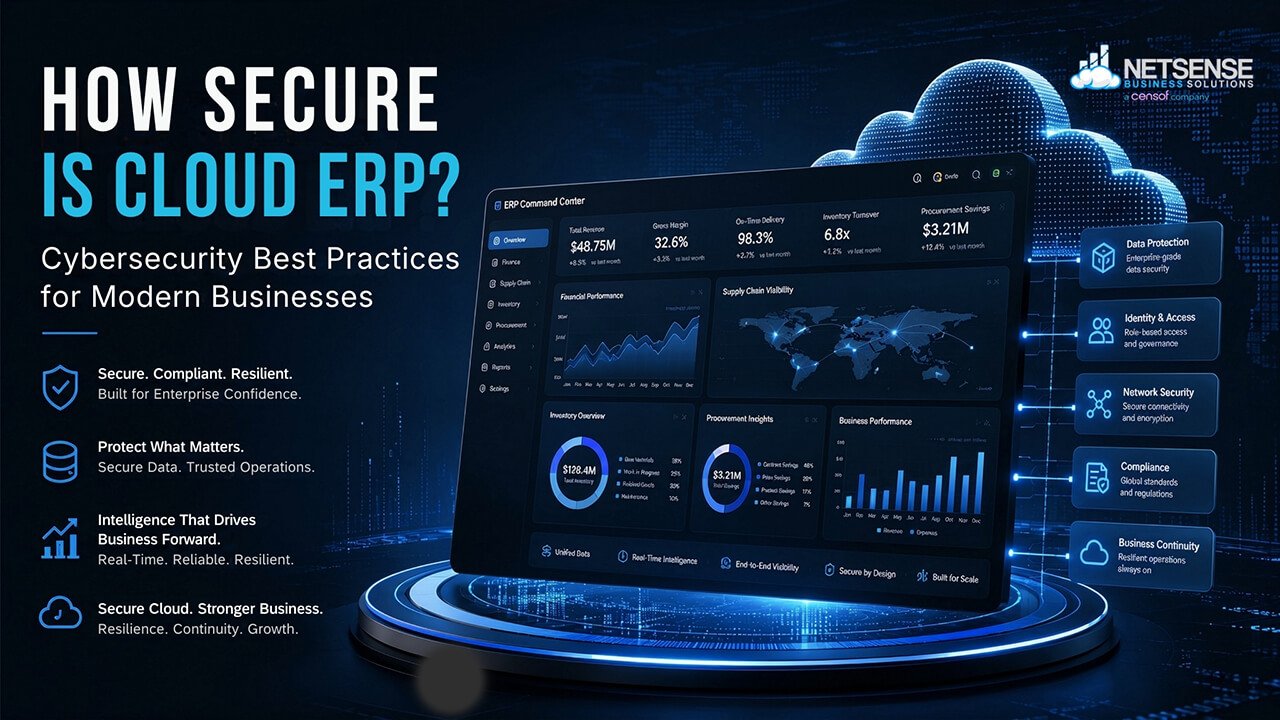
Cloud ERP adoption continues to grow as businesses seek greater efficiency, scalability, and real-time visibility across their operations. From finance and inventory management to procurement and customer service, ERP systems have become the foundation of modern business processes.
As more critical business data moves to the cloud, cybersecurity has become a major concern for business leaders. Ransomware attacks, data breaches, unauthorized access, and evolving compliance requirements have made security a key factor when evaluating ERP solutions.
Many organizations still question whether cloud ERP systems can adequately protect sensitive business information. Understanding the realities of cloud ERP security is therefore essential for companies looking to modernize operations while minimizing cyber risks.
In this article, we explore the most common cybersecurity threats facing ERP systems, examine whether cloud ERP is truly secure, and share best practices businesses can implement to protect their data and support long-term business continuity.
Table of contents
- Why Cloud ERP Security Matters
- Common Cybersecurity Threats Facing Cloud ERP Systems
- Is Cloud ERP Really Secure?
- Why On-Premise ERP Is Not Automatically Safer Than Cloud ERP
- Why Businesses Are Moving Toward Secure Cloud ERP Solutions
- Essential Cloud ERP Cybersecurity Best Practices
- What Security Features Should Businesses Look for in a Cloud ERP Solution?
- Questions Businesses Should Ask Before Choosing a Cloud ERP Provider
- Cloud ERP Security Is Now a Business Continuity Strategy
- Why Cloud ERP Security Matters for Businesses in Malaysia and Southeast Asia
- How Acumatica Supports Secure Cloud ERP Operations
- Why Businesses Choose Netsense Business Solutions
- Frequently Asked Questions (FAQs)
- Key Takeaways
- Ready to Evaluate a Secure Cloud ERP Solution?
Why Cloud ERP Security Matters
An ERP system serves as the central hub of business operations, connecting critical functions such as finance, customer management, human resources, procurement, inventory, and supply chain management within a single platform. Because of its role in storing and processing large volumes of sensitive information, ERP systems have become a valuable target for cybercriminals.
A successful attack on an ERP environment can expose financial records, customer information, employee data, payroll details, and operational insights. In many cases, unauthorized access to ERP data can impact multiple departments simultaneously, creating significant business risks beyond the IT function.
The consequences of an ERP security breach can be severe. Organizations may face financial losses caused by fraud, ransomware attacks, or unexpected downtime. Business operations can also be disrupted, affecting productivity, order fulfillment, and customer service. In addition, companies may encounter compliance challenges if sensitive data is exposed, potentially resulting in regulatory penalties and legal consequences.
Beyond the financial and operational impact, cybersecurity incidents can damage customer trust and brand reputation. As cyber threats continue to evolve, protecting ERP systems is no longer just a technical requirement—it is a critical component of business resilience and long-term growth.
Common Cybersecurity Threats Facing Cloud ERP Systems
While modern cloud ERP platforms offer robust security capabilities, organizations must remain aware of the cyber threats that can compromise sensitive business data and disrupt operations. Understanding these risks is the first step toward building a stronger security posture and reducing potential vulnerabilities.
Phishing and Credential Theft
Phishing remains one of the most common cybersecurity threats targeting ERP users. Attackers often use fraudulent emails, fake login pages, or social engineering tactics to trick employees into revealing usernames, passwords, or other sensitive credentials. Once access is obtained, cybercriminals can potentially view, modify, or steal critical business information stored within the ERP system.
Ransomware Attacks
Ransomware attacks can encrypt business data and prevent organizations from accessing critical systems until a ransom is paid. In severe cases, ransomware incidents can halt operations, disrupt supply chains, delay financial processes, and create significant recovery costs. Businesses that lack proper backup and disaster recovery strategies are particularly vulnerable to these attacks.
Weak Authentication Practices
Weak passwords, password sharing, and the absence of multi-factor authentication (MFA) continue to create security gaps within many organizations. Cybercriminals frequently exploit poor authentication practices to gain unauthorized access to ERP environments. Strong authentication controls are essential for protecting sensitive business data and reducing account compromise risks.
Third-Party Integration Vulnerabilities
Many ERP systems integrate with external applications, payment platforms, e-commerce systems, and other business tools. While these integrations improve efficiency, they can also introduce additional security risks if third-party applications are not properly secured, maintained, or monitored. A vulnerability within one connected system may potentially expose data across multiple business applications.
Misconfigured Cloud Environments
Cloud security is not only dependent on technology but also on proper configuration and governance. Incorrect user permissions, exposed storage settings, and inadequate access controls can unintentionally create security vulnerabilities. Even highly secure cloud platforms can become vulnerable when security configurations are not properly managed.
Cybersecurity threats are not solely caused by external attackers. In many cases, human error, weak security processes, and poor governance practices contribute significantly to security incidents. For this reason, businesses should adopt a comprehensive approach that combines technology, policies, and employee awareness to strengthen ERP security.
Is Cloud ERP Really Secure?
One of the most common concerns among business leaders is whether cloud ERP systems can provide the same level of security as traditional on-premise solutions. Given the increasing frequency of cyberattacks and data breaches, it is understandable that organizations want assurance that their critical business data remains protected.
In reality, modern cloud ERP platforms can offer a highly secure environment when implemented and managed correctly. Leading cloud ERP providers invest heavily in cybersecurity technologies, infrastructure protection, and security expertise—often at a level that many individual businesses would find difficult to achieve internally.
Cloud ERP vendors continuously strengthen their security frameworks through regular updates, vulnerability management, threat detection, and system monitoring. Dedicated security teams work to identify and address emerging threats before they can impact customers, helping organizations maintain a strong security posture without the burden of managing every security function themselves.
In addition, modern cloud environments benefit from advanced security capabilities such as data encryption, role-based access controls, multi-factor authentication, audit logging, and automated backup processes. These features help protect sensitive business information while improving visibility and control over system access.
However, cloud security is not solely the responsibility of the ERP provider. Businesses must also implement strong internal security practices, including user access management, employee cybersecurity awareness, and ongoing governance policies. Even the most secure platform can be exposed to risk if security controls are not properly maintained.
The question is therefore not whether cloud ERP is secure, but whether the right technology, security controls, and business practices are in place. When supported by a trusted ERP provider and a well-defined security strategy, cloud ERP can provide a secure, scalable, and resilient foundation for modern business operations.
Also Read: Why Acumatica Is Becoming the Preferred ERP for Modern Businesses in Southeast Asia
Why On-Premise ERP Is Not Automatically Safer Than Cloud ERP
A common misconception among business leaders is that keeping ERP systems on local servers automatically provides better security than using a cloud-based solution. The logic seems straightforward: if the data remains within the company’s own infrastructure, it should be easier to control and protect. However, cybersecurity is far more complex than simply deciding where data is stored.
In reality, the security of an ERP system depends on how effectively it is managed, monitored, and maintained. Many organizations running on-premise ERP environments face challenges such as delayed software updates, aging infrastructure, and limited IT resources. Over time, these issues can create security vulnerabilities that cybercriminals may exploit.
Unlike leading cloud ERP providers that continuously deploy security updates and monitor for emerging threats, businesses operating on-premise systems are often responsible for managing patches, backups, security monitoring, and disaster recovery on their own. If these activities are not performed consistently, the organization’s risk exposure can increase significantly.
Another challenge is the availability of cybersecurity expertise. Maintaining a secure ERP environment requires specialized skills, continuous monitoring, and a proactive approach to threat management. Many organizations, particularly small and mid-sized businesses, may not have dedicated security teams with the resources needed to address evolving cyber risks around the clock.
Ultimately, cybersecurity is not determined by whether an ERP system is hosted on-premise or in the cloud. The greatest risks often stem from weak governance, ineffective security processes, inadequate access controls, and outdated technology. Organizations that prioritize strong security practices, regardless of deployment model, are generally better positioned to protect their business data and maintain operational resilience.
For this reason, businesses should evaluate ERP security based on the overall security strategy, controls, and operational practices in place rather than assuming that on-premise infrastructure is inherently safer than cloud-based solutions.
Also Read: 10 Reasons Growing Businesses Are Switching to Acumatica ERP in 2026
Why Businesses Are Moving Toward Secure Cloud ERP Solutions
As cybersecurity concerns continue to grow, businesses are increasingly seeking ERP solutions that not only improve operational efficiency but also provide stronger protection for critical data and business processes. Modern cloud ERP platforms have evolved significantly over the years, offering advanced security capabilities that help organizations reduce risk while supporting long-term growth and scalability.
Scalability
Business requirements constantly change as organizations expand into new markets, add users, increase transaction volumes, or adopt new technologies. Cloud ERP solutions provide the flexibility to scale resources as needed without requiring significant investments in additional hardware or infrastructure. This scalability allows businesses to grow while maintaining consistent security standards across the organization.
Vendor-Managed Security
One of the key advantages of cloud ERP is access to security expertise provided by the ERP vendor. Leading cloud ERP providers maintain dedicated security teams responsible for monitoring threats, addressing vulnerabilities, and implementing security enhancements. This helps organizations strengthen their security posture without carrying the full burden of managing complex cybersecurity operations internally.
Continuous Updates
Cyber threats evolve rapidly, making it essential for ERP systems to remain up to date. Cloud ERP platforms typically receive regular security updates, patches, and platform improvements to address newly discovered vulnerabilities and emerging risks. By maintaining a continuously updated environment, businesses can reduce exposure to security threats while benefiting from the latest innovations.
Compliance Support
Organizations must increasingly comply with industry regulations, data privacy requirements, and security standards. Modern cloud ERP solutions often include features that support compliance initiatives, such as audit trails, access controls, data protection mechanisms, and reporting capabilities. These features help businesses strengthen governance while simplifying compliance management.
Business Continuity Benefits
Unexpected disruptions such as cyberattacks, hardware failures, natural disasters, or system outages can significantly impact operations. Cloud ERP solutions help improve business continuity through built-in backup capabilities, disaster recovery mechanisms, and high-availability infrastructure. These safeguards enable organizations to recover more quickly and maintain critical business functions during unexpected events.
How Acumatica Strengthens Cloud ERP Security
As a modern cloud ERP platform, Acumatica incorporates multiple security layers designed to protect sensitive business information and support secure operations. Its cloud-native architecture enables organizations to benefit from enterprise-grade infrastructure while maintaining flexibility and scalability.
Acumatica includes role-based access controls that help organizations restrict user permissions according to job responsibilities, reducing the risk of unauthorized access. Comprehensive audit trails improve visibility by tracking user activities and system changes, supporting both security monitoring and compliance efforts.
The platform also benefits from regular updates and security enhancements that help address emerging threats and vulnerabilities. In addition, data encryption helps protect sensitive information both during transmission and while stored within supported environments.
By combining modern security capabilities with scalability, usability, and operational flexibility, Acumatica helps businesses build a secure foundation for digital transformation and long-term growth.
Essential Cloud ERP Cybersecurity Best Practices
Implementing a secure cloud ERP system requires more than selecting the right technology. Organizations must establish a combination of security controls, governance policies, and employee awareness programs to protect sensitive business data and reduce cybersecurity risks. The following best practices can help businesses strengthen their cloud ERP security posture.
1) Multi-Factor Authentication (MFA)
Multi-factor authentication (MFA) requires users to verify their identity using two or more authentication methods, such as a password and a one-time verification code.
MFA significantly reduces the risk of unauthorized access, even if user credentials are compromised through phishing attacks or password theft. By adding an additional layer of verification, organizations can better protect critical ERP data and business processes.
From a business perspective, MFA helps reduce account compromise incidents, improve data security, and strengthen overall access control across the organization.
2) Role-Based Access Control (RBAC)
Role-Based Access Control (RBAC) limits system access based on an employee’s job responsibilities and business requirements.
Not every user requires access to all ERP functions or sensitive data. Restricting permissions according to specific roles helps minimize security risks, reduce accidental errors, and prevent unauthorized access to confidential information.
Implementing RBAC improves governance, strengthens internal controls, and supports compliance efforts while ensuring employees can access the information they need to perform their roles effectively.
3) Regular Security Updates
Security updates and software patches help address vulnerabilities that could potentially be exploited by cybercriminals.
As new threats emerge, ERP providers continuously release updates designed to strengthen system security and improve platform resilience. Organizations that fail to apply updates promptly may leave their systems exposed to known security risks.
Maintaining an up-to-date ERP environment helps reduce vulnerability exposure, improve system stability, and support long-term cybersecurity readiness.
4) Data Encryption
Data encryption converts sensitive information into a secure format that can only be accessed by authorized parties.
Encryption helps protect business data while it is being transmitted between systems and while it is stored within ERP environments. Even if data is intercepted or accessed without authorization, encrypted information remains significantly more difficult to read or misuse.
Strong encryption practices help safeguard financial records, customer information, and operational data while supporting data privacy and compliance requirements.
5) Continuous Monitoring and Threat Detection
Continuous monitoring involves actively tracking system activities, user behavior, and security events to identify potential threats in real time.
Cybersecurity incidents often begin with unusual login attempts, suspicious user activity, or unexpected system behavior. Monitoring tools and threat detection capabilities help organizations identify these warning signs before they develop into larger security incidents.
Early detection enables faster response times, reduces potential damage, and improves overall security resilience across the ERP environment.
6) Automated Backup and Disaster Recovery
Backup and disaster recovery strategies ensure that critical business data can be restored following a cyberattack, system failure, or other unexpected disruption.
Regular automated backups help protect against data loss caused by ransomware, hardware failures, human error, or operational incidents. Disaster recovery plans provide a structured approach for restoring systems and resuming business operations as quickly as possible.
These capabilities help organizations minimize downtime, maintain business continuity, and reduce the operational impact of unexpected events.
7) Employee Cybersecurity Awareness Training
Employees play a critical role in protecting ERP systems from cyber threats.
Many security incidents originate from phishing attacks, weak password practices, or other forms of human error. Regular cybersecurity training helps employees recognize potential threats, follow security best practices, and respond appropriately to suspicious activities.
By building a security-aware culture, organizations can reduce avoidable risks, strengthen their overall security posture, and create an additional layer of defense against evolving cyber threats.
What Security Features Should Businesses Look for in a Cloud ERP Solution?
Choosing a cloud ERP solution involves more than evaluating functionality, scalability, and usability. Security should be a key consideration, as the ERP system will store and manage some of the organization’s most critical business data. Understanding the essential security features available can help businesses make more informed decisions when evaluating ERP vendors.
| Security Feature | Why It Matters | Business Benefit |
|---|---|---|
| Multi-Factor Authentication (MFA) | Adds an additional verification layer beyond passwords to reduce the risk of unauthorized access. | Strengthens account security and helps protect sensitive business data from credential-based attacks. |
| Role-Based Access Control (RBAC) | Restricts user access based on job responsibilities and business requirements. | Improves governance, reduces insider risks, and limits exposure of confidential information. |
| Data Encryption | Protects data while it is stored and transmitted between systems. | Helps safeguard sensitive information and supports data privacy requirements. |
| Audit Logs | Records user activities, system changes, and access events for review and investigation. | Improves visibility, accountability, and compliance readiness. |
| Continuous Monitoring | Detects suspicious activities, unusual login attempts, and potential security threats in real time. | Enables faster threat detection and response, reducing potential business impact. |
| Automated Backup | Regularly creates copies of critical business data to prevent permanent data loss. | Supports data recovery and minimizes downtime following unexpected incidents. |
| Disaster Recovery Capabilities | Provides structured processes for restoring systems and operations after disruptions. | Strengthens business continuity and operational resilience. |
| Compliance Support | Helps organizations meet regulatory, industry, and data protection requirements. | Reduces compliance risks and simplifies governance processes. |
While no single feature can eliminate cybersecurity risks entirely, a combination of these capabilities provides a strong foundation for protecting ERP environments. Businesses should evaluate ERP vendors not only on the presence of these features but also on how effectively they are implemented, managed, and supported.
Ultimately, selecting a secure cloud ERP solution is about balancing operational efficiency with risk management. Organizations that prioritize security during the evaluation process are better positioned to protect critical data, maintain compliance, and support long-term business growth.
Questions Businesses Should Ask Before Choosing a Cloud ERP Provider
Selecting a cloud ERP solution is a long-term investment that can significantly impact business operations, data security, and organizational resilience. Beyond evaluating features and functionality, businesses should carefully assess how potential ERP providers approach cybersecurity, compliance, and risk management.
The following questions can help organizations make more informed decisions when comparing cloud ERP vendors.
How Is Business Data Protected?
Data protection should be one of the first areas to evaluate when assessing a cloud ERP provider. Businesses should understand how sensitive information is secured both in storage and during transmission.
Key questions to ask include:
- Is data encrypted at rest and in transit?
- What access controls are available?
- Is multi-factor authentication supported?
- How is unauthorized access prevented and monitored?
Understanding these protections can help organizations assess whether a provider has the necessary safeguards in place to protect critical business information.
What Compliance Standards Are Supported?
Compliance requirements vary across industries and regions, making it important to understand how a cloud ERP provider supports regulatory obligations.
Businesses should ask:
- What security certifications does the provider maintain?
- How does the platform support data privacy requirements?
- Are audit logs and reporting capabilities available?
- What controls are in place to support governance and compliance initiatives?
A provider with strong compliance capabilities can help reduce regulatory risks while improving operational transparency.
How Are Backups Managed?
Data backups play a critical role in protecting organizations from data loss, ransomware attacks, and unexpected system failures.
Important questions include:
- How frequently are backups performed?
- Are backups automated?
- Where are backup copies stored?
- How quickly can data be restored if needed?
Reliable backup processes help ensure business-critical information can be recovered when disruptions occur.
How Frequently Are Security Updates Released?
Cybersecurity threats evolve continuously, making regular updates essential for maintaining a secure ERP environment.
Organizations should ask:
- How are security vulnerabilities identified and addressed?
- How frequently are security patches released?
- Are updates applied automatically or manually?
- How does the provider communicate security-related updates?
A proactive approach to updates demonstrates a provider’s commitment to maintaining platform security and resilience.
What Disaster Recovery Capabilities Are Available?
Even with strong security controls, organizations should be prepared for unexpected disruptions such as cyberattacks, infrastructure failures, or natural disasters.
Key questions to consider include:
- What disaster recovery processes are in place?
- What recovery time objectives (RTOs) are supported?
- How quickly can services be restored after an outage?
- How is business continuity maintained during recovery efforts?
Effective disaster recovery capabilities help minimize downtime, reduce operational disruption, and ensure organizations can continue serving customers during unexpected events.
By asking these questions early in the evaluation process, businesses can move beyond feature comparisons and gain a clearer understanding of each provider’s security maturity. A secure cloud ERP solution should not only support operational efficiency but also provide the protection, resilience, and governance required to support long-term business success.
Cloud ERP Security Is Now a Business Continuity Strategy
For many years, cybersecurity was viewed primarily as an IT responsibility. Security discussions often focused on firewalls, antivirus software, network protection, and technical controls managed by internal IT teams. Today, however, the role of cybersecurity has expanded far beyond technology.
As organizations become increasingly dependent on digital systems, cybersecurity has become a critical component of business continuity and long-term resilience. A successful cyberattack can disrupt operations, delay customer deliveries, interrupt financial processes, and impact an organization’s ability to serve customers effectively. In many cases, the business consequences extend far beyond the technology environment itself.
Modern business leaders are therefore beginning to view cybersecurity as a strategic risk management issue rather than a purely technical concern. Protecting ERP systems is no longer just about preventing unauthorized access—it is about safeguarding the processes, data, and operational capabilities that keep the business running.
Cybersecurity also plays a direct role in operational resilience. Organizations with strong security controls, reliable backup strategies, and well-defined recovery plans are better equipped to respond to unexpected disruptions and recover quickly when incidents occur. This ability to maintain critical operations can significantly reduce downtime and minimize financial impact.
Customer trust is another important consideration. Clients, partners, and stakeholders increasingly expect businesses to demonstrate responsible data management practices and strong security standards. A major security incident can damage reputation, weaken customer confidence, and affect future business opportunities.
Ultimately, cloud ERP security supports more than compliance and risk reduction. It helps protect business growth by ensuring that organizations can scale operations, adopt new technologies, and pursue digital transformation initiatives with confidence.
As cyber threats continue to evolve, organizations that treat cybersecurity as a business continuity strategy—not simply an IT function—will be better positioned to maintain resilience, protect stakeholder trust, and support sustainable long-term growth.
Why Cloud ERP Security Matters for Businesses in Malaysia and Southeast Asia
Cloud adoption continues to accelerate across Malaysia and Southeast Asia as organizations pursue digital transformation, operational efficiency, and business agility. Businesses are increasingly moving critical applications and data to cloud-based platforms to support remote work, improve collaboration, and gain greater visibility into their operations. As a result, cloud ERP systems are becoming a strategic investment for organizations seeking to modernize their business processes and remain competitive in a rapidly evolving market.
At the same time, the regional cybersecurity landscape continues to grow more complex. Cybercriminals are increasingly targeting businesses of all sizes through ransomware attacks, phishing campaigns, credential theft, and other forms of cybercrime. As organizations become more digitally connected, the potential impact of security incidents on business operations, customer trust, and financial performance becomes increasingly significant.
Regulatory and compliance expectations are also evolving across the region. Businesses are under greater pressure to demonstrate responsible data management practices, strengthen cybersecurity controls, and protect sensitive information from unauthorized access. For organizations operating across multiple countries, managing security and compliance requirements can become even more challenging as regulations continue to develop.
These factors make cloud ERP security an important consideration for businesses evaluating digital transformation initiatives. Beyond selecting a secure technology platform, organizations must ensure that ERP implementations align with their operational requirements, risk management objectives, and compliance obligations.
This is where local ERP expertise can provide significant value. Working with an experienced ERP implementation partner helps businesses navigate security considerations, establish appropriate governance controls, and align ERP deployments with both business objectives and regional requirements. Local support and industry knowledge can also help organizations address challenges more effectively throughout the implementation and post-deployment lifecycle.
As cloud adoption continues to expand across Malaysia and Southeast Asia, organizations that prioritize ERP security, governance, and long-term resilience will be better positioned to protect their data, maintain compliance, and support sustainable business growth.
How Acumatica Supports Secure Cloud ERP Operations
As organizations increasingly prioritize cybersecurity, selecting an ERP platform with strong security capabilities has become an important part of long-term risk management. Acumatica is designed with security, visibility, and operational resilience in mind, helping businesses protect critical data while supporting growth and digital transformation initiatives.
Acumatica leverages modern cloud technologies and security frameworks to help safeguard business information. The platform is designed to support secure data management, system availability, and ongoing protection against evolving cyber threats. By utilizing enterprise-grade cloud infrastructure, businesses can benefit from security capabilities that are continuously maintained and enhanced.
Controlling who can access specific data and system functions is a fundamental component of ERP security. Acumatica supports role-based access controls that allow organizations to assign permissions based on employee responsibilities and business requirements.
This approach helps ensure users only have access to the information necessary for their roles, reducing the risk of unauthorized access, accidental data exposure, and internal security issues.
Maintaining visibility into system activity is essential for both security and compliance. Acumatica provides audit capabilities that help organizations track user actions, monitor system changes, and maintain detailed records of critical activities.
These audit trails support internal governance initiatives while helping businesses investigate security events, improve accountability, and strengthen compliance readiness.
As businesses grow, ERP systems must be able to support additional users, transactions, locations, and operational complexity. Acumatica’s cloud-based architecture enables organizations to scale efficiently while maintaining consistent security controls and governance standards across the business.
This flexibility allows companies to expand operations without facing the infrastructure limitations often associated with traditional ERP environments.
Cybersecurity is constantly evolving, requiring organizations to adapt to new threats and vulnerabilities. Acumatica benefits from ongoing platform enhancements, security updates, and performance improvements that help businesses maintain a secure and reliable ERP environment over time.
Regular updates help address emerging security risks while ensuring organizations continue to benefit from the latest platform capabilities without the operational burden of managing complex infrastructure upgrades.
By combining strong access controls, auditability, scalability, and continuous security improvements, Acumatica provides businesses with a secure foundation for managing critical operations in the cloud. For organizations seeking a modern ERP solution that balances operational efficiency with robust security practices, Acumatica offers a platform designed to support both business growth and long-term resilience.
Why Businesses Choose Netsense Business Solutions
Implementing a secure and effective ERP system requires more than selecting the right software. Organizations also need an experienced implementation partner that understands business processes, industry requirements, security considerations, and long-term digital transformation goals. Choosing the right partner can significantly influence the success of an ERP project and the value delivered over time.
Netsense Business Solutions is an Acumatica Gold Certified Partner, helping businesses across Malaysia and the region implement modern cloud ERP solutions that support operational efficiency, business growth, and digital transformation initiatives. This partnership reflects a commitment to delivering high-quality ERP solutions backed by industry expertise and best practices.
Successful ERP projects require careful planning, process alignment, user adoption, and ongoing optimization. Netsense brings extensive experience in ERP implementation, helping organizations streamline operations, improve visibility, and gain greater control over business processes.
By understanding the unique requirements of each business, Netsense helps ensure ERP deployments are aligned with both immediate operational needs and long-term strategic objectives.
Cybersecurity should be considered throughout every stage of an ERP implementation. Netsense follows a security-focused approach that emphasizes access controls, governance, user permissions, and system configuration best practices to help organizations reduce risk and strengthen overall ERP security.
This proactive approach helps businesses establish a secure foundation while supporting compliance, operational resilience, and responsible data management.
Working with a local ERP partner provides organizations with access to responsive support, regional expertise, and a deeper understanding of local business environments. Netsense works closely with clients throughout the implementation journey, helping them address challenges, optimize processes, and maximize the value of their ERP investment.
This combination of technical expertise and local knowledge enables businesses to navigate ERP projects with greater confidence and efficiency.
ERP implementation is not a one-time project but an ongoing business transformation journey. As organizations grow and business requirements evolve, ERP systems must continue to support new processes, users, and operational demands.
Netsense helps businesses develop a long-term ERP strategy that supports scalability, continuous improvement, and sustainable growth. By combining modern cloud ERP technology with implementation expertise and ongoing support, organizations can build a resilient foundation for future success.
Whether evaluating a new ERP system or planning a cloud ERP migration, partnering with an experienced implementation provider can help reduce risk, strengthen security, and accelerate the path toward operational excellence.
Frequently Asked Questions (FAQs)
Is cloud ERP secure?
Yes, modern cloud ERP systems can be highly secure when implemented and managed properly. Leading ERP providers invest heavily in security technologies, infrastructure protection, encryption, access controls, threat monitoring, and regular security updates. However, businesses must also implement strong internal security practices such as multi-factor authentication, user access management, and employee cybersecurity training.
Is cloud ERP safer than on-premise ERP?
Not necessarily. Security depends more on governance, monitoring, security controls, and maintenance practices than where the system is hosted. Many cloud ERP providers maintain dedicated security teams and continuously update their platforms, while organizations using on-premise ERP are often responsible for managing security internally. The safest environment is one that follows strong cybersecurity best practices regardless of deployment model.
How does Acumatica protect business data?
Acumatica supports multiple security capabilities designed to protect sensitive business information. These include role-based access controls, audit trails, user authentication controls, data protection mechanisms, and regular platform updates. Combined with proper implementation and governance practices, these features help organizations strengthen ERP security and maintain operational integrity.
What cybersecurity features should businesses look for in ERP software?
Businesses should evaluate ERP solutions based on security features such as multi-factor authentication (MFA), role-based access control (RBAC), data encryption, audit logging, continuous monitoring, automated backups, disaster recovery capabilities, and compliance support. Together, these features help reduce risk and improve overall security posture.
Can cloud ERP help businesses meet compliance requirements?
Yes. Many cloud ERP solutions provide capabilities that support compliance initiatives, including audit trails, access controls, reporting tools, data protection mechanisms, and governance features. While ERP software alone does not guarantee compliance, it can help organizations strengthen controls and simplify compliance management efforts.
What is the biggest cybersecurity risk in ERP systems?
Human error remains one of the most significant cybersecurity risks. Phishing attacks, weak passwords, improper access management, and poor security awareness can create vulnerabilities that cybercriminals may exploit. This is why employee training and strong security policies are just as important as technology controls.
How often should ERP security controls be reviewed?
ERP security controls should be reviewed regularly and whenever significant business, technology, or regulatory changes occur. Many organizations conduct formal security reviews at least annually while continuously monitoring critical controls such as user access permissions, authentication settings, and system activity.
Why do businesses choose cloud ERP over on-premise ERP?
Businesses often choose cloud ERP because it offers greater scalability, flexibility, accessibility, and operational efficiency. Cloud ERP also reduces the burden of maintaining infrastructure, enables automatic updates, supports remote access, and provides built-in capabilities that can strengthen security, business continuity, and disaster recovery readiness.
Key Takeaways
- Cloud ERP can be highly secure when supported by strong security controls, proper governance, and ongoing cybersecurity best practices.
- Cyber threats such as phishing, ransomware, weak authentication, and misconfigured cloud environments remain common risks for ERP systems.
- Security is not determined by whether an ERP system is cloud-based or on-premise. Effective security management, monitoring, and access controls are far more important.
- Essential ERP cybersecurity measures include multi-factor authentication (MFA), role-based access control (RBAC), data encryption, continuous monitoring, and automated backups.
- Modern cloud ERP solutions such as Acumatica help organizations strengthen security, improve business continuity, and support long-term digital transformation initiatives.
Ready to Evaluate a Secure Cloud ERP Solution?
Cybersecurity is no longer just an IT concern—it is a critical business priority that affects operational resilience, compliance, customer trust, and long-term growth. As organizations continue to embrace digital transformation, selecting a secure and reliable ERP platform has become more important than ever.
Whether you are evaluating your current ERP environment, planning a cloud migration, or exploring ways to strengthen cybersecurity readiness, having the right strategy and implementation partner can make a significant difference.
At Netsense Business Solutions, we help organizations assess their ERP requirements, evaluate security considerations, and implement modern cloud ERP solutions that support both business performance and data protection objectives.
If you’re looking to improve operational efficiency while maintaining strong security and governance standards, our team can help you:
- Assess your current ERP environment and security posture
- Evaluate cloud ERP readiness and migration requirements
- Explore Acumatica ERP capabilities and security features
- Identify opportunities to improve business processes and operational visibility
- Develop a roadmap for a successful ERP implementation
Contact Netsense Business Solutions today to discuss your business requirements and discover how a secure cloud ERP solution can support your organization’s growth, resilience, and long-term success.