Modern businesses generate more data than ever before. Every customer inquiry, sales opportunity, purchase order, inventory movement, and financial transaction creates valuable information that can help organizations make better decisions. Yet despite having access to vast amounts of data, many companies still struggle with inefficiencies, delays, and a lack of visibility across their operations. The problem is rarely a shortage of information—it is the inability to connect and use that information effectively. Simply put, businesses don’t struggle because they lack data—they struggle because their data is disconnected.
In many organizations, sales teams manage customer relationships through a CRM system, while finance teams rely on ERP software to oversee accounting and financial processes. Customer service departments may use separate support tools, and management often depends on manually compiled spreadsheets to gain a broader view of the business. When these systems operate independently, information becomes fragmented across departments. Customer records may not match financial data, inventory updates may not reach sales teams in real time, and decision-makers may spend more time reconciling reports than acting on insights. The result is slower decision-making, reduced productivity, and missed opportunities for growth.
This is why CRM and ERP integration has become a strategic priority for organizations pursuing digital transformation in 2026. Integrating these critical business systems is no longer just an IT initiative aimed at improving software functionality. It has evolved into an operational necessity that enables businesses to streamline processes, improve collaboration, enhance customer experiences, and gain the visibility needed to compete in an increasingly data-driven economy. As companies continue to scale and customer expectations continue to rise, connected systems provide the foundation required for sustainable growth and long-term success.
Why Disconnected Systems Slow Business Growth
One of the most common challenges growing businesses face is the existence of data silos. Different departments often use separate systems to manage their daily operations, resulting in information being stored in multiple locations. Sales teams maintain customer records in a CRM platform, finance teams work within accounting or ERP systems, while operations teams may rely on separate inventory or procurement tools. When these systems are not connected, there is no single source of truth for the organization. As a result, teams often work with different versions of the same information, creating confusion, inconsistencies, and delays when critical decisions need to be made.
Disconnected systems also create a significant amount of manual work. Employees frequently find themselves copying and pasting information between applications, re-entering customer details, updating order statuses manually, or sending spreadsheets back and forth to keep teams informed. While these tasks may seem manageable at first, they become increasingly inefficient as the business grows. More importantly, manual processes increase the likelihood of human error. A simple mistake in customer information, pricing, inventory levels, or order details can lead to operational disruptions, customer dissatisfaction, and unnecessary costs.
Reporting becomes another major challenge when business data is spread across multiple platforms. Leaders often need information from sales, finance, inventory, and customer service teams to evaluate performance and make strategic decisions. However, when these departments operate in separate systems, generating accurate reports requires extensive manual consolidation. Data discrepancies become common, reports take longer to prepare, and decision-makers struggle to obtain a real-time view of business performance. Instead of focusing on strategy and growth opportunities, management teams spend valuable time validating data and reconciling conflicting reports.
These challenges create what many organizations experience as operational friction—small inefficiencies that accumulate across departments and gradually slow down the entire business. The larger a company becomes, the greater the impact of disconnected systems. More customers, more transactions, more employees, and more business processes increase the complexity of managing information. Without an integrated approach, businesses often find themselves reacting to problems rather than proactively driving growth. This is why eliminating data silos and connecting core business systems has become a critical priority for modern organizations seeking greater efficiency, visibility, and scalability.
What CRM and ERP Integration Really Means
To understand the value of CRM and ERP integration, it is important to first understand the role each system plays within a business. Customer Relationship Management (CRM) software is designed to manage customer-facing activities. It helps organizations track leads, manage sales opportunities, monitor customer interactions, and build stronger relationships throughout the customer lifecycle. Sales and customer service teams rely on CRM systems to gain visibility into customer needs, communication history, and sales pipelines, allowing them to engage prospects and customers more effectively.
Enterprise Resource Planning (ERP) software, on the other hand, focuses on managing core business operations. ERP systems centralize critical functions such as finance, accounting, inventory management, procurement, order processing, manufacturing, and supply chain operations. By consolidating operational and financial data into a single platform, ERP software helps organizations improve efficiency, maintain accuracy, and gain greater control over day-to-day business processes.
CRM and ERP integration connects these two critical systems, allowing information to flow automatically between customer-facing and operational departments. Instead of maintaining separate databases and manually transferring information, data is synchronized in real time across the organization. Customer records, sales orders, inventory updates, financial information, and operational data remain consistent and accessible to all relevant teams. This eliminates duplicate data entry, reduces the risk of errors, and ensures that every department is working from the same set of accurate information.
Consider a simple example. A sales representative creates a new order within the CRM system after closing a deal with a customer. In an integrated environment, that information is automatically transferred to the ERP platform. The ERP system can instantly generate a sales order, verify inventory availability, update procurement requirements if necessary, and record the financial transaction for invoicing and reporting purposes. At the same time, customer service teams gain visibility into the order status, while management can track the impact on revenue and operations. All of this happens without manual data entry, reducing delays and enabling faster, more efficient business processes across the organization.
Key Benefits of CRM and ERP Integration
Integrating CRM and ERP systems delivers benefits that extend far beyond simple data sharing. In today’s competitive business environment, organizations need accurate information, efficient workflows, and complete visibility across departments to remain agile and responsive. By connecting customer-facing activities with core business operations, CRM and ERP integration creates a more unified and efficient organization that is better equipped to support growth, improve customer satisfaction, and drive long-term business success.
1) Real-Time Data Synchronization
One of the most significant advantages of CRM and ERP integration is real-time data synchronization. When customer information, sales orders, inventory levels, and financial data are automatically updated across systems, employees no longer have to rely on outdated information or manually transfer data between applications. Every department has access to the latest business information, ensuring greater accuracy and consistency across the organization.
For example, when a customer places an order, the information can instantly flow from the CRM system into the ERP platform. Inventory levels are updated automatically, finance teams receive accurate transaction data, and customer service representatives can track order progress without requesting information from multiple departments. This real-time visibility helps businesses operate more efficiently while reducing delays and communication gaps.
2) Better Customer Experience
Customer expectations continue to rise, and businesses are under increasing pressure to deliver faster, more personalized experiences. CRM and ERP integration enables organizations to provide a more seamless customer journey by giving employees access to complete and up-to-date customer information.
Sales representatives can view purchase history, account status, and previous interactions before engaging with customers. Customer service teams can quickly access order details, delivery status, payment information, and support records without switching between multiple systems. As a result, customers receive faster responses, more accurate information, and a more consistent experience across every touchpoint. Rather than repeating the same information to different departments, customers benefit from a connected organization that understands their needs and can resolve issues more efficiently.
3) Stronger Business Decisions
Effective decision-making depends on having accurate and timely information. When CRM and ERP systems operate separately, leaders often struggle to obtain a complete picture of business performance. Important insights may be scattered across multiple systems, making it difficult to identify trends, forecast demand, or evaluate operational efficiency.
An integrated environment provides decision-makers with a comprehensive view of the business. Leadership teams can analyze sales performance, customer behavior, inventory levels, financial results, and operational metrics from a connected data ecosystem. This end-to-end visibility improves forecasting accuracy, supports strategic planning, and enables organizations to respond more quickly to changing market conditions. With access to reliable real-time data, businesses can make informed decisions with greater confidence and speed.
4) Higher Operational Efficiency
Manual processes and disconnected workflows can significantly reduce productivity across an organization. Employees often spend valuable time entering data multiple times, searching for information, or coordinating updates between departments. These repetitive administrative tasks not only consume resources but also slow down critical business processes.
CRM and ERP integration helps streamline workflows by automating the movement of information between systems. Sales orders can be processed automatically, inventory updates can be synchronized in real time, and financial records can be updated without manual intervention. By reducing administrative workloads and eliminating unnecessary steps, employees can focus on higher-value activities such as customer engagement, business development, and strategic initiatives. The result is a more productive organization with faster and more efficient operations.
5) Reduced Errors and Rework
Data accuracy is essential for maintaining operational efficiency and delivering a positive customer experience. When employees are required to manually enter information into multiple systems, the risk of errors increases significantly. Duplicate records, incorrect order details, pricing inconsistencies, and outdated customer information can lead to costly mistakes and unnecessary rework.
By synchronizing data automatically between CRM and ERP systems, organizations can eliminate duplicate data entry and reduce the likelihood of human error. Information is entered once and shared across relevant departments, ensuring consistency throughout the organization. Improved data accuracy also leads to more reliable reporting, better compliance, and greater confidence in business decisions. Over time, reducing errors helps organizations save costs, improve efficiency, and strengthen customer trust.
6) Scalability for Business Growth
As businesses grow, managing increasing volumes of customers, transactions, and operational processes becomes more complex. Systems that work effectively for a small organization may struggle to support expansion if they are disconnected or heavily dependent on manual processes.
CRM and ERP integration provides the foundation for scalable growth by creating a connected business environment that can adapt to changing demands. Whether a company is expanding into new markets, adding new product lines, increasing transaction volumes, or growing its customer base, integrated systems help ensure that information continues to flow efficiently across departments. This scalability allows organizations to maintain operational control, improve collaboration, and support sustainable growth without significantly increasing administrative complexity.
Ultimately, CRM and ERP integration is not simply about connecting software. It is about creating a more agile, efficient, and scalable business capable of responding to customer needs, adapting to market changes, and achieving long-term growth objectives. As organizations continue to modernize their operations in 2026 and beyond, integrated business systems will play an increasingly important role in driving performance and competitive advantage.
The Real Value of Integration: Visibility Across the Entire Business
When businesses evaluate CRM and ERP integration projects, many initially focus on automation. They expect integration to reduce manual data entry, eliminate repetitive tasks, and improve workflow efficiency. While these benefits are certainly valuable, they only represent part of the picture. The true business value of integration extends far beyond automation. In reality, the most significant advantage is the ability to gain complete visibility across the entire organization.
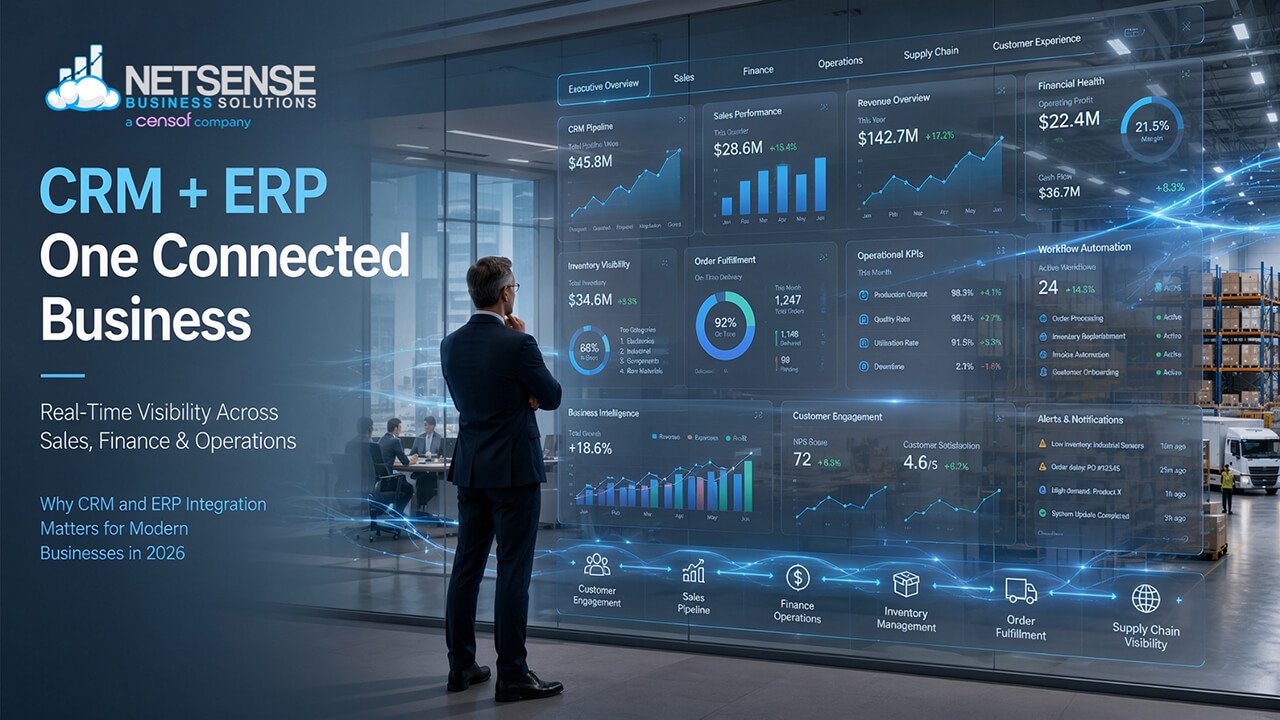
Visibility allows businesses to see how customer activities, operational processes, and financial performance are connected. Instead of viewing sales, inventory, finance, and customer service as separate functions, leaders gain a unified perspective of how each area impacts the others. Customer journey visibility helps organizations understand how prospects become customers and how customer relationships evolve over time. Operational visibility provides insight into inventory availability, order fulfillment, procurement activities, and resource allocation. Financial visibility enables management to monitor revenue, profitability, cash flow, and business performance with greater accuracy and confidence.
This level of transparency empowers decision-makers to move from reactive management to proactive leadership. Rather than waiting for issues to appear in monthly reports, executives can monitor sales performance, inventory positions, cash flow trends, and customer behavior in near real time. For example, management can quickly identify products experiencing increased demand, detect potential inventory shortages before they affect customers, or recognize emerging sales trends that require strategic attention. Because all departments operate within a connected data ecosystem, insights become more accurate, timely, and actionable.
Also Read: Acumatica vs SAP Business One: Which ERP Fits Growing Companies Better?
Ultimately, businesses do not integrate CRM and ERP systems simply to save time on administrative tasks. They integrate them to gain a clearer understanding of how the entire organization operates and performs. In an increasingly competitive and data-driven business environment, that visibility becomes a powerful competitive advantage. The real value of CRM and ERP integration is not automation—it is visibility.
How Modern Cloud ERP Platforms Simplify Integration
For many years, integrating business systems was often viewed as a complex and expensive undertaking. Traditional on-premises ERP solutions were typically built using rigid architectures that required extensive customization to connect with other applications. Businesses often relied on custom coding, third-party middleware, and lengthy implementation projects just to enable basic data exchange between systems. As a result, integration initiatives frequently involved significant costs, ongoing maintenance challenges, and long deployment timelines, making them difficult for many organizations to justify.
Modern cloud ERP platforms have fundamentally changed this landscape. Today’s cloud-based solutions are designed with connectivity in mind, making it significantly easier to integrate CRM, finance, operations, and other business applications. Through built-in APIs, integration frameworks, and cloud-native technologies, organizations can connect systems more efficiently while reducing complexity. Real-time data synchronization ensures that information flows seamlessly across departments, allowing businesses to operate with greater accuracy and agility. Compared to traditional approaches, cloud ERP integration projects can often be deployed faster and scaled more effectively as business needs evolve.
Another major advantage of modern cloud ERP platforms is their ability to support centralized workflows across the organization. Instead of managing disconnected processes in separate systems, businesses can create streamlined workflows that connect sales, customer service, finance, procurement, inventory, and operations. Cloud-native architecture enables users to access accurate information from anywhere while maintaining consistency across departments. Combined with workflow automation, these capabilities help eliminate manual tasks, reduce process bottlenecks, and improve collaboration throughout the organization.
As businesses continue to prioritize digital transformation and operational efficiency, selecting the right cloud ERP platform becomes increasingly important. Solutions designed around connectivity and scalability make it easier to build a truly integrated business environment where information flows freely and decisions can be made with confidence. This is one reason why many organizations are turning to modern cloud ERP platforms such as Acumatica, which are specifically designed to support connected operations, real-time visibility, and long-term business growth.
Why Acumatica Is Built for Connected Business Operations
As businesses grow, managing multiple disconnected systems becomes increasingly difficult. Information is often scattered across separate applications for sales, finance, inventory, customer service, and operations, creating inefficiencies that limit productivity and visibility. This is where modern cloud ERP platforms such as Acumatica play an important role. Designed specifically for today’s digital business environment, Acumatica provides a flexible and scalable cloud ERP platform that helps organizations unify critical business processes within a single ecosystem. Its modern architecture enables companies to adapt more easily to changing business requirements while supporting long-term growth.
One of Acumatica’s key strengths is its ability to centralize business data and connect workflows across departments. Instead of relying on separate systems that require constant manual updates, organizations can manage customer information, financial records, inventory data, purchasing activities, and operational processes from a connected platform. Acumatica also supports workflow automation, helping businesses reduce repetitive administrative tasks and improve process consistency. In addition, its CRM capabilities and integration options enable organizations to align customer-facing activities with back-office operations, creating a more seamless flow of information throughout the business.
Also Read: Key Features of Acumatica Field Service Edition for Modern Service Businesses
The business benefits of this connected approach extend far beyond operational efficiency. With centralized data and integrated workflows, decision-makers gain greater visibility into business performance across departments. Sales teams can access real-time inventory information, finance teams can monitor transactions more accurately, and management can evaluate performance using consistent and reliable data. Improved visibility supports faster decision-making, while stronger collaboration between departments helps eliminate communication gaps that often arise when teams work within isolated systems. The result is greater operational control and a more agile organization that can respond quickly to customer needs and market changes.
Perhaps most importantly, Acumatica helps businesses reduce the complexity that often accompanies growth. As organizations expand their customer base, product offerings, and operational processes, disconnected systems can create significant challenges that slow progress and increase costs. By providing a connected cloud ERP environment, Acumatica enables businesses to streamline operations, improve data accuracy, and establish a foundation for scalable growth. For organizations seeking to modernize their technology landscape and create a more connected business operation, Acumatica offers a practical and future-ready approach to enterprise management.
Why Malaysian Businesses Are Prioritising CRM and ERP Integration
Malaysia’s business landscape is becoming increasingly competitive as organizations accelerate their digital transformation initiatives. Companies across industries are investing in technology to improve efficiency, strengthen customer relationships, and gain greater control over their operations. At the same time, customers expect faster responses, better service experiences, and more accurate information. To remain competitive, businesses need systems that enable departments to work together seamlessly rather than operate in isolation. This growing demand for operational agility is one of the key reasons why CRM and ERP integration has become a strategic priority for many Malaysian organizations in 2026.
Despite ongoing digital transformation efforts, many businesses in Malaysia continue to face challenges caused by fragmented technology environments. It is not uncommon for organizations to rely on a combination of legacy systems, spreadsheets, and standalone applications that were implemented at different stages of growth. Sales teams may use one platform to manage customer relationships, while finance and operations teams depend on separate systems for accounting, inventory, and procurement. As a result, critical business information becomes scattered across multiple sources, making it difficult to maintain data consistency and gain a complete view of business performance. This fragmentation often leads to inefficiencies, reporting challenges, and unnecessary operational complexity.
As economic conditions continue to evolve, businesses are under increasing pressure to improve productivity while maintaining control over costs. CRM and ERP integration helps address these challenges by creating a connected environment where information flows automatically between departments. Organizations can reduce manual processes, eliminate duplicate data entry, and improve collaboration across teams. More importantly, integrated systems provide leadership with greater visibility into sales performance, customer activity, operational efficiency, and financial results. This level of transparency enables faster and more informed decision-making, helping businesses identify opportunities, respond to market changes, and allocate resources more effectively.
Also Read: Why Malaysian Businesses Are Replacing Legacy ERP Systems in 2026
Looking ahead, organizations that invest in connected business systems will be better positioned to support sustainable growth. As companies expand their customer base, introduce new products and services, or enter new markets, operational complexity naturally increases. Businesses that continue to rely on disconnected systems often struggle to scale efficiently, while those with integrated CRM and ERP environments can maintain visibility, streamline operations, and adapt more easily to changing business demands. For many Malaysian businesses, CRM and ERP integration is no longer simply a technology upgrade—it has become a critical foundation for long-term competitiveness, resilience, and growth.
Industries That Benefit Most from CRM and ERP Integration
While CRM and ERP integration delivers value across virtually every industry, certain sectors benefit particularly strongly due to the complexity of their operations, customer relationships, and supply chain requirements. For businesses that rely on accurate data, efficient workflows, and real-time visibility, integrating customer-facing processes with back-office operations can significantly improve performance and support long-term growth.
Manufacturing
Manufacturing companies operate in an environment where production planning, inventory management, procurement, and customer demand must remain closely aligned. When CRM and ERP systems are disconnected, production teams may lack visibility into upcoming sales opportunities, while sales teams may not have accurate information about inventory availability or production capacity.
By integrating CRM and ERP, manufacturers can improve coordination between sales and operations. Sales forecasts generated within the CRM system can help production teams anticipate future demand and plan manufacturing schedules more effectively. Real-time inventory synchronization ensures that stock levels remain accurate across departments, reducing the risk of overproduction, stock shortages, or delayed deliveries. In addition, access to consolidated business data enables more accurate demand forecasting, helping manufacturers optimize resource allocation and improve overall operational efficiency.
Distribution
Distribution businesses depend heavily on speed, accuracy, and visibility throughout the order fulfillment process. Managing customer orders, inventory levels, warehouse operations, and delivery schedules across disconnected systems often creates inefficiencies that impact customer satisfaction and profitability.
CRM and ERP integration helps distributors streamline operations by connecting sales activities directly with inventory and fulfillment processes. When customer orders are entered into the CRM system, information can automatically flow into the ERP platform for processing, inventory allocation, and invoicing. Warehouse teams gain real-time visibility into inventory availability, while sales representatives can provide customers with accurate updates on order status and delivery timelines. Improved inventory accuracy reduces fulfillment errors, minimizes stock discrepancies, and supports a more reliable customer experience throughout the distribution cycle.
Retail
Retail businesses face increasing pressure to deliver seamless customer experiences across both online and offline channels. Customers expect consistent service, accurate product availability, and personalized interactions regardless of how they choose to engage with a brand. Managing these expectations becomes difficult when customer data, sales transactions, and inventory information are stored in separate systems.
An integrated CRM and ERP environment helps retailers unify omnichannel operations by creating a centralized view of customers, products, and transactions. Sales and customer service teams can access valuable customer insights, including purchase history, preferences, and engagement patterns, enabling more personalized interactions and targeted marketing initiatives. At the same time, integrated inventory management provides real-time visibility into stock levels across stores, warehouses, and e-commerce channels, helping retailers reduce stockouts, improve fulfillment efficiency, and optimize inventory planning.
Professional Services
For professional services organizations such as consulting firms, engineering companies, IT service providers, and project-based businesses, success depends on effectively managing people, projects, and profitability. Disconnected systems can make it difficult to track project progress, allocate resources efficiently, and maintain visibility into financial performance.
CRM and ERP integration enables professional services firms to connect business development activities with project execution and financial management. Opportunities captured within the CRM system can seamlessly transition into active projects within the ERP environment, reducing administrative work and improving project visibility. Resource planning becomes more efficient as managers gain access to real-time information about staff availability, project workloads, and utilization rates. Additionally, integrated financial data supports more accurate profitability tracking, allowing organizations to evaluate project performance, manage costs, and make informed decisions that improve both operational efficiency and business outcomes.
Regardless of industry, the common benefit of CRM and ERP integration is the ability to create a connected business environment where information flows freely between departments. By eliminating data silos and improving visibility across operations, organizations can make faster decisions, enhance customer experiences, and build a stronger foundation for scalable growth.
Signs Your Business Needs CRM and ERP Integration
Many organizations assume their current systems are functioning adequately simply because daily operations continue without major disruptions. However, fragmented systems often create hidden inefficiencies that gradually affect productivity, decision-making, customer satisfaction, and business growth. These challenges may not be immediately visible, especially when employees have become accustomed to manual workarounds and disconnected processes. Over time, however, the cost of operating with siloed information becomes increasingly difficult to ignore.
If your business is experiencing any of the following challenges, it may be a strong indication that CRM and ERP integration should be a priority.
Customer Data Exists Across Multiple Systems
One of the clearest signs of disconnected business processes is when customer information is stored in multiple locations. Sales teams may maintain customer records in a CRM platform, while finance teams manage billing information in accounting software and customer service teams use separate support tools. When information is spread across different systems, employees often struggle to access a complete and accurate view of the customer. This fragmentation increases the risk of inconsistencies, duplicate records, and communication gaps that can negatively impact customer relationships.
Sales and Finance Teams Frequently Work with Different Data
When CRM and ERP systems are not integrated, sales and finance departments often rely on separate data sources. Sales teams may have different customer records, order information, or payment statuses than those available to finance teams. This lack of alignment can create confusion, delay order processing, and lead to inaccurate reporting. If employees regularly need to verify information with other departments before taking action, it is often a sign that critical business data is not properly connected.
Reporting Depends on Manual Spreadsheets
Many businesses continue to rely on spreadsheets to consolidate information from multiple systems. While spreadsheets can serve as temporary reporting tools, they often become a symptom of a larger problem when they are required to create routine business reports. Employees may spend hours collecting data from various applications, manually updating spreadsheets, and reconciling discrepancies before reports can be generated. This process not only consumes valuable time but also increases the likelihood of errors and delays in decision-making.
Customer Service Teams Struggle to Access Accurate Information
Providing excellent customer service becomes significantly more difficult when employees cannot access complete customer information quickly. If customer service representatives frequently need to contact other departments to check order status, payment history, inventory availability, or delivery updates, it indicates that information is not flowing efficiently across the organization. Integrated CRM and ERP systems help ensure that customer-facing teams have immediate access to the information they need to respond quickly and accurately.
Employees Repeatedly Enter the Same Data
Duplicate data entry is one of the most common signs of disconnected systems. When employees are required to enter customer information, sales orders, or transaction details into multiple applications, valuable time is lost on administrative work. In addition to reducing productivity, repeated data entry increases the risk of human error and creates inconsistencies between systems. Businesses seeking greater efficiency should aim to enter data once and allow it to flow automatically across relevant processes.
Order Fulfillment Processes Are Slow and Inefficient
Order fulfillment often requires coordination between sales, inventory, finance, procurement, and logistics teams. Without integrated systems, information must be manually shared between departments, creating delays and increasing the likelihood of mistakes. Businesses may experience slower order processing, inventory discrepancies, missed delivery commitments, or customer complaints. If fulfilling customer orders requires extensive manual coordination, CRM and ERP integration can help streamline the entire process and improve operational performance.
Limited Real-Time Visibility Across the Business
Perhaps the most significant warning sign is the inability to obtain a real-time view of business performance. Leadership teams need timely insights into sales activities, customer trends, operational efficiency, inventory levels, and financial results to make informed decisions. When information is scattered across disconnected systems, gaining this visibility becomes difficult and often requires manual reporting efforts. Organizations that lack real-time visibility are more likely to react to problems after they occur rather than proactively managing growth opportunities and operational risks.
The reality is that many businesses experience several of these challenges simultaneously without realizing they stem from the same root cause: disconnected systems. As organizations grow, these inefficiencies become more pronounced and increasingly costly. Integrating CRM and ERP systems helps eliminate information silos, improve collaboration, automate workflows, and provide the visibility needed to support smarter decision-making and sustainable business growth.
Frequently Asked Questions
Why integrate CRM and ERP?
CRM and ERP integration helps businesses connect customer-facing activities with core operational processes. Instead of managing customer data, sales information, inventory records, and financial transactions in separate systems, integration creates a unified flow of information across departments. This improves data accuracy, enhances collaboration, reduces manual work, and provides leadership with greater visibility into overall business performance.
What are the benefits of CRM and ERP integration?
The benefits of CRM and ERP integration extend beyond simple data sharing. Organizations can improve operational efficiency, reduce duplicate data entry, enhance customer experiences, increase reporting accuracy, and make better business decisions through real-time visibility. Integration also supports scalability by enabling businesses to manage growth without significantly increasing administrative complexity.
How does CRM and ERP integration improve customer experience?
When CRM and ERP systems are connected, employees gain access to a complete view of customer information, including purchase history, order status, payment records, and previous interactions. This enables sales and customer service teams to respond more quickly, provide more accurate information, and deliver a more personalized experience. Customers benefit from faster issue resolution, improved communication, and a smoother journey throughout their relationship with the business.
Can Acumatica integrate CRM and ERP in one platform?
Yes. Acumatica is designed as a modern cloud ERP platform that combines ERP functionality with integrated CRM capabilities. By centralizing customer, financial, operational, and inventory data within a connected environment, Acumatica helps organizations improve visibility, streamline workflows, and reduce the challenges associated with managing multiple disconnected systems.
Is CRM and ERP integration suitable for SMEs?
Absolutely. While large enterprises often benefit from integration due to their operational complexity, small and medium-sized businesses can also gain significant advantages. CRM and ERP integration helps SMEs improve efficiency, eliminate manual processes, enhance customer service, and establish scalable operational foundations that support future growth. In many cases, implementing integrated systems early can help businesses avoid costly inefficiencies as they expand.
How long does CRM and ERP integration take?
The timeline for CRM and ERP integration depends on several factors, including the complexity of existing systems, the number of business processes involved, customization requirements, and data migration needs. Some cloud-based integrations can be implemented within a few weeks, while larger projects involving multiple departments and extensive process redesign may take several months. Working with an experienced implementation partner can help ensure a smoother and more efficient deployment process.
What industries benefit most from CRM and ERP integration?
CRM and ERP integration provides value across many industries, but it is particularly beneficial for manufacturing, distribution, retail, professional services, wholesale trade, and project-based businesses. These industries often rely on close coordination between customer management, inventory control, finance, operations, and service delivery, making integrated systems especially valuable for improving visibility and operational efficiency.
Is cloud ERP better for CRM integration?
In many cases, yes. Modern cloud ERP platforms are typically designed with integration capabilities in mind, offering built-in APIs, real-time data synchronization, and flexible connectivity options. Compared to traditional legacy systems, cloud ERP solutions generally make it easier to connect business applications, automate workflows, and maintain a single source of truth across the organization. As a result, businesses can achieve faster implementation, greater scalability, and improved long-term agility.
By integrating CRM and ERP systems, organizations create a connected business environment that improves visibility, strengthens decision-making, and supports sustainable growth. As digital transformation continues to reshape the business landscape, integrated systems will remain a critical foundation for operational excellence and competitive advantage.
Key Takeaways
As businesses continue to navigate increasingly complex operational environments, the ability to connect systems and unify data has become a critical factor in achieving sustainable growth. CRM and ERP integration is no longer simply about improving software functionality—it is about creating a connected organization that can operate more efficiently, make better decisions, and deliver superior customer experiences.
The key takeaways from this article include:
- Disconnected data slows business growth by creating information silos, manual processes, and reporting challenges across departments.
- CRM and ERP integration creates a single source of truth, ensuring that teams work with accurate and consistent information throughout the organization.
- Integrated systems improve customer experience by providing employees with real-time access to customer, order, and operational data.
- Automation and workflow efficiency increase significantly when information flows seamlessly between sales, finance, inventory, and operations.
- Business visibility is the most valuable benefit of integration, enabling leaders to make faster and more informed decisions based on real-time insights.
- Modern cloud ERP platforms simplify integration through cloud-native architecture, API connectivity, and centralized workflows.
- Malaysian businesses are increasingly prioritising system integration as part of their digital transformation and operational modernization strategies.
- Platforms such as Acumatica provide a connected business environment that helps organizations improve collaboration, enhance operational control, and support long-term scalability.
- Integrated CRM and ERP systems create a stronger foundation for growth, allowing businesses to adapt more effectively to changing customer expectations and market demands.
Ultimately, businesses that connect their customer management and operational systems are better positioned to improve efficiency, strengthen decision-making, and build a more agile organization. In an increasingly data-driven economy, integrated business systems are becoming a fundamental requirement for companies seeking long-term competitiveness and sustainable growth.
Conclusion
In today’s fast-moving business environment, disconnected systems can create significant barriers to growth. When customer information, operational data, and financial records are spread across multiple platforms, organizations often face data silos, fragmented processes, and limited visibility into overall business performance. These challenges not only reduce productivity but also make it more difficult for leaders to make informed decisions, respond quickly to customer needs, and adapt to changing market conditions.
CRM and ERP integration addresses these challenges by creating a connected business environment where information flows seamlessly across departments. By unifying customer management, finance, inventory, operations, and reporting processes, businesses gain access to real-time information that improves collaboration, increases operational efficiency, and supports smarter decision-making. Instead of spending valuable time reconciling data from different systems, teams can focus on driving growth, improving customer experiences, and executing strategic initiatives with confidence.
As an official Acumatica Gold Partner, Netsense Business Solutions helps organizations build connected cloud ERP environments that unify customer management, operations, finance, and business intelligence. Whether you are looking to eliminate data silos, streamline workflows, or create a scalable foundation for future growth, our team can help you implement a solution tailored to your business needs. Explore how CRM and ERP integration can support your long-term growth strategy and accelerate your digital transformation journey.