
For many service-based businesses, growth creates a new set of operational challenges. What once worked with spreadsheets, phone calls, and manual scheduling quickly becomes difficult to manage as service requests increase, technician teams expand, and customer expectations continue to rise.
Service managers are expected to coordinate technicians, appointments, service contracts, spare parts, customer communications, and billing processes while maintaining high service quality and profitability. At the same time, operations leaders need real-time visibility into field activities to ensure resources are being utilized efficiently and customer commitments are being met.
Unfortunately, many organizations still operate with disconnected systems that make field service management unnecessarily complex. Scheduling may exist in one application, inventory data in another, customer records in a CRM, and financial information inside an accounting system. As a result, teams often struggle with scheduling conflicts, delayed invoicing, limited visibility, duplicate data entry, and inconsistent customer experiences.
Modern service organizations require more than standalone scheduling tools. They need a connected platform that brings together field operations, inventory, contracts, billing, customer information, and business reporting within a single system.
This is where Acumatica Field Service Edition delivers significant value. As part of Acumatica’s cloud ERP platform, it enables service businesses to manage the complete service lifecycle—from appointment scheduling and technician dispatching to inventory tracking, work order management, contract administration, and invoicing—all within a unified environment.
For Service Managers, Operations Managers, and Business Owners evaluating a field service ERP solution, understanding the key capabilities of Acumatica Field Service Edition is essential. In this article, we explore the features that help modern service organizations improve operational visibility, increase technician productivity, accelerate billing cycles, and create a more scalable service operation.
Table of contents
- Why Traditional Field Service Management Often Creates Operational Bottlenecks
- What Is Acumatica Field Service Edition?
- Key Features of Acumatica Field Service Edition
- Intelligent Appointment and Resource Scheduling
- Mobile Access for Field Technicians
- Service Order and Work Order Management
- Service Contract Management
- Integrated Billing and Invoicing
- Inventory and Spare Parts Management
- Expense Tracking and Cost Visibility
- Electronic Signature and Service Confirmation
- Real-Time Operational Visibility and Reporting
- Feature Summary: How Acumatica Field Service Supports Modern Service Businesses
- How Acumatica Field Service Creates Business Value
- Acumatica Field Service Feature Comparison
- Why Implementation Strategy Matters as Much as Software Selection
- How Netsense Business Solutions Helps Service Organizations Maximize Acumatica
- Is Acumatica Field Service Edition Right for Your Business?
- Do You Manage Field Technicians or Service Crews?
- Do You Provide Installation, Maintenance, Repair, or Inspection Services?
- Do You Operate Recurring Service Contracts?
- Do Your Technicians Need Mobile Access to Business Information?
- Do You Need Better Visibility into Inventory and Spare Parts?
- Do You Want to Connect Service Operations with ERP Processes?
- Quick Assessment Checklist
- Final Thoughts
- Frequently Asked Questions (FAQ)
Why Traditional Field Service Management Often Creates Operational Bottlenecks
Before exploring the capabilities of modern field service ERP solutions, it is important to understand why many service organizations struggle to maintain efficiency as they grow.
In the early stages of a business, managing service operations with spreadsheets, emails, phone calls, and manual processes may seem sufficient. However, as the number of customers, technicians, service requests, and service contracts increases, these disconnected approaches often create operational bottlenecks that limit productivity, profitability, and customer satisfaction.
For Service Managers, Operations Managers, and Business Owners, these challenges can quickly become barriers to sustainable growth.
Disconnected Scheduling Processes
Scheduling is at the heart of every service operation. Yet many organizations still rely on spreadsheets, whiteboards, emails, or standalone scheduling applications to coordinate technicians and appointments.
While these methods may work for a small team, they become increasingly difficult to manage as service demand grows. Dispatchers often spend significant time manually assigning jobs, checking technician availability, coordinating schedule changes, and responding to urgent customer requests.
Without a centralized scheduling system, organizations commonly experience:
- Appointment conflicts and double bookings
- Inefficient technician utilization
- Increased travel time between service calls
- Delayed response to urgent requests
- Reduced service capacity
As a result, service teams spend more time managing schedules and less time delivering value to customers.
Limited Visibility into Field Operations
One of the biggest challenges facing operations leaders is the lack of real-time visibility into what is happening in the field.
In many organizations, managers depend on phone calls, text messages, or end-of-day reports to understand job status and technician activities. This creates information gaps that make it difficult to identify issues before they impact customers.
Without real-time operational visibility, managers often struggle to answer critical questions such as:
- Which jobs are currently in progress?
- Which appointments have been completed?
- Are technicians running behind schedule?
- Are service-level commitments being met?
- What resources are required for upcoming work orders?
When accurate information is unavailable, decision-making becomes reactive rather than proactive, increasing operational risk and reducing service quality.
Delayed Billing and Revenue Recognition
Many service organizations continue to rely on paper forms, manual approvals, and disconnected billing processes after work has been completed.
Technicians may finish a job on-site, but service reports often need to be returned to the office, reviewed by administrative staff, and manually entered into accounting systems before invoices can be generated.
This process creates unnecessary delays between service delivery and revenue collection.
Common consequences include:
- Slower invoicing cycles
- Delayed cash flow
- Increased administrative workload
- Greater risk of billing errors
- Reduced financial visibility
For growing service businesses, these inefficiencies can directly affect profitability and working capital management.
Inventory and Spare Parts Challenges
Field service performance depends heavily on having the right parts available at the right time.
Unfortunately, many organizations manage inventory separately from service operations, creating limited visibility into stock availability and part usage. Technicians may arrive at customer sites only to discover that required components are unavailable, incorrectly allocated, or out of stock.
These situations often result in:
- Additional site visits
- Longer service resolution times
- Increased operational costs
- Emergency purchasing expenses
- Lower customer satisfaction
When inventory data is disconnected from field service activities, organizations lose the ability to plan resources effectively and maximize first-time fix rates.
Manual Processes Create Hidden Operational Costs
Beyond scheduling, billing, and inventory management, many service organizations continue to rely on manual administrative processes throughout the service lifecycle.
Technicians may complete paper-based work orders, supervisors may manually approve service reports, and office staff may spend hours re-entering information into multiple systems.
Although these activities may appear manageable individually, they collectively consume valuable time and introduce unnecessary risk.
Over time, manual processes contribute to:
- Data entry errors
- Duplicate work
- Slower decision-making
- Reduced employee productivity
- Limited operational scalability
As service volumes increase, these hidden inefficiencies become increasingly expensive.
Growing Service Businesses Need More Than Scheduling Software
While many organizations initially attempt to solve these challenges with standalone scheduling or dispatching tools, the underlying issue is often much broader.
Field service operations do not operate in isolation. Scheduling decisions affect inventory availability, service contracts influence billing, technician activities impact customer satisfaction, and operational performance ultimately affects financial results.
To achieve greater efficiency and visibility, modern service organizations require a connected platform that brings together field operations, inventory management, purchasing, customer information, service contracts, and financial processes within a single system.
This is why many growing service businesses are moving beyond standalone field service applications and adopting integrated ERP solutions that provide a complete view of their operations.
What Is Acumatica Field Service Edition?
After identifying the operational challenges that commonly affect service organizations, the next question becomes: what kind of solution is needed to overcome them?
While many businesses initially look for scheduling tools or standalone field service applications, these solutions often address only a portion of the problem. As organizations grow, they require a platform that not only manages field operations but also connects service activities with inventory, purchasing, customer information, financial management, and overall business performance.
This is where Acumatica Field Service Edition stands out.
Acumatica Field Service Edition is a cloud-based ERP solution designed to help service-centric organizations manage the complete service lifecycle from a single platform. It enables businesses to coordinate service requests, appointments, technicians, work orders, service contracts, inventory, billing, and customer interactions while maintaining real-time visibility across the organization.
Rather than operating as a separate field service application, Acumatica extends field operations into a fully connected business management environment. This allows service teams, office staff, finance departments, and business leaders to work from the same set of accurate, up-to-date information.
For organizations seeking to improve operational efficiency, increase technician productivity, and create a more scalable service model, Acumatica provides a unified foundation for growth.
A Cloud ERP Solution Built for Service-Centric Businesses
Many field service software solutions focus primarily on dispatching and scheduling. While these capabilities are important, they often leave organizations managing critical business processes in separate systems.
For example, a dispatcher may schedule appointments in one application, technicians may complete work orders in another, inventory may be managed separately, and invoices may be generated within an accounting platform. This fragmented approach creates information silos that limit visibility and increase administrative effort.
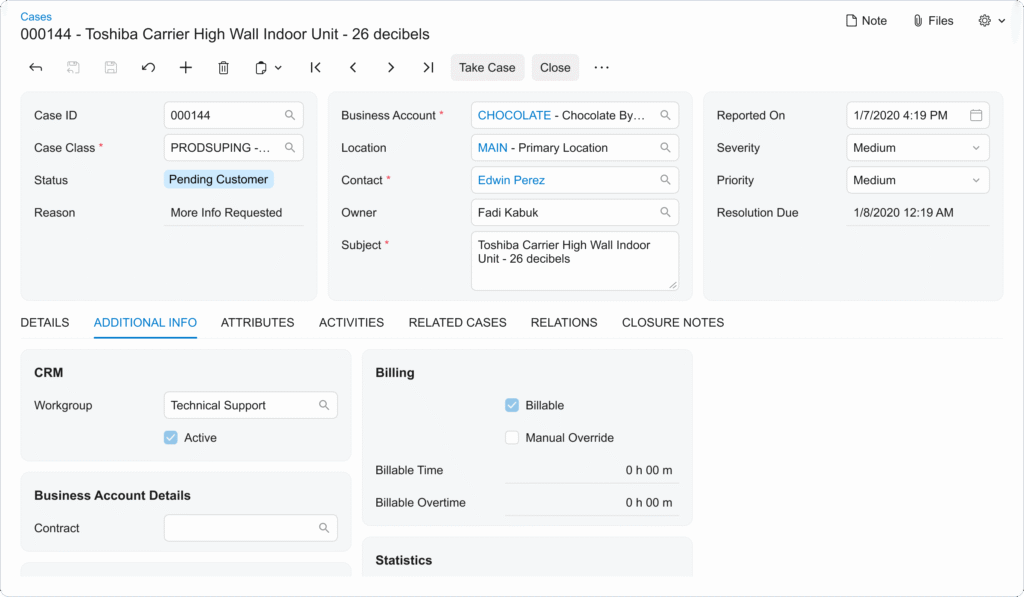
Acumatica Field Service Edition takes a different approach by bringing these processes together within a single cloud ERP platform.
Instead of simply managing appointments, organizations gain the ability to connect field service activities with:
- Customer records and service history
- Inventory and spare parts availability
- Purchasing and procurement processes
- Service contracts and warranties
- Financial management and billing
- Operational reporting and business analytics
This integrated structure enables organizations to make faster decisions, eliminate duplicate data entry, improve process consistency, and create a more connected service operation.
By centralizing operational and financial information, Acumatica helps businesses move beyond reactive service management and toward a more strategic, data-driven approach.
Designed for Growing and Distributed Service Teams
As service organizations expand, operational complexity increases significantly.
A business that once managed a small local team may eventually need to coordinate multiple technicians, service vehicles, regional territories, service-level agreements, recurring maintenance contracts, and growing customer expectations.
Without the right systems in place, growth can create inefficiencies that reduce profitability and negatively impact customer experience.
Acumatica Field Service Edition is designed to support organizations through this growth journey.
Whether a company manages a handful of technicians or a large distributed workforce, Acumatica provides a centralized environment that helps teams maintain control without increasing administrative complexity.
Service managers gain better visibility into technician availability and workload distribution. Operations leaders can monitor service performance in real time. Finance teams benefit from faster billing processes and improved financial accuracy. Business owners gain access to operational insights that support more informed decision-making.
Because Acumatica is built on a modern cloud platform, users can securely access information from virtually anywhere, enabling stronger collaboration between field teams and office personnel.
This flexibility makes Acumatica particularly valuable for organizations that operate across multiple service locations, support mobile workforces, or plan to scale their service operations over time.
Why Modern Service Businesses Are Moving Toward Integrated ERP Platforms
The role of field service has evolved significantly over the last decade.
Customers now expect faster response times, accurate scheduling, proactive communication, and consistent service experiences. At the same time, service organizations face increasing pressure to improve operational efficiency, control costs, and maintain profitability.
Meeting these expectations requires more than basic scheduling software.
Modern service businesses need real-time access to operational data, visibility across departments, and the ability to connect service activities with broader business processes.
This is why many organizations are adopting integrated ERP platforms such as Acumatica Field Service Edition.
By unifying scheduling, dispatching, inventory management, service contracts, work orders, billing, and reporting within a single system, organizations can improve efficiency, reduce operational friction, and build a service operation that is better equipped to support long-term growth.
The true value of Acumatica Field Service Edition lies not only in managing field activities but in creating a connected operational environment where people, processes, and information work together seamlessly.
Key Features of Acumatica Field Service Edition
The true value of a field service ERP solution is not determined by the number of features it offers, but by how effectively those capabilities help service organizations improve efficiency, visibility, customer satisfaction, and profitability.
Acumatica Field Service Edition was designed to support the complete service lifecycle, connecting field operations with inventory management, customer information, service contracts, billing, and financial processes within a single cloud ERP platform.
The following capabilities help modern service businesses gain greater control over their operations while creating a foundation for scalable growth.
Intelligent Appointment and Resource Scheduling
Efficient scheduling is one of the most important factors influencing service performance. Assigning the right technician, with the right skills and resources, to the right customer at the right time directly impacts customer satisfaction, technician productivity, and operational costs.
Acumatica Field Service Edition provides centralized scheduling capabilities that help dispatchers manage appointments, assign technicians, allocate equipment, and coordinate resources through a single platform.
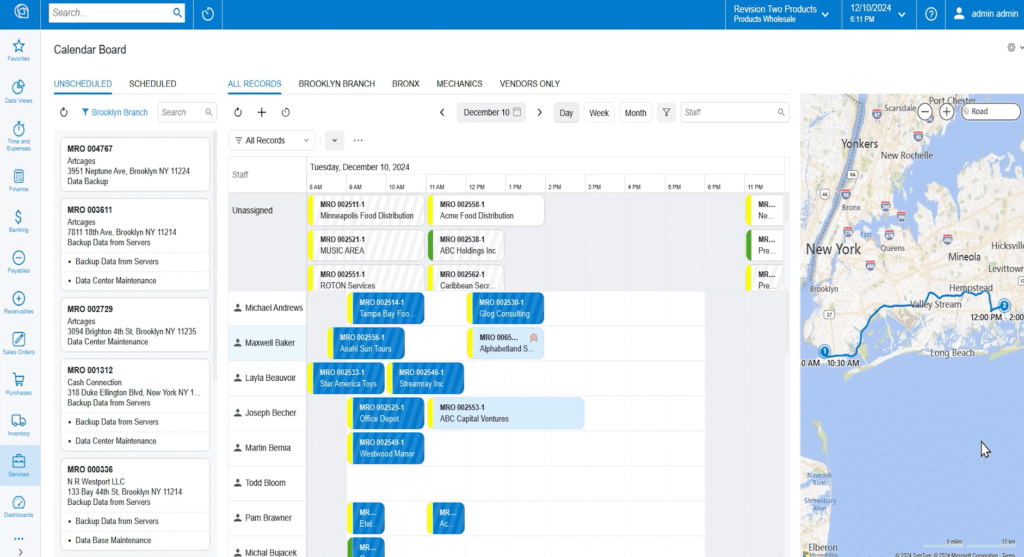
Rather than relying on spreadsheets or disconnected scheduling tools, service teams gain a real-time view of technician availability, workload distribution, and upcoming appointments.
Key Benefits
- Improve technician utilization rates
- Reduce scheduling conflicts
- Optimize resource allocation
- Increase service capacity
- Improve response times for customer requests
Business Impact
Better scheduling leads to more efficient field operations, lower travel costs, improved workforce productivity, and a more consistent customer experience.
Mobile Access for Field Technicians
Field technicians need immediate access to accurate information while performing service work. Delays caused by phone calls, paperwork, or disconnected systems can significantly reduce productivity and increase the likelihood of errors.
Acumatica provides mobile capabilities that allow technicians to access and update service information directly from the field using mobile devices.
Technicians can review appointments, view customer history, update work orders, record labor activities, capture photos, and communicate job status in real time.
Field Technicians Can
- Access customer and equipment information
- Review service history
- View assigned appointments
- Record labor and service activities
- Upload photos and supporting documentation
- Update work order status instantly
Business Impact
Real-time communication between field teams and office staff improves operational visibility, reduces administrative delays, and accelerates service completion processes.
Service Order and Work Order Management
As service operations grow, maintaining visibility across service requests becomes increasingly challenging.
Acumatica helps organizations manage the entire service workflow, from the initial customer request through appointment scheduling, technician assignment, service delivery, and work order completion.
This structured approach ensures that service activities remain organized, traceable, and measurable throughout the lifecycle of each customer engagement.
Key Benefits
- Centralized work order management
- Improved service tracking
- Better accountability across teams
- Reduced manual administration
- Faster issue resolution
Business Impact
Organizations gain greater control over service execution while reducing operational inefficiencies that often occur when work orders are managed manually.
Service Contract Management
Many service organizations generate recurring revenue through maintenance agreements, warranties, inspections, and long-term service contracts.
Managing these commitments manually can create compliance risks and increase administrative complexity.
Acumatica Field Service Edition enables organizations to manage service agreements from a centralized platform while maintaining visibility into contract obligations, service schedules, renewals, and customer commitments.
Common Service Contract Scenarios
- Preventive maintenance programs
- Annual maintenance agreements
- Equipment service contracts
- Warranty-based service commitments
- Subscription service models
Business Impact
Organizations can improve contract compliance, strengthen customer retention, and create more predictable recurring revenue streams.
Integrated Billing and Invoicing
One of the most common challenges in service organizations is the delay between work completion and invoice generation.
When technicians complete service activities but information remains disconnected from accounting systems, billing cycles become slower and administrative workloads increase.
Acumatica connects field service activities directly to financial processes, helping organizations generate invoices more quickly and accurately.
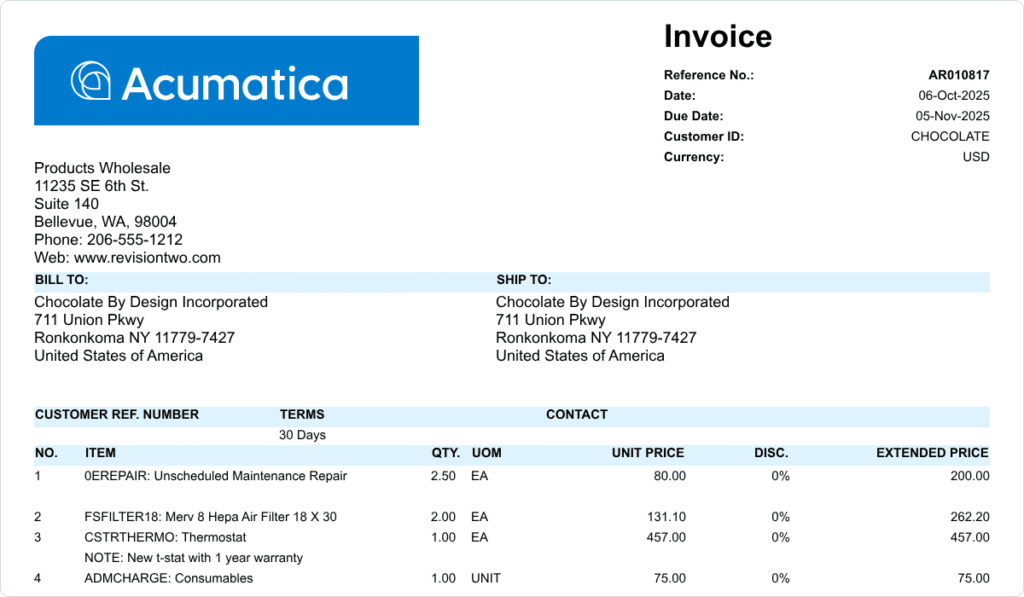
Because service data is captured within the ERP environment, billing information can flow seamlessly between operations and finance teams.
Key Benefits
- Faster invoice generation
- Improved billing accuracy
- Reduced manual data entry
- Better financial visibility
- Stronger cash flow management
Business Impact
Organizations can shorten revenue collection cycles while improving customer confidence in billing accuracy.
Inventory and Spare Parts Management
For many service businesses, successful service delivery depends on having the right parts available when technicians need them.
Acumatica integrates field service operations with inventory management, helping organizations maintain accurate visibility into stock levels, part availability, purchasing requirements, and inventory consumption.
This integration reduces the risk of arriving on-site without the necessary materials to complete the job.
Key Benefits
- Improved inventory accuracy
- Better spare parts availability
- Reduced stock shortages
- More efficient purchasing decisions
- Improved first-time fix rates
Business Impact
Organizations can reduce service delays, lower operational costs, and improve customer satisfaction by ensuring technicians have access to the resources they need.
Expense Tracking and Cost Visibility
Understanding service profitability requires accurate visibility into labor, travel expenses, materials, equipment usage, and other service-related costs.
Acumatica allows organizations to capture operational expenses directly within service workflows, providing a clearer picture of job-level and contract-level profitability.
This information helps managers identify opportunities to improve efficiency and protect margins.
Why It Matters
Without accurate cost tracking, organizations may underestimate service delivery costs and unknowingly operate unprofitable contracts or customer engagements.
Business Impact
Improved cost visibility supports better pricing decisions, stronger financial control, and more accurate profitability analysis.
Electronic Signature and Service Confirmation
Manual service confirmations often create delays, paperwork, and disputes regarding completed work.
Acumatica enables technicians to capture electronic signatures and customer approvals directly from the field, creating a digital record of completed service activities.
This documentation can be linked directly to service orders and billing processes.
Key Benefits
- Faster service completion workflows
- Improved documentation accuracy
- Better compliance and audit readiness
- Reduced customer disputes
- Improved customer experience
Business Impact
Organizations can accelerate work order closure while maintaining a clear and reliable record of customer approvals.
Real-Time Operational Visibility and Reporting
Service leaders require accurate information to make informed operational decisions.
Acumatica provides dashboards, reporting tools, and real-time visibility into service performance, helping managers monitor activities across technicians, service orders, appointments, inventory, and financial outcomes.
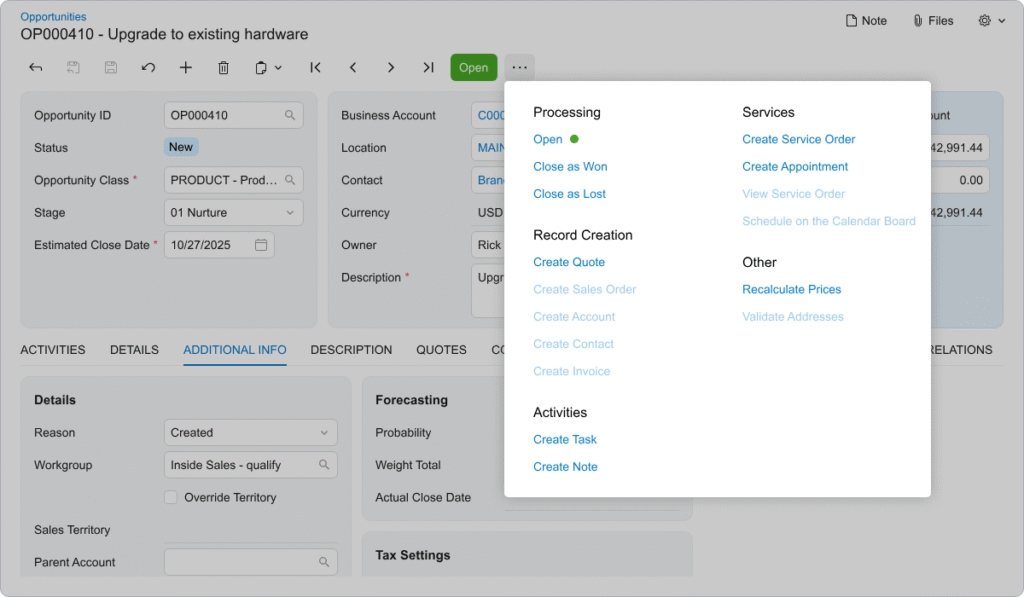
Rather than relying on manually compiled reports, decision-makers gain immediate access to operational insights.
Managers Can Monitor
- Open and completed work orders
- Technician utilization
- Appointment status
- Service response performance
- Inventory consumption
- Revenue and profitability metrics
Business Impact
Greater visibility enables faster decision-making, stronger operational control, and continuous performance improvement across the service organization.
Feature Summary: How Acumatica Field Service Supports Modern Service Businesses
| Capability | Operational Challenge Solved | Business Outcome |
|---|---|---|
| Appointment Scheduling | Inefficient dispatching and resource allocation | Higher technician productivity |
| Mobile Access | Limited field visibility and delayed communication | Faster service execution |
| Work Order Management | Manual service tracking | Improved operational control |
| Service Contracts | Difficulty managing recurring obligations | Better contract compliance |
| Billing & Invoicing | Slow revenue collection | Improved cash flow |
| Inventory Management | Spare parts shortages and stock visibility issues | Higher first-time fix rates |
| Expense Tracking | Limited profitability visibility | Better margin control |
| Electronic Signatures | Manual documentation processes | Faster work order closure |
| Real-Time Reporting | Delayed decision-making | Stronger operational visibility |
Collectively, these capabilities enable service organizations to move beyond reactive field service management and establish a more connected, scalable, and data-driven operating model. For businesses seeking a modern field service ERP platform, Acumatica Field Service Edition provides the tools needed to align field operations with broader business objectives.
How Acumatica Field Service Creates Business Value
Technology investments are ultimately evaluated based on business outcomes, not feature lists. While capabilities such as scheduling, mobile access, inventory management, and billing automation are important, their true value lies in how they help organizations improve operational performance, customer satisfaction, and profitability.
Acumatica Field Service Edition is designed to support multiple stakeholders across a service organization. From service managers responsible for daily execution to business owners focused on long-term growth, the platform helps align field operations with broader business objectives.
The following sections highlight how different leadership roles can benefit from a connected field service ERP platform.
For Service Managers
Service Managers are responsible for ensuring technicians are productive, customer commitments are met, and service operations run smoothly on a daily basis.
However, managing multiple technicians, service requests, emergency dispatches, and customer expectations can become increasingly difficult when information is spread across spreadsheets, emails, paper-based work orders, and disconnected systems.
Acumatica Field Service Edition helps Service Managers gain greater control over day-to-day service operations through centralized scheduling, real-time technician visibility, work order management, and mobile connectivity.
Key Benefits for Service Managers
- Improve technician scheduling accuracy
- Balance workloads more effectively
- Reduce appointment conflicts and delays
- Track service activities in real time
- Improve service delivery consistency
- Increase technician productivity
Because managers have access to current operational data, they can make faster decisions, respond more effectively to changing priorities, and maintain higher service quality standards.
Business Outcome
Service Managers can spend less time coordinating administrative tasks and more time optimizing service performance, improving customer satisfaction, and supporting team productivity.
For Operations Managers
Operations Managers focus on resource utilization, process efficiency, operational visibility, and organizational performance.
Without accurate real-time information, it becomes difficult to identify bottlenecks, allocate resources effectively, or maintain consistent service levels across teams and locations.
Acumatica Field Service Edition provides a connected operational environment where service activities, inventory usage, technician performance, customer commitments, and operational metrics can be monitored from a single platform.
This visibility allows Operations Managers to move beyond reactive problem-solving and adopt a more proactive approach to managing service operations.
Key Benefits for Operations Managers
- Gain real-time visibility into field activities
- Improve resource allocation and utilization
- Monitor service performance across teams
- Reduce operational bottlenecks
- Improve inventory coordination
- Strengthen service-level compliance
By connecting field operations with inventory, purchasing, contracts, and reporting, organizations can create more predictable and efficient service workflows.
Business Outcome
Operations Managers gain the insights needed to improve efficiency, reduce operational friction, and build scalable service processes that support business growth.
For Business Owners
Business Owners and executive leaders often evaluate service operations from a broader perspective.
While day-to-day activities are important, leadership teams are typically focused on profitability, customer retention, cash flow, operational scalability, and long-term growth.
Disconnected systems, delayed billing, limited visibility, and inefficient service processes can create hidden costs that negatively impact business performance.
Acumatica Field Service Edition helps business leaders connect operational activities with financial outcomes, providing greater visibility into the overall health of the service organization.
Because service operations, inventory management, customer information, contracts, and billing processes are connected within a single ERP platform, decision-makers gain a clearer understanding of performance across the business.
Key Benefits for Business Owners
- Improve financial visibility
- Accelerate billing and revenue collection
- Increase operational efficiency
- Support business scalability
- Strengthen customer satisfaction and retention
- Improve decision-making with real-time data
As service volumes increase, organizations can continue growing without relying on additional administrative complexity or disconnected systems.
Business Outcome
Business Owners gain greater confidence in their ability to scale operations, improve profitability, enhance customer experiences, and maximize return on technology investments.
Business Value Summary
The benefits of Acumatica Field Service Edition extend beyond individual departments. By connecting scheduling, field operations, inventory, service contracts, billing, and reporting within a unified ERP platform, organizations can create a more efficient and scalable service operation.
The result is improved visibility, stronger operational control, faster decision-making, and a better customer experience across the entire service lifecycle.
| Role | Primary Challenge | How Acumatica Helps | Business Value |
|---|---|---|---|
| Service Manager | Scheduling complexity and technician coordination | Centralized scheduling, work orders, mobile access | Higher productivity and service consistency |
| Operations Manager | Limited visibility and operational inefficiencies | Real-time monitoring and resource management | Improved efficiency and process control |
| Business Owner | Profitability, scalability, and financial visibility | Integrated ERP and service management | Stronger growth, profitability, and customer retention |
Ultimately, Acumatica Field Service Edition helps service organizations align people, processes, and technology within a single connected environment, enabling teams at every level to make better decisions and deliver better service outcomes.
Acumatica Field Service Feature Comparison
Choosing a field service solution is not simply about evaluating software features. Service organizations need to understand how different approaches affect operational efficiency, customer service, visibility, and long-term scalability.
Many businesses initially rely on spreadsheets, paper-based processes, standalone scheduling applications, or disconnected systems to manage field operations. While these approaches may be sufficient during the early stages of growth, they often become increasingly difficult to manage as service volumes expand.
The following comparison highlights how Acumatica Field Service Edition helps address common operational challenges faced by modern service organizations.
| Operational Area | Traditional Approach | Acumatica Field Service Edition | Business Impact |
|---|---|---|---|
| Appointment Scheduling | Spreadsheets, phone calls, emails, or separate scheduling tools | Centralized scheduling with real-time technician and resource visibility | Improved technician utilization and faster response times |
| Technician Mobility | Limited access to customer and job information while in the field | Mobile access to appointments, customer history, work orders, and updates | Increased productivity and improved field communication |
| Work Order Management | Paper-based work orders or disconnected applications | Digital work order management within a unified ERP platform | Better service tracking and reduced administrative workload |
| Service Contract Management | Manual tracking of maintenance agreements and renewals | Centralized contract management and service scheduling | Improved compliance and recurring revenue management |
| Inventory Visibility | Separate inventory systems with limited field visibility | Real-time integration between field operations and inventory management | Reduced stock shortages and higher first-time fix rates |
| Billing and Invoicing | Manual invoice preparation after service completion | Connected workflows between service operations and financial management | Faster billing cycles and improved cash flow |
| Expense Tracking | Separate spreadsheets and manual cost reconciliation | Direct expense capture within service workflows | Improved profitability visibility and cost control |
| Customer Approvals | Paper-based signatures and service reports | Electronic signature capture and digital service confirmation | Faster work order closure and reduced disputes |
| Reporting and Analytics | Manually compiled reports from multiple systems | Real-time dashboards and operational reporting | Faster decision-making and improved operational visibility |
| ERP Integration | Disconnected applications and duplicate data entry | Unified platform connecting service, inventory, purchasing, and finance | Greater efficiency and enterprise-wide visibility |
Why This Difference Matters
The gap between traditional field service management and an integrated ERP-driven approach becomes increasingly significant as organizations grow.
When scheduling, inventory management, billing, service contracts, customer information, and reporting operate in separate systems, employees spend considerable time searching for information, reconciling data, and manually coordinating activities. These inefficiencies often result in slower service delivery, higher operating costs, delayed invoicing, and limited visibility into overall business performance.
Acumatica Field Service Edition addresses these challenges by connecting operational and financial processes within a single platform. Instead of managing service activities in isolation, organizations gain a comprehensive view of customers, technicians, inventory, contracts, and financial outcomes in real time.
Key Takeaway for Service Leaders
For Service Managers, Operations Managers, and Business Owners, the objective is not simply to digitize existing processes. The goal is to create a more connected, efficient, and scalable service organization.
By combining scheduling, mobile field service capabilities, inventory management, service contracts, billing, reporting, and ERP integration within one platform, Acumatica Field Service Edition helps organizations move beyond reactive service management and establish a stronger foundation for long-term growth.
The result is improved operational visibility, greater workforce productivity, faster revenue recognition, and a better customer experience across the entire service lifecycle.
Why Implementation Strategy Matters as Much as Software Selection
Selecting the right ERP platform is an important decision, but software alone does not guarantee business success.
Many organizations invest significant time evaluating features, comparing vendors, and assessing technology capabilities. While these factors are certainly important, they represent only one part of a successful ERP transformation initiative.
In reality, many ERP projects fail to achieve their intended objectives not because the software lacks functionality, but because organizations underestimate the importance of implementation strategy, process alignment, user adoption, data readiness, and change management.
For service organizations, these factors become even more critical because field operations involve multiple stakeholders, including service managers, dispatchers, technicians, inventory personnel, finance teams, and business leaders.
To maximize the value of Acumatica Field Service Edition, organizations must ensure that technology, processes, and people work together effectively.
Aligning Technology with Operational Processes
One of the most common ERP implementation mistakes is attempting to deploy new technology without first understanding how the business actually operates.
Service organizations often have unique workflows related to scheduling, dispatching, inventory management, preventive maintenance, service contracts, work order approvals, and billing processes.
If these workflows are not properly mapped and aligned during implementation, employees may struggle to use the system effectively, resulting in process inefficiencies and reduced adoption.
A successful implementation begins by evaluating existing operational processes and identifying opportunities for improvement.
This approach helps organizations avoid simply transferring inefficient manual processes into a digital environment. Instead, they can redesign workflows to take full advantage of automation, real-time visibility, and integrated business processes.
Key Considerations
- How service requests are created and assigned
- How technicians receive and complete work orders
- How inventory is allocated and consumed
- How service contracts are managed
- How billing information flows into finance processes
- How performance metrics are tracked and reported
When technology is aligned with operational requirements, organizations can achieve greater efficiency, consistency, and long-term scalability.
Business Outcome
Organizations gain a system that supports how their teams actually work rather than forcing employees to adapt to disconnected or inefficient processes.
Ensuring Adoption Across Field and Office Teams
Even the most advanced ERP solution delivers little value if employees do not actively use it.
User adoption is one of the most important factors influencing ERP success, particularly within service organizations where field technicians and office personnel often work in very different environments.
Field technicians need tools that are intuitive, mobile-friendly, and capable of supporting daily activities without creating additional administrative burdens. Office teams require visibility, reporting, and workflow management capabilities that support operational decision-making.
Without proper training, communication, and change management, employees may continue relying on spreadsheets, emails, paper-based records, or informal workarounds.
This reduces data quality, limits visibility, and prevents organizations from realizing the full benefits of their ERP investment.
Best Practices for Strong Adoption
- Involve key stakeholders early in the project
- Define clear business objectives
- Provide role-specific training programs
- Establish standardized workflows
- Encourage continuous feedback from users
- Monitor adoption and performance metrics after go-live
Organizations that prioritize user adoption typically achieve faster implementation success and stronger long-term outcomes.
Business Outcome
Higher user adoption leads to more accurate data, better operational visibility, improved collaboration, and a faster return on ERP investment.
Building a Scalable Service Operation
Many organizations initially invest in technology to solve immediate operational challenges. However, the most successful ERP implementations look beyond current needs and focus on future growth.
As service businesses expand, they often face increasing complexity related to workforce management, customer demands, inventory requirements, service contracts, compliance obligations, and financial reporting.
Systems that work well today may become operational constraints tomorrow.
Acumatica Field Service Edition provides a scalable platform that allows organizations to support growth without continually adding disconnected applications or manual processes.
However, scalability requires more than software functionality. It requires a clear implementation strategy that anticipates future business requirements and establishes a foundation for long-term operational excellence.
Organizations should evaluate questions such as:
- How will service volumes change over the next five years?
- Will additional technicians or service locations be added?
- Will new service offerings be introduced?
- Will reporting and compliance requirements increase?
- How will customer expectations continue to evolve?
By considering these factors during implementation, organizations can create a system architecture that supports growth while maintaining efficiency and control.
Business Outcome
A scalable implementation strategy enables organizations to expand operations, improve service delivery, and support long-term business growth without repeatedly redesigning core processes.
ERP Success Requires More Than Technology
The most successful service organizations recognize that ERP implementation is not simply a software deployment project. It is an operational transformation initiative that affects people, processes, and business performance.
While Acumatica Field Service Edition provides the technology foundation, achieving measurable business results requires careful planning, workflow optimization, user adoption, training, and long-term support.
Organizations that take a strategic approach to implementation are better positioned to improve efficiency, increase visibility, accelerate growth, and maximize the value of their ERP investment.
This is why choosing the right implementation partner can be just as important as selecting the right ERP platform itself.
How Netsense Business Solutions Helps Service Organizations Maximize Acumatica
Selecting the right ERP platform is only the first step toward improving service operations. The long-term value of an ERP investment depends heavily on how well the solution is implemented, adopted, integrated, and aligned with business objectives.
For service organizations, implementation can be particularly complex because field service operations often involve multiple departments, workflows, and stakeholders. Scheduling, dispatching, inventory management, service contracts, customer service, finance, and reporting must all work together seamlessly to support efficient service delivery.
This is why many organizations choose to work with an experienced implementation partner that understands both the technology and the operational realities of running a service business.
Netsense Business Solutions helps organizations successfully implement Acumatica by combining ERP expertise with a practical understanding of business processes, operational requirements, and long-term growth objectives.
Rather than treating ERP implementation as a software deployment project, Netsense focuses on helping organizations build a connected and scalable operational environment that supports measurable business outcomes.
Understanding Service Business Requirements
Every service organization operates differently.
Some businesses focus on equipment maintenance and preventive service programs, while others manage installation projects, field repairs, inspections, technical support, or long-term service contracts. Each model introduces unique operational requirements that influence how an ERP system should be configured and deployed.
Before implementation begins, Netsense works closely with stakeholders to understand existing processes, operational challenges, reporting requirements, and growth objectives.
This discovery-driven approach helps ensure that Acumatica is configured to support the way the business operates rather than forcing teams to adapt to unnecessary complexity.
Areas Typically Evaluated
- Service request management
- Scheduling and dispatch workflows
- Technician productivity requirements
- Service contract administration
- Inventory and spare parts management
- Billing and invoicing processes
- Reporting and management visibility
Business Outcome
Organizations gain an implementation strategy that reflects their operational realities and business priorities.
Optimizing Workflows Across Departments
One of the greatest advantages of Acumatica is its ability to connect multiple business functions within a unified platform.
However, realizing this value requires careful workflow design.
Netsense helps organizations identify opportunities to streamline processes, eliminate manual activities, reduce duplicate data entry, and improve information flow between departments.
By aligning service operations with inventory management, purchasing, customer management, and financial processes, organizations can create a more efficient and connected operating model.
Potential Areas for Optimization
- Service-to-billing workflows
- Work order management processes
- Inventory allocation and replenishment
- Customer communication workflows
- Contract management procedures
- Approval and reporting processes
Business Outcome
Improved process efficiency, reduced administrative workload, and greater operational consistency across the organization.
Supporting System Integration and Data Connectivity
Modern service businesses often rely on multiple systems to support operations.
Customer information, financial records, inventory data, business intelligence tools, and third-party applications may all play an important role in day-to-day activities.
To maximize visibility and operational efficiency, these systems must work together effectively.
Netsense helps organizations evaluate integration requirements and establish data flows that support business processes while reducing information silos.
A connected technology environment helps ensure that employees have access to accurate information when they need it, regardless of department or function.
Business Outcome
Better visibility, improved data accuracy, and more efficient cross-functional collaboration.
Driving User Adoption and Long-Term Success
Technology alone does not create business value.
The success of any ERP initiative ultimately depends on how effectively employees adopt and use the system.
Netsense supports organizations through training, knowledge transfer, process guidance, and post-implementation support to help users gain confidence and maximize the capabilities of Acumatica.
By focusing on adoption from the beginning, organizations can reduce resistance to change and accelerate the realization of business benefits.
Key Focus Areas
- User training
- Change management support
- Process standardization
- Knowledge transfer
- Ongoing system guidance
Business Outcome
Higher adoption rates, improved data quality, and faster realization of ERP value.
Supporting Growth Beyond Initial Implementation
ERP implementation should not be viewed as a one-time technology project.
As service organizations grow, operational requirements evolve. New service offerings, additional locations, larger technician teams, changing customer expectations, and increased reporting requirements can all create new challenges.
Netsense helps organizations continuously align Acumatica with business growth strategies, ensuring the platform remains capable of supporting future operational and financial requirements.
This long-term perspective helps organizations protect their ERP investment while maintaining scalability and operational control.
Business Outcome
A future-ready ERP environment that supports sustainable business growth and operational excellence.
Why the Right Acumatica Partner Matters
Acumatica provides a powerful foundation for managing modern service operations. However, achieving measurable business outcomes requires more than software functionality alone.
Successful organizations need an implementation partner that understands how technology, processes, people, and business objectives interact.
By helping organizations evaluate requirements, optimize workflows, support adoption, and align Acumatica with long-term business goals, Netsense Business Solutions helps service organizations maximize the value of their ERP investment.
The result is a more connected, efficient, and scalable service operation that is better equipped to meet customer expectations and support future growth.
Is Acumatica Field Service Edition Right for Your Business?
Not every organization requires a dedicated field service ERP solution. However, as service operations become more complex, many businesses reach a point where spreadsheets, disconnected applications, manual workflows, and standalone scheduling tools are no longer sufficient.
The challenge is not simply managing more service requests. It is maintaining operational visibility, service quality, profitability, and customer satisfaction while continuing to scale.
Acumatica Field Service Edition is designed to help organizations overcome these challenges by connecting field operations with inventory management, service contracts, billing, customer information, and broader ERP processes within a single cloud platform.
The following questions can help determine whether Acumatica Field Service Edition may be a suitable fit for your organization.
Do You Manage Field Technicians or Service Crews?
Organizations that deploy technicians, engineers, inspectors, installers, maintenance teams, or service crews often struggle with scheduling coordination, resource allocation, and real-time visibility.
As the workforce grows, manual scheduling methods can create inefficiencies that impact service delivery and customer satisfaction.
If your organization manages field personnel across multiple locations, customer sites, or service territories, a centralized field service management platform can help improve coordination and operational control.
Typical Examples
- Equipment maintenance providers
- Industrial service companies
- Technical support organizations
- Utility and infrastructure service providers
- Building maintenance contractors
- HVAC service companies
- Electrical and mechanical service providers
Do You Provide Installation, Maintenance, Repair, or Inspection Services?
Businesses that deliver services at customer locations often require detailed scheduling, work order management, technician tracking, service history visibility, and customer documentation.
When these activities are managed through disconnected systems, it becomes difficult to maintain consistency and efficiency.
Acumatica Field Service Edition helps organizations manage the complete service lifecycle from the initial service request through completion and invoicing.
You May Benefit If Your Business Provides
- Equipment installation services
- Preventive maintenance programs
- Repair and troubleshooting services
- Inspection and compliance services
- Asset maintenance services
- On-site technical support
Do You Operate Recurring Service Contracts?
Recurring service agreements often represent a significant source of revenue for service organizations.
However, managing maintenance schedules, contract obligations, renewals, warranties, and customer commitments manually can become increasingly difficult as the customer base grows.
If your business relies on recurring service contracts, preventive maintenance programs, or long-term customer agreements, Acumatica can help centralize and automate contract-related activities.
Common Scenarios
- Annual maintenance agreements
- Preventive maintenance schedules
- Warranty service programs
- Equipment support contracts
- Subscription-based service models
Do Your Technicians Need Mobile Access to Business Information?
Field personnel often require immediate access to customer records, equipment history, service instructions, inventory availability, and work order details.
Without mobile access, technicians may rely on phone calls, emails, printed documents, or manual updates that slow service delivery and create communication gaps.
Acumatica’s mobile capabilities help field teams stay connected to operational information regardless of location.
Indicators That Mobile ERP Access Is Important
- Technicians frequently work off-site
- Service updates are delayed
- Field teams require access to customer history
- Managers need real-time visibility into job progress
- Documentation is still handled manually
Do You Need Better Visibility into Inventory and Spare Parts?
Inventory availability plays a critical role in service performance.
When technicians arrive on-site without the required parts, organizations often face additional travel costs, delayed repairs, and dissatisfied customers.
If inventory data is disconnected from field service activities, maintaining accurate stock visibility becomes increasingly difficult.
Acumatica helps connect service operations with inventory management, allowing organizations to improve planning, reduce shortages, and support higher first-time fix rates.
Warning Signs
- Frequent stock shortages
- Emergency purchasing requirements
- Limited visibility into inventory levels
- Excessive spare parts carrying costs
- Multiple visits required to complete service work
Do You Want to Connect Service Operations with ERP Processes?
Many service organizations operate using separate systems for scheduling, inventory management, accounting, customer information, and reporting.
While these systems may function independently, they often create information silos that limit visibility and increase administrative effort.
Organizations seeking a more connected operational environment can benefit from a platform that brings together field service management, inventory, purchasing, finance, and reporting within a unified ERP solution.
This is where Acumatica Field Service Edition provides significant value.
Benefits of an Integrated ERP Approach
- Reduced duplicate data entry
- Improved operational visibility
- Better financial accuracy
- Faster billing processes
- Stronger reporting capabilities
- More informed decision-making
Quick Assessment Checklist
Your organization may be a strong candidate for Acumatica Field Service Edition if you answer “Yes” to several of the following questions:
| Evaluation Question | Yes / No |
|---|---|
| Do you manage field technicians or service teams? | □ |
| Do you provide installation, maintenance, repair, or inspection services? | □ |
| Do you operate recurring service contracts? | □ |
| Do technicians require mobile access to operational information? | □ |
| Do inventory and spare parts impact service delivery? | □ |
| Do you experience scheduling challenges? | □ |
| Is billing often delayed after service completion? | □ |
| Do you rely on multiple disconnected systems? | □ |
| Do you need better visibility into service performance? | □ |
| Are you looking to scale service operations efficiently? | □ |
If you answered “Yes” to several of these questions, your organization may benefit from a modern field service ERP platform such as Acumatica Field Service Edition.
Final Thoughts
As customer expectations continue to rise and service operations become more complex, organizations need more than scheduling tools or standalone service applications. They need a connected platform that supports visibility, efficiency, scalability, and informed decision-making across the entire service lifecycle.
Acumatica Field Service Edition helps organizations bring together field operations, inventory management, service contracts, billing, customer information, and reporting within a single cloud ERP environment.
For businesses seeking to improve operational performance and prepare for future growth, evaluating a modern field service ERP solution may be the next logical step.
If your organization is exploring Acumatica Field Service Edition, working with an experienced implementation partner such as Netsense Business Solutions can help ensure the platform is aligned with your operational requirements, growth objectives, and long-term business goals.
Frequently Asked Questions (FAQ)
What is Acumatica Field Service Edition?
Acumatica Field Service Edition is a cloud-based ERP solution designed to help service organizations manage scheduling, dispatching, work orders, field technicians, service contracts, inventory, billing, and customer interactions within a unified platform. By connecting field operations with broader business processes, organizations can improve visibility, efficiency, and service delivery performance.
What types of businesses can benefit from Acumatica Field Service Edition?
Acumatica Field Service Edition is particularly suitable for organizations that provide installation, maintenance, repair, inspection, technical support, or preventive maintenance services.
Industries that commonly benefit include:
- Equipment maintenance providers
- HVAC service companies
- Electrical and mechanical contractors
- Building maintenance organizations
- Industrial service providers
- Utility and infrastructure service companies
- Field engineering and technical support businesses
How does Acumatica improve field service scheduling?
Acumatica helps organizations manage appointments, technicians, equipment, and resources through centralized scheduling tools.
Instead of relying on spreadsheets or disconnected systems, dispatchers can view technician availability, assign resources more effectively, and respond to service requests with greater efficiency.
This helps reduce scheduling conflicts, improve technician utilization, and increase service responsiveness.
Does Acumatica provide mobile access for field technicians?
Yes.
Acumatica includes mobile capabilities that allow field technicians to access appointments, customer information, service history, work orders, inventory details, and job updates directly from mobile devices.
Technicians can also update work orders, record labor activities, upload photos, and capture customer signatures while working in the field.
Can Acumatica manage work orders and service requests?
Yes.
Acumatica Field Service Edition provides end-to-end work order management capabilities that help organizations track service requests from initial customer contact through scheduling, execution, completion, and invoicing.
This helps improve accountability, operational visibility, and service consistency.
Does Acumatica support preventive maintenance programs?
Yes.
Organizations can use Acumatica to manage recurring maintenance schedules, preventive maintenance activities, inspections, and long-term service agreements.
This helps ensure maintenance commitments are completed on time while improving asset reliability and customer satisfaction.
Can Acumatica manage service contracts and maintenance agreements?
Yes.
Acumatica supports service contracts, maintenance agreements, warranties, recurring service schedules, and contract-based service operations.
Organizations can centralize contract information and improve visibility into customer commitments, renewals, and scheduled service activities.
How does Acumatica improve inventory management for field service operations?
Acumatica connects field service activities with inventory management processes, helping organizations maintain visibility into stock levels, spare parts availability, inventory consumption, and purchasing requirements.
This integration helps reduce stock shortages, improve planning accuracy, and increase first-time fix rates.
How does Acumatica improve billing and invoicing?
Acumatica links service activities directly to financial processes.
When work orders, labor activities, expenses, and materials are recorded within the system, organizations can generate invoices more efficiently and accurately.
This helps reduce billing delays, improve cash flow, and minimize manual data entry.
Does Acumatica support electronic signatures?
Yes.
Field technicians can capture customer approvals and electronic signatures directly from mobile devices while completing service activities.
This creates a digital record of completed work and helps improve documentation accuracy while reducing administrative effort.
Can Acumatica integrate field service operations with ERP processes?
Yes.
One of Acumatica’s key advantages is its ability to connect field service management with inventory, purchasing, finance, customer management, reporting, and other ERP functions within a unified platform.
This eliminates many of the information silos commonly found in service organizations.
What are the benefits of using a field service ERP instead of standalone scheduling software?
While standalone scheduling tools can help coordinate appointments, they often operate separately from inventory management, accounting, customer records, and reporting systems.
A field service ERP platform such as Acumatica provides a connected environment where operational and financial processes work together, improving visibility, efficiency, and decision-making.
Is Acumatica suitable for growing service businesses?
Yes.
Acumatica is designed to support organizations as they scale. Whether managing a small service team or a large distributed workforce, businesses can maintain operational visibility and control while supporting future growth.
Because Acumatica is cloud-based, organizations can expand operations without relying on disconnected systems or extensive manual processes.
How long does an Acumatica Field Service implementation typically take?
Implementation timelines vary depending on factors such as business complexity, process requirements, integration needs, data migration scope, and user adoption planning.
A structured implementation approach that includes process analysis, configuration, training, and testing is essential for long-term success.
Why is choosing the right Acumatica implementation partner important?
The success of an ERP project depends not only on software capabilities but also on implementation quality.
An experienced implementation partner can help organizations align Acumatica with business processes, optimize workflows, support user adoption, manage integrations, and ensure the platform delivers measurable business value.
How can Netsense Business Solutions help with Acumatica Field Service implementation?
Netsense Business Solutions helps organizations evaluate requirements, optimize service workflows, implement Acumatica, support system integrations, train users, and provide ongoing guidance after deployment.
By aligning technology with operational objectives, Netsense helps service organizations maximize the value of their Acumatica investment and build a scalable foundation for future growth.