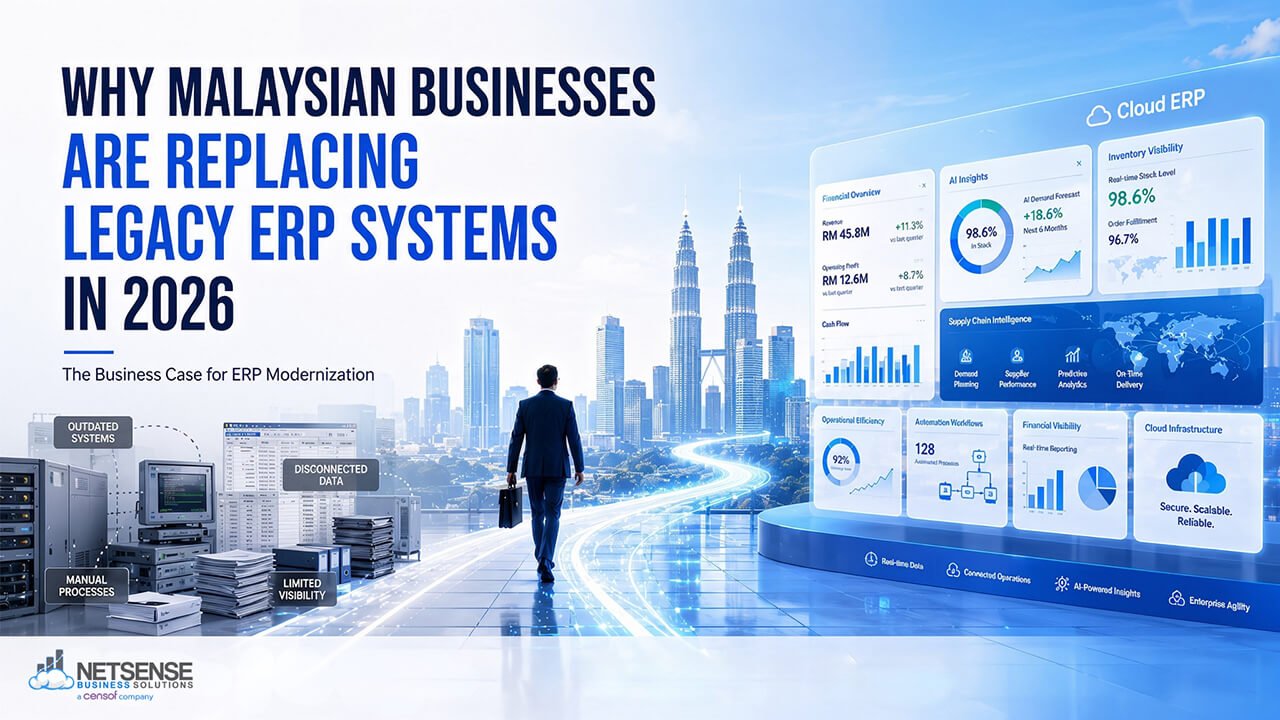
For many Malaysian businesses, ERP systems implemented 10 to 20 years ago were once considered strategic investments that helped centralize operations, improve financial control, and support business growth. However, as markets become more competitive and digital transformation accelerates, many of these legacy ERP systems are no longer equipped to meet modern business requirements.
What was once a business enabler is increasingly becoming a barrier to efficiency, agility, and growth. Organizations relying on outdated ERP platforms often face challenges such as fragmented data across departments, slow reporting processes, limited integration capabilities, rising maintenance costs, and difficulties supporting remote or multi-location operations. As a result, decision-makers frequently struggle to access accurate real-time information needed to respond quickly to changing market conditions.
This challenge is becoming more significant as Malaysian businesses embrace cloud technologies, automation, artificial intelligence, and data-driven decision-making. At the same time, evolving regulatory requirements, including Malaysia’s e-Invoicing initiative, are placing additional pressure on organizations to modernize their technology infrastructure and improve compliance readiness.
For CFOs and COOs, the discussion is no longer simply about upgrading software. It is about ensuring the organization has the visibility, scalability, and operational resilience needed to support future growth. Continuing to maintain an outdated ERP system may appear less disruptive in the short term, but the hidden costs of inefficiency, manual processes, limited reporting, and increased business risk can become substantial over time.
This is why many Malaysian companies are actively evaluating legacy ERP replacement strategies in 2026. By moving to modern cloud ERP platforms, organizations can improve operational efficiency, gain real-time business insights, strengthen compliance, and build a foundation that supports long-term digital transformation.
In this article, we explore the key reasons Malaysian businesses are replacing legacy ERP systems, the risks of maintaining outdated platforms, and what decision-makers should consider when planning an ERP modernization initiative.
Table of contents
- What Is a Legacy ERP System?
- Why Legacy ERP Systems Are Becoming a Business Risk
- 7 Reasons Malaysian Businesses Are Replacing Legacy ERP Systems in 2026
- Hidden Costs of Keeping an Outdated ERP System
- Legacy ERP Upgrade vs ERP Replacement: Which Is Better?
- How CFOs Can Build a Business Case for ERP Replacement
- ERP Replacement Checklist for Malaysian Businesses
- What to Look for in a Modern Cloud ERP Platform
- Why Acumatica Is a Popular Choice for Legacy ERP Replacement
- Frequently Asked Questions About Legacy ERP Replacement
- Key Takeaway
- Conclusion
- Planning to Replace Your Legacy ERP System?
What Is a Legacy ERP System?
A legacy ERP system is an enterprise resource planning platform that no longer aligns with the operational, technological, and business requirements of a modern organization. While these systems may still perform core functions such as accounting, inventory management, procurement, and reporting, they often lack the flexibility, scalability, and connectivity needed to support today’s fast-moving business environment.
In many Malaysian companies, legacy ERP systems were implemented more than a decade ago and were originally designed for a different era of business operations. At the time, they successfully streamlined processes and centralized information. However, as organizations expanded, adopted digital tools, and faced increasing demands for real-time visibility, many of these systems struggled to keep pace.
Legacy ERP does not necessarily mean the software is old. An ERP system can become “legacy” when it creates operational limitations, increases maintenance burdens, or prevents the business from adopting new technologies and processes efficiently.
Common characteristics of a legacy ERP system include:
- More than 10 years old with limited vendor innovation
- On-premise infrastructure that requires ongoing hardware and server maintenance
- Extensive customizations that make upgrades costly and complex
- Outdated user interfaces that reduce productivity and user adoption
- Limited support for cloud, mobile, and remote work environments
- Difficulty integrating with modern business applications, analytics platforms, and automation tools
- Dependence on manual processes to compensate for system limitations
As digital transformation becomes a strategic priority for many Malaysian businesses, these limitations can create significant challenges across finance, operations, supply chain, and executive decision-making processes.
Signs Your ERP Has Become Legacy
Not every outdated ERP system fails overnight. In most cases, organizations experience a gradual increase in inefficiencies that eventually impact performance, profitability, and growth. If your business is experiencing several of the following issues, it may be a strong indication that your ERP system has become a legacy platform.
Frequent Manual Workarounds
Employees regularly perform tasks outside the ERP system because standard workflows no longer support current business processes. Teams rely on emails, spreadsheets, and manual approvals to complete everyday activities.
Heavy Dependence on Excel
Critical financial, operational, and management reports require extensive spreadsheet manipulation before they can be used for decision-making. This increases the risk of errors, inconsistent data, and reporting delays.
Slow Reporting and Limited Visibility
Generating financial statements, inventory reports, or management dashboards takes hours or even days. Decision-makers lack access to real-time information needed to respond quickly to market changes.
Rising Maintenance and Support Costs
A growing portion of the IT budget is spent maintaining servers, databases, custom integrations, and aging infrastructure rather than supporting innovation and business growth.
Limited Integration Capabilities
The ERP system struggles to connect with CRM platforms, e-commerce systems, business intelligence tools, HR applications, warehouse management solutions, or third-party services. As a result, data remains fragmented across multiple systems.
Unsupported or End-of-Life Software Versions
The software vendor no longer provides regular updates, security patches, or technical support. This increases cybersecurity risks, compliance concerns, and the likelihood of operational disruptions.
Difficulty Supporting Business Growth
The system cannot efficiently handle additional business entities, new locations, higher transaction volumes, multi-currency operations, or regional expansion initiatives.
When these challenges become common across the organization, maintaining the existing ERP system often becomes more costly than investing in a modern cloud ERP platform designed to support future growth.
Why Legacy ERP Systems Are Becoming a Business Risk
For many organizations, legacy ERP systems are often viewed as an IT concern. However, in today’s business environment, the risks associated with outdated ERP platforms extend far beyond technology. What was once considered a stable operational system can gradually become a source of financial inefficiencies, operational bottlenecks, compliance challenges, and strategic limitations.
As businesses face increasing pressure to improve agility, control costs, strengthen cybersecurity, and comply with evolving regulations, the limitations of legacy ERP systems can directly impact business performance and competitiveness. For CFOs and COOs, the question is no longer whether an aging ERP system can continue functioning, but whether it can support the organization’s future growth objectives without creating unnecessary risk.
The following are some of the most significant business risks associated with maintaining a legacy ERP environment.
Rising Maintenance Costs
One of the most common reasons organizations consider ERP replacement is the steadily increasing cost of maintaining outdated systems.
Legacy ERP platforms often require dedicated on-premise infrastructure, including servers, storage devices, networking equipment, and database environments. As hardware ages, businesses must invest in periodic upgrades and replacements to ensure system reliability and performance. In addition, software maintenance agreements, database licensing fees, and infrastructure support costs can consume a growing portion of the IT budget.
Many organizations also become heavily dependent on external consultants who possess specialized knowledge of customized legacy environments. Because these systems are often highly tailored and poorly documented, even minor modifications or troubleshooting efforts can become costly and time-consuming.
Over time, the total cost of maintaining a legacy ERP system may exceed the investment required to transition to a modern cloud ERP platform that offers lower infrastructure requirements and more predictable operating costs.
Lack of Real-Time Visibility
Modern businesses depend on timely and accurate information to make informed decisions. Unfortunately, many legacy ERP systems were not designed to provide the real-time visibility that today’s executives require.
Data is frequently stored across multiple systems, departments, or databases, creating information silos throughout the organization. As a result, finance teams spend significant time consolidating reports, while operational managers often work with outdated information when making critical decisions.
Delayed reporting can affect everything from cash flow management and inventory planning to procurement decisions and production scheduling. Without access to real-time dashboards and accurate business insights, executives may struggle to identify issues early, respond to market changes quickly, or capitalize on new growth opportunities.
In a competitive business environment, slow access to information often translates directly into slower decision-making and reduced organizational agility.
Growing Cybersecurity Risks
Cybersecurity has become a board-level concern for organizations across all industries. Unfortunately, legacy ERP systems frequently introduce security vulnerabilities that increase exposure to cyber threats.
Many older ERP platforms operate on unsupported software versions or outdated infrastructure that no longer receive regular security updates and patches. As cybercriminals continue to develop more sophisticated attack methods, unpatched systems become increasingly vulnerable to exploitation.
Legacy environments may also lack modern security capabilities such as advanced access controls, multi-factor authentication, automated threat monitoring, and enhanced data protection mechanisms. These gaps can increase the likelihood of unauthorized access, data breaches, ransomware attacks, and operational disruptions.
Beyond the immediate financial impact, cybersecurity incidents can damage customer trust, disrupt business continuity, and expose organizations to regulatory scrutiny and legal liabilities.
Regulatory and Compliance Challenges
Regulatory requirements continue to evolve, placing greater pressure on organizations to maintain accurate records, improve transparency, and demonstrate compliance.
For businesses operating in Malaysia, initiatives such as e-Invoicing requirements introduced by the Inland Revenue Board of Malaysia (LHDN) are accelerating the need for modern, integrated business systems. Organizations must ensure their ERP platforms can support accurate transaction reporting, data integrity, and seamless compliance processes.
Legacy ERP systems often rely on manual workarounds and disconnected processes that increase the risk of reporting errors, inconsistent records, and audit challenges. Preparing for audits may require significant manual effort to collect, verify, and reconcile information from multiple sources.
As compliance obligations become more complex, organizations with outdated ERP environments may find it increasingly difficult to meet regulatory expectations efficiently while maintaining operational effectiveness.
For many Malaysian businesses, these financial, operational, cybersecurity, and compliance challenges are driving a strategic shift toward modern cloud ERP solutions. Replacing a legacy ERP system is no longer simply a technology upgrade—it is a business transformation initiative designed to reduce risk, improve visibility, and support sustainable long-term growth.
7 Reasons Malaysian Businesses Are Replacing Legacy ERP Systems in 2026
Across Malaysia, organizations are re-evaluating the role of ERP in supporting growth, profitability, and operational resilience. While legacy ERP systems may continue to perform basic business functions, many companies are discovering that outdated platforms create limitations that directly affect decision-making, productivity, and competitiveness.
As digital transformation initiatives accelerate and compliance requirements become more demanding, replacing legacy ERP systems has become a strategic priority rather than a technology upgrade. The following are the key reasons why Malaysian businesses are investing in ERP modernization in 2026.
1. Need for Real-Time Financial Reporting
For CFOs and finance leaders, access to accurate and timely financial information is essential. Unfortunately, many legacy ERP systems rely on batch processing, fragmented databases, or manual reporting processes that delay access to critical business data.
As organizations grow, finance teams often struggle with consolidating information across multiple departments, subsidiaries, or business entities. Month-end closing cycles become longer, reporting accuracy may suffer, and executives lack real-time visibility into financial performance.
Modern cloud ERP platforms provide real-time financial reporting, automated consolidation, and centralized data management. This allows decision-makers to monitor cash flow, profitability, expenses, and financial performance more effectively while reducing dependence on manual spreadsheets and disconnected systems.
2. Increasing Demand for Business Automation
Many organizations continue to rely on manual processes because their legacy ERP systems lack advanced automation capabilities. These inefficiencies increase labor costs, create bottlenecks, and reduce overall productivity.
Common areas affected include:
- Accounts payable processing
- Purchase requisitions and approvals
- Inventory replenishment
- Order management
- Vendor management
- Financial reconciliation
As transaction volumes increase, manual processes become increasingly difficult to manage. Employees spend valuable time on repetitive administrative tasks instead of focusing on strategic activities that drive business growth.
Modern ERP solutions automate routine workflows, streamline approvals, reduce human error, and improve operational efficiency across finance, procurement, inventory, and supply chain functions.
3. Support for Malaysia’s E-Invoicing Requirements
Malaysia’s e-Invoicing initiative is becoming a major catalyst for ERP modernization. Organizations must ensure their systems can support accurate transaction processing, regulatory reporting, and seamless integration with evolving compliance requirements.
Many legacy ERP systems were not designed to accommodate modern digital tax and invoicing frameworks. As a result, businesses often rely on manual workarounds or third-party solutions that increase complexity and operational risk.
A modern ERP platform can help organizations prepare for e-Invoicing by providing:
- Standardized financial processes
- Improved data accuracy
- Automated invoice management
- Better audit trails
- Enhanced reporting capabilities
For many companies, investing in ERP modernization is becoming an essential step toward maintaining compliance while reducing administrative burdens associated with regulatory reporting.
4. Cloud ERP Delivers Lower Long-Term Costs
One of the most common misconceptions is that maintaining an existing ERP system is always less expensive than replacing it. While avoiding a major ERP project may reduce short-term spending, the long-term costs of maintaining legacy systems can be substantial.
Legacy ERP environments typically require:
- Physical servers and infrastructure
- Database licensing
- Hardware replacement cycles
- Ongoing maintenance contracts
- External consulting support
- Costly upgrade projects
These expenses accumulate over time and often provide little additional business value.
Cloud ERP platforms operate using a subscription-based model that significantly reduces infrastructure requirements and eliminates many maintenance responsibilities. Organizations can shift resources away from maintaining technology and focus instead on innovation, process improvement, and business growth.
5. Better Integration Across Business Functions
Modern businesses depend on a connected technology ecosystem. However, legacy ERP systems frequently struggle to integrate with newer applications and digital platforms.
This creates data silos that force employees to manually transfer information between systems, increasing the risk of errors and inconsistencies.
Organizations increasingly require ERP integration with:
- Customer Relationship Management (CRM) systems
- Human Resource Management systems
- Business Intelligence and analytics platforms
- E-commerce platforms
- Warehouse Management Systems (WMS)
- Third-party logistics providers
- Banking and payment systems
Modern ERP solutions provide open architectures and integration capabilities that enable seamless data sharing across departments. This creates a single source of truth that improves visibility, collaboration, and decision-making throughout the organization.
6. Scalability for Regional Growth
Many Malaysian businesses are expanding beyond domestic markets and establishing operations across Southeast Asia. As organizations enter new countries and manage increasingly complex business structures, ERP scalability becomes a critical requirement.
Legacy ERP systems often struggle to support:
- Multiple legal entities
- Multi-currency transactions
- Multi-country operations
- Intercompany transactions
- Regional financial consolidation
- Diverse tax and regulatory requirements
These limitations can create operational complexity and increase administrative overhead.
Modern cloud ERP platforms are designed to support regional expansion and evolving business requirements. Whether a company operates in Malaysia, Singapore, Indonesia, Thailand, or other regional markets, a scalable ERP platform can provide the flexibility needed to manage growth efficiently.
7. Improved User Experience and Productivity
User adoption plays a significant role in ERP success. Unfortunately, many legacy ERP systems were designed with outdated interfaces that are difficult to navigate and require extensive training.
As workforce expectations evolve, employees increasingly expect business applications to be intuitive, accessible, and easy to use.
Modern ERP solutions offer:
- Browser-based access
- Mobile accessibility
- Personalized dashboards
- Self-service reporting
- Simplified workflows
- Improved user interfaces
These capabilities enable employees to access information faster, complete tasks more efficiently, and make better-informed decisions.
For organizations embracing hybrid and remote work models, mobile and cloud-based ERP access also ensures that employees can remain productive regardless of location.
Ultimately, the decision to replace a legacy ERP system is rarely driven by a single factor. Most Malaysian businesses are responding to a combination of financial, operational, compliance, and growth-related challenges that outdated systems can no longer support. By adopting a modern cloud ERP platform, organizations can improve efficiency, reduce risk, and establish a stronger foundation for long-term business success.
Hidden Costs of Keeping an Outdated ERP System
Many organizations delay ERP replacement because the existing system appears to be functioning adequately. From a surface-level perspective, maintaining the current ERP environment may seem like the most cost-effective option. However, the true cost of a legacy ERP system extends far beyond annual maintenance fees and IT support expenses.
For CFOs and business leaders, some of the most significant costs are often hidden within daily operations. These costs accumulate gradually through inefficiencies, missed opportunities, increased risk exposure, and reduced organizational agility. Over time, they can have a substantial impact on profitability, productivity, and long-term business performance.
The table below highlights some of the most common hidden costs associated with outdated ERP systems.
| Cost Area | Business Impact |
|---|---|
| Manual Processes | Increased labor costs due to repetitive data entry, approvals, reconciliations, and administrative work. |
| Downtime and System Failures | Operational disruptions, delayed transactions, reduced productivity, and potential revenue loss. |
| Poor Visibility | Slower decision-making caused by delayed reporting and limited access to real-time business information. |
| Compliance Risks | Increased likelihood of reporting errors, audit issues, regulatory non-compliance, and financial penalties. |
| Integration Challenges | Additional expenses for custom integrations, middleware, and manual data transfers between systems. |
| Security Vulnerabilities | Greater exposure to cyberattacks, ransomware incidents, data breaches, and business continuity risks. |
| Spreadsheet Dependency | Higher risk of human error, inconsistent reporting, and inefficient financial management. |
| Employee Productivity Loss | Employees spend excessive time navigating complex workflows and performing manual tasks. |
| Limited Scalability | Additional operational costs and process inefficiencies as the business expands into new markets or entities. |
| Missed Business Opportunities | Delayed responses to customer demands, market changes, and growth opportunities due to limited business insight. |
The Financial Impact Often Goes Unnoticed
Unlike software licenses or infrastructure investments, many legacy ERP costs are not clearly visible in financial statements. They appear as operational inefficiencies spread across multiple departments.
For example, finance teams may spend days consolidating reports from different systems, procurement teams may rely on manual approval processes, and operations teams may struggle with inaccurate inventory data. While each issue may seem manageable individually, the cumulative impact can be significant.
Organizations often underestimate the cost of:
- Manual reporting and data reconciliation
- Delayed month-end and year-end closing processes
- Duplicate data entry across multiple systems
- Time spent correcting errors caused by disconnected workflows
- Lost productivity due to outdated user interfaces
- External consulting fees required to maintain customized legacy environments
As these inefficiencies compound over time, they can reduce profitability and limit the organization’s ability to respond quickly to changing business conditions.
The Opportunity Cost of Delaying ERP Modernization
One of the most overlooked expenses is opportunity cost.
When decision-makers lack real-time visibility into financial and operational performance, strategic decisions may be delayed or based on incomplete information. Growth initiatives, expansion plans, automation projects, and process improvements can also be postponed because the existing ERP system cannot support them effectively.
In highly competitive industries, the inability to move quickly can result in lost customers, reduced market share, and slower revenue growth.
Looking Beyond Direct IT Costs
When evaluating whether to replace a legacy ERP system, organizations should look beyond infrastructure expenses and software maintenance fees. A comprehensive assessment should consider the total cost of ownership (TCO), including operational inefficiencies, compliance risks, productivity losses, cybersecurity exposure, and missed business opportunities.
For many Malaysian businesses, this analysis reveals that the cost of maintaining an outdated ERP system is often far greater than the investment required to implement a modern cloud ERP solution. Rather than simply reducing IT expenses, ERP modernization can create measurable business value through improved efficiency, better visibility, stronger compliance, and greater organizational agility.
Legacy ERP Upgrade vs ERP Replacement: Which Is Better?
One of the most important decisions organizations face during ERP modernization is whether to upgrade their existing system or replace it entirely with a modern ERP platform.
At first glance, upgrading may appear to be the safer and less expensive option. It allows businesses to retain their current system while gaining access to selected new features and vendor-supported updates. However, an upgrade does not always address the underlying limitations that prompted the modernization discussion in the first place.
For organizations struggling with outdated architecture, extensive customizations, poor integration capabilities, scalability challenges, or increasing maintenance costs, a full ERP replacement may deliver significantly greater long-term value.
The right choice depends on the condition of the existing ERP system, business objectives, growth plans, and the organization’s willingness to invest in transformation.
Legacy ERP Upgrade vs ERP Replacement Comparison
| Factor | ERP Upgrade | ERP Replacement |
|---|---|---|
| Initial Investment | Lower upfront cost | Higher upfront investment |
| Implementation Complexity | Generally lower | Typically higher |
| Time to Deploy | Faster implementation | Longer project timeline |
| Existing Customizations | Retains most customizations | Opportunity to eliminate unnecessary customizations |
| Business Disruption | Lower short-term disruption | Requires more structured change management |
| Technology Architecture | Continues relying on existing architecture | Modern cloud-native architecture |
| Integration Capabilities | May remain limited | Designed for modern integrations and APIs |
| Scalability | Restricted by existing platform limitations | Built to support future growth and expansion |
| User Experience | Incremental improvements | Significant usability enhancements |
| Long-Term Business Value | Moderate | High |
| Future Readiness | May require additional upgrades later | Better positioned for long-term digital transformation |
When an ERP Upgrade Makes Sense
An ERP upgrade may be appropriate when the existing system continues to meet most business requirements and the organization only needs incremental improvements.
Businesses may consider upgrading when:
- The ERP platform is still actively supported by the vendor.
- Existing workflows remain effective and aligned with business processes.
- Customizations are limited and manageable.
- Integration requirements are relatively simple.
- The organization is not planning significant expansion or operational transformation.
- Current performance, security, and compliance requirements can be adequately addressed through upgrades.
In these situations, upgrading can extend the useful life of the ERP system while minimizing implementation costs and organizational disruption.
When ERP Replacement Is the Better Choice
A full ERP replacement is often the preferred option when the existing platform has become a barrier to growth, efficiency, or innovation.
Organizations should consider ERP replacement if they are experiencing:
- Frequent manual workarounds and spreadsheet dependency.
- Rising maintenance and support costs.
- Limited reporting capabilities and poor real-time visibility.
- Difficulty integrating with modern business applications.
- Outdated user interfaces that hinder productivity.
- Compliance challenges and increasing cybersecurity concerns.
- Scalability limitations that restrict expansion plans.
- Vendor support issues or end-of-life software versions.
In these cases, investing in a modern cloud ERP solution can provide greater operational efficiency, stronger business insights, improved compliance, and a more flexible foundation for future growth.
A CFO Perspective: Short-Term Cost vs Long-Term Value
For many organizations, the decision ultimately comes down to balancing short-term cost against long-term business value.
An upgrade typically requires less investment initially, but it may only postpone larger modernization challenges. Businesses can continue carrying the inefficiencies, technical limitations, and operational risks associated with an aging ERP environment.
ERP replacement, while requiring a larger upfront investment, often delivers broader strategic benefits. These may include process automation, improved reporting, enhanced compliance, lower infrastructure costs, better user adoption, and increased organizational agility.
For CFOs evaluating ERP modernization initiatives, the key question is not simply “Which option costs less today?” but rather “Which option will create the greatest business value over the next five to ten years?”
The Bottom Line
If the existing ERP system remains technologically relevant and continues to support business objectives effectively, an upgrade may be sufficient. However, if the organization is facing recurring operational inefficiencies, growing maintenance burdens, integration challenges, or scalability constraints, ERP replacement is often the more strategic investment.
For many Malaysian businesses preparing for future growth, digital transformation, and evolving compliance requirements, replacing a legacy ERP system with a modern cloud ERP platform provides a stronger foundation for long-term success than continuing to extend the life of an aging system.
How CFOs Can Build a Business Case for ERP Replacement
One of the biggest obstacles to ERP modernization is not selecting the right software—it is securing executive approval and organizational alignment for the investment.
For CFOs, an ERP replacement project must be justified through measurable business outcomes rather than technology benefits alone. Executive teams and boards are increasingly focused on financial impact, operational efficiency, risk management, and long-term value creation. As a result, a successful ERP business case should clearly demonstrate how replacing a legacy ERP system supports strategic business objectives while delivering a tangible return on investment.
The strongest ERP business cases combine financial analysis, operational improvements, risk reduction, and growth enablement into a single framework that decision-makers can evaluate with confidence.
Calculate Total Cost of Ownership (TCO)
Many organizations evaluate ERP replacement based solely on implementation costs. However, this approach often overlooks the significant expenses associated with maintaining a legacy ERP environment.
A comprehensive Total Cost of Ownership (TCO) analysis should compare the current ERP system against a modern cloud ERP solution over a five- to ten-year period.
Key cost components to evaluate include:
- Software licensing and maintenance fees
- Server and infrastructure costs
- Database licensing costs
- Hardware refresh cycles
- Cybersecurity investments
- External consulting and support fees
- Internal IT administration costs
- Upgrade and customization expenses
- Integration maintenance costs
- Downtime and system disruption costs
In many cases, organizations discover that the ongoing cost of maintaining an outdated ERP system is substantially higher than initially expected.
A TCO analysis helps CFOs move the discussion beyond implementation expenses and focus on the long-term financial implications of each option.
Quantify Productivity Improvements
Productivity gains are often one of the largest sources of value in an ERP replacement initiative.
Legacy ERP systems frequently require employees to perform manual tasks, duplicate data entry, reconcile information across systems, and generate reports using spreadsheets. These inefficiencies consume valuable time and reduce overall organizational productivity.
To quantify productivity improvements, CFOs should identify:
- Hours spent on manual reporting and reconciliation
- Time required for month-end and year-end closing
- Manual approval processes
- Data entry and correction activities
- Inventory management inefficiencies
- Procurement processing delays
- Customer order processing bottlenecks
For example, if finance personnel spend several days each month preparing management reports, a modern ERP platform may automate much of this process and significantly reduce administrative workload.
Even modest efficiency gains across multiple departments can generate substantial annual savings.
Estimate Risk Reduction
ERP replacement projects often deliver value by reducing business risk as much as by improving efficiency.
Legacy ERP environments can expose organizations to a variety of risks, including:
- Cybersecurity vulnerabilities
- Regulatory compliance issues
- Financial reporting errors
- Audit challenges
- Operational disruptions
- Data integrity concerns
- Vendor support limitations
While risk reduction may be more difficult to quantify than direct cost savings, it remains a critical component of the business case.
CFOs should assess the potential financial impact of:
- System downtime
- Security breaches
- Compliance violations
- Audit findings
- Data loss incidents
- Business continuity disruptions
Reducing the likelihood of these events can protect the organization from significant financial losses and reputational damage.
Measure Expected ROI
Ultimately, executive stakeholders want to understand the expected return on investment (ROI).
A robust ERP business case should estimate both the financial benefits and the investment required to achieve them.
Potential benefits may include:
- Reduced operating costs
- Lower IT infrastructure expenses
- Improved employee productivity
- Faster financial close processes
- Better inventory management
- Reduced compliance-related costs
- Improved cash flow visibility
- Increased decision-making speed
- Revenue growth enabled by scalability and automation
A simple ROI framework can be structured as follows:
Annual Financial Benefits
- Cost savings from process automation
- Labor savings from improved efficiency
- Reduced infrastructure and maintenance expenses
- Avoided compliance and risk-related costs
Investment Costs
- Software licensing or subscription fees
- Implementation services
- Data migration
- Training and change management
- Internal project resources
Organizations should also consider the payback period—the amount of time required for the benefits generated by the new ERP system to offset the initial investment.
Many successful ERP modernization projects achieve measurable business benefits within the first few years while continuing to deliver value long after implementation.
Focus on Business Outcomes, Not Technology
One of the most common mistakes in ERP justification is presenting the initiative as an IT upgrade.
Boards and executive teams rarely approve major investments because software is outdated. They approve investments because those investments improve business performance.
The most compelling ERP business cases focus on outcomes such as:
- Improved profitability
- Better financial visibility
- Reduced operational costs
- Stronger compliance readiness
- Enhanced cybersecurity posture
- Greater organizational agility
- Support for future growth and expansion
When positioned as a strategic business transformation initiative rather than a technology project, ERP replacement becomes significantly easier to justify and gain executive support for.
For Malaysian businesses navigating digital transformation, regulatory changes, and increasing competitive pressures, a well-structured business case can provide the foundation for making informed ERP modernization decisions that create lasting business value.
ERP Replacement Checklist for Malaysian Businesses
Replacing a legacy ERP system is a significant business initiative that affects processes, people, technology, and long-term organizational strategy. While selecting the right ERP platform is important, successful ERP replacement projects often depend on preparation rather than software alone.
Before launching an ERP modernization initiative, organizations should assess both their business readiness and technology readiness. A structured evaluation helps reduce implementation risks, improve stakeholder alignment, and increase the likelihood of achieving the expected business outcomes.
The following checklist can help Malaysian businesses determine whether they are prepared for a successful ERP replacement project.
Business Readiness Checklist
✓ Executive Sponsorship
Strong executive sponsorship is one of the most critical success factors in ERP projects. Leadership support helps secure resources, accelerate decision-making, and ensure organizational alignment throughout the implementation process.
Ask yourself:
- Is senior management actively supporting the ERP initiative?
- Are business leaders aligned on project objectives?
- Is there a clear project sponsor with decision-making authority?
✓ Defined Business Goals
ERP replacement should be driven by business outcomes, not technology alone. Organizations should establish clear objectives before evaluating software solutions.
Common goals include:
- Improving operational efficiency
- Increasing financial visibility
- Reducing manual processes
- Supporting regional expansion
- Enhancing compliance readiness
- Enabling business automation
Clearly defined goals provide a framework for measuring project success.
✓ Business Process Review
Many companies attempt to automate inefficient processes instead of improving them first. ERP replacement presents an opportunity to evaluate and optimize workflows across the organization.
Review key processes such as:
- Financial management
- Procurement
- Inventory control
- Sales order processing
- Supply chain operations
- Approval workflows
The objective should be to streamline operations before configuring the new ERP system.
✓ Budget Planning
Organizations should develop a realistic budget that reflects both implementation costs and long-term value.
Budget considerations typically include:
- Software licensing or subscriptions
- Implementation services
- Data migration
- User training
- Change management
- Internal project resources
- Ongoing support requirements
A comprehensive budget helps prevent unexpected costs and improves financial planning.
✓ Change Management Strategy
ERP projects affect employees across multiple departments. Without effective change management, even technically successful implementations can struggle to achieve user adoption.
Organizations should prepare for:
- Stakeholder communication
- User engagement
- Training programs
- Process changes
- Adoption monitoring
Employees who understand the purpose and benefits of the project are more likely to embrace the new system successfully.
Technology Readiness Checklist
✓ Cloud Strategy
Organizations should determine whether cloud ERP aligns with their long-term technology roadmap and business objectives.
Key considerations include:
- Scalability requirements
- Remote and hybrid work support
- Infrastructure reduction goals
- Business continuity objectives
- Future digital transformation initiatives
A clearly defined cloud strategy helps guide ERP selection and deployment decisions.
✓ Data Migration Plan
Data migration is often one of the most complex aspects of ERP replacement. Poor data quality can negatively impact reporting, operations, and user confidence after go-live.
Before implementation, organizations should assess:
- Data accuracy
- Duplicate records
- Historical data requirements
- Data ownership responsibilities
- Migration timelines
Clean and reliable data significantly improves implementation outcomes.
✓ Integration Requirements
Modern businesses rely on multiple applications to support daily operations. ERP systems should integrate seamlessly with the broader technology ecosystem.
Potential integration requirements may include:
- CRM platforms
- Human resource systems
- Payroll applications
- Banking systems
- E-commerce platforms
- Warehouse management systems
- Business intelligence tools
- Third-party logistics providers
Documenting integration needs early helps avoid costly redesigns later in the project.
✓ Security Requirements
Cybersecurity should be incorporated into ERP planning from the beginning rather than addressed after implementation.
Organizations should evaluate:
- User access controls
- Role-based permissions
- Multi-factor authentication
- Data encryption requirements
- Audit trail capabilities
- Backup and disaster recovery processes
A modern ERP platform should support both operational efficiency and strong security governance.
✓ Compliance Requirements
Businesses operating in Malaysia must ensure their ERP system can support current and future regulatory obligations.
Areas to assess include:
- Financial reporting requirements
- Audit readiness
- Tax compliance
- Data retention policies
- Industry-specific regulations
- Malaysia e-Invoicing requirements
Early compliance planning helps reduce implementation risks and supports smoother regulatory reporting.
Final ERP Readiness Assessment
Before moving forward with ERP replacement, decision-makers should be able to answer the following questions confidently:
- Do we have executive support for the project?
- Have we clearly defined our business objectives?
- Are our core business processes documented and reviewed?
- Have we established a realistic budget and timeline?
- Do we have a change management strategy in place?
- Is our data ready for migration?
- Have we identified all integration requirements?
- Are our security and compliance needs fully understood?
- Does the selected ERP platform support our future growth plans?
Organizations that can confidently answer “yes” to these questions are significantly more likely to achieve a successful ERP implementation and realize the full value of their modernization investment.
What to Look for in a Modern Cloud ERP Platform
As businesses evaluate options for replacing legacy ERP systems, selecting the right platform becomes a critical strategic decision. The market offers a wide range of ERP solutions, but not all platforms are designed to support the operational complexity, scalability, and digital transformation goals of modern organizations.
For CFOs, COOs, and business leaders, the focus should extend beyond software features alone. A modern cloud ERP platform should help improve visibility, streamline operations, reduce risk, support compliance, and provide the flexibility needed for future growth.
The following capabilities are among the most important factors to consider when evaluating a modern ERP solution in 2026.
Financial Management
Financial management remains the foundation of any ERP system. Modern organizations require more than basic accounting functionality—they need real-time financial visibility that supports faster and more informed decision-making.
A modern cloud ERP platform should provide:
- General ledger, accounts payable, and accounts receivable management
- Real-time financial reporting and dashboards
- Budgeting and forecasting capabilities
- Cash flow visibility
- Multi-company and multi-entity management
- Multi-currency support
- Automated financial consolidation
- Audit-ready financial controls
For CFOs, access to accurate financial data in real time can significantly improve planning, profitability analysis, and overall financial governance.
Supply Chain Management
Supply chain disruptions, fluctuating demand, and increasing customer expectations have made supply chain visibility more important than ever.
An effective ERP platform should provide end-to-end visibility across procurement, purchasing, inventory, warehousing, production, and distribution processes.
Key capabilities include:
- Procurement and purchasing management
- Vendor management
- Demand planning
- Procurement approvals and workflow automation
- Warehouse and distribution management
- Supply chain performance tracking
- Real-time inventory visibility
Organizations with integrated supply chain processes can respond more quickly to disruptions, optimize inventory levels, and improve customer service performance.
Inventory Control
Inventory is often one of the largest operational assets for manufacturing, wholesale distribution, retail, and project-based businesses. Poor inventory visibility can result in excess stock, stock shortages, lost sales opportunities, and unnecessary carrying costs.
Modern ERP systems should support:
- Real-time inventory tracking
- Multi-location inventory management
- Lot and serial number tracking
- Inventory forecasting
- Reorder automation
- Inventory valuation and costing
- Warehouse optimization
Accurate inventory management enables organizations to reduce working capital requirements while maintaining service levels and operational efficiency.
Business Intelligence
One of the most significant advantages of modern cloud ERP platforms is their ability to transform business data into actionable insights.
Decision-makers should no longer have to rely on manually compiled spreadsheets or delayed reports to understand business performance.
A modern ERP solution should include:
- Real-time dashboards
- Customizable reporting tools
- Financial analytics
- Operational performance metrics
- KPI monitoring
- Predictive analysis capabilities
- Executive-level reporting
Business intelligence capabilities help leaders identify trends, monitor performance, and make data-driven decisions with greater confidence.
Mobile Accessibility
The way businesses operate has changed significantly. Executives, managers, sales teams, and operational staff increasingly need access to critical business information from any location.
Modern ERP platforms should provide secure access through web browsers and mobile devices, enabling users to perform key tasks without being tied to a specific office or workstation.
Important mobile capabilities include:
- Mobile approvals
- Expense management
- Dashboard access
- Customer and sales information access
- Inventory inquiries
- Project tracking
- Field service support
For organizations embracing hybrid work models or managing multiple locations, mobile accessibility has become a business necessity rather than a convenience.
AI and Automation Capabilities
Artificial intelligence and automation are rapidly becoming key differentiators in modern ERP systems. In 2026, organizations are increasingly seeking ERP platforms that not only record transactions but also help automate processes, identify patterns, and support better decision-making.
Modern ERP solutions should offer capabilities such as:
- Intelligent workflow automation
- Automated invoice processing
- Predictive inventory planning
- AI-assisted forecasting
- Anomaly detection and exception monitoring
- Automated data entry and reconciliation
- Natural language reporting and search
- AI-powered business insights
These technologies help organizations reduce manual workloads, improve accuracy, accelerate decision-making, and uncover opportunities that may otherwise go unnoticed.
Future-Proofing Your ERP Investment
While features and functionality are important, organizations should also evaluate whether an ERP platform can support long-term business growth.
A future-ready ERP solution should provide:
- Cloud-native architecture
- Open APIs and integration capabilities
- Strong cybersecurity controls
- Regular product updates and innovation
- Scalability for multi-entity and multi-country operations
- Support for evolving compliance requirements
- Flexibility to adapt to changing business models
Ultimately, the goal of ERP modernization is not simply to replace outdated software. It is to establish a technology foundation that enables greater visibility, operational efficiency, business agility, and sustainable growth.
Businesses that select an ERP platform based on long-term strategic value rather than short-term requirements are often better positioned to compete, innovate, and scale successfully in the years ahead.
Why Acumatica Is a Popular Choice for Legacy ERP Replacement
As organizations evaluate options for replacing legacy ERP systems, many are looking for solutions that not only address today’s operational challenges but also provide the flexibility to support future growth. This is one reason why Acumatica has gained increasing attention among businesses seeking to modernize their ERP environment.
Unlike traditional ERP systems that were designed primarily for on-premise deployment, Acumatica was built with a cloud-first approach. Its modern architecture, flexible deployment options, and business-centric capabilities make it an attractive choice for organizations that want to improve visibility, streamline operations, and support digital transformation initiatives.
For companies moving away from legacy ERP platforms, the following capabilities are among the key reasons Acumatica is frequently considered during the evaluation process.
Cloud-Native Architecture Designed for Modern Business
Many legacy ERP systems were developed before cloud computing became mainstream. As a result, they often require significant infrastructure investments, ongoing maintenance, and complex upgrade processes.
Acumatica’s cloud-native architecture enables organizations to access business data and processes through a centralized platform without relying on traditional on-premise infrastructure. This allows businesses to reduce hardware dependency, improve accessibility, and benefit from regular system enhancements without disruptive upgrade projects.
For organizations embracing hybrid work environments, multiple locations, or regional operations, cloud accessibility can significantly improve collaboration and operational agility.
Open Architecture and Integration Flexibility
One of the biggest challenges associated with legacy ERP systems is limited integration capability. As businesses adopt new technologies, disconnected systems can create data silos and operational inefficiencies.
Acumatica is designed with an open architecture that supports integration with a wide range of business applications, including:
- Customer Relationship Management (CRM) systems
- E-commerce platforms
- Business intelligence solutions
- Warehouse management systems
- Payroll and HR applications
- Banking and payment platforms
- Industry-specific software solutions
This flexibility allows organizations to build a connected digital ecosystem while maintaining a single source of truth across business operations.
Real-Time Reporting and Business Visibility
Access to timely and accurate information is one of the most common drivers behind ERP modernization initiatives.
Many legacy ERP environments rely on batch processing, manual report generation, or spreadsheet-based analysis. These limitations can delay decision-making and reduce organizational responsiveness.
Acumatica provides real-time visibility across financial, operational, inventory, project, and customer-related data. Interactive dashboards and role-based reporting capabilities allow decision-makers to monitor performance continuously rather than waiting for periodic reports.
For CFOs and COOs, this level of visibility can improve forecasting accuracy, resource allocation, cash flow management, and overall business control.
Flexible Licensing That Supports Growth
Traditional ERP licensing models can become restrictive as organizations expand. Adding users, departments, or business units may result in rising software costs that are difficult to predict.
Acumatica takes a different approach by focusing on business usage and resource consumption rather than charging solely based on the number of users. This licensing flexibility can be particularly valuable for organizations that expect growth, require broad user adoption, or operate across multiple departments.
By reducing barriers to system access, businesses can encourage wider ERP utilization and improve collaboration across the organization.
Multi-Entity and Multi-Company Management
As Malaysian businesses expand regionally, managing multiple legal entities, business units, or subsidiaries becomes increasingly complex.
Many legacy ERP systems require separate databases or disconnected processes to manage different entities, making consolidation and reporting difficult.
Acumatica supports multi-entity and multi-company operations within a unified platform, enabling organizations to:
- Consolidate financial data more efficiently
- Manage intercompany transactions
- Support multiple currencies
- Standardize business processes
- Improve visibility across group operations
This capability is particularly valuable for organizations operating across Malaysia, Singapore, Indonesia, Thailand, and other regional markets.
Built for Continuous Innovation
Technology requirements continue to evolve as businesses adopt automation, artificial intelligence, advanced analytics, and digital workflows. Organizations selecting an ERP platform today must consider not only current requirements but also future business needs.
Acumatica’s modern technology framework allows businesses to take advantage of ongoing innovation while maintaining a scalable and adaptable ERP foundation. This helps reduce the risk of future technology limitations that often lead organizations back into another cycle of ERP replacement.
Is Acumatica the Right Choice for Your Business?
There is no single ERP solution that fits every organization. The right platform depends on factors such as industry requirements, operational complexity, growth objectives, compliance needs, and existing technology investments.
However, for businesses seeking to replace a legacy ERP system with a modern cloud-based platform, Acumatica is frequently shortlisted because it combines flexibility, scalability, real-time visibility, and integration capabilities within a modern architecture designed for long-term growth.
As organizations evaluate their ERP modernization strategy, the key objective should not simply be replacing outdated software, but selecting a platform that can support operational excellence, business agility, and sustainable growth for years to come.
Frequently Asked Questions About Legacy ERP Replacement
When should a company replace its legacy ERP system?
A company should consider replacing its legacy ERP system when the platform can no longer support current business requirements efficiently. Common warning signs include increasing maintenance costs, heavy reliance on manual processes, slow reporting, limited integration capabilities, cybersecurity concerns, and difficulties supporting business growth. If the ERP system is preventing operational improvements or digital transformation initiatives, replacement may provide greater long-term value than continued maintenance or upgrades.
What are the risks of using outdated ERP software?
Outdated ERP software can expose organizations to several business risks, including operational inefficiencies, inaccurate reporting, cybersecurity vulnerabilities, compliance challenges, and limited scalability. Legacy systems often require manual workarounds and may lack support for modern business applications, making it difficult to respond quickly to market changes and growth opportunities. Over time, these limitations can negatively affect productivity, profitability, and competitiveness.
How much does ERP replacement cost in Malaysia?
The cost of ERP replacement in Malaysia varies depending on factors such as company size, number of users, business complexity, customization requirements, implementation scope, and the ERP platform selected. Small and mid-sized businesses may invest tens of thousands of dollars, while larger organizations with multiple entities and complex processes may require significantly larger budgets. Rather than focusing solely on implementation costs, businesses should evaluate the total cost of ownership (TCO) and the long-term return on investment generated through improved efficiency, automation, and business visibility.
Is cloud ERP safer than legacy ERP?
In many cases, modern cloud ERP platforms offer stronger security capabilities than legacy ERP systems. Cloud ERP providers typically invest heavily in cybersecurity measures such as data encryption, multi-factor authentication, continuous monitoring, disaster recovery, and regular security updates. Legacy ERP systems, particularly those running on unsupported software versions or aging infrastructure, may be more vulnerable to cyber threats and data breaches. However, security ultimately depends on system configuration, governance practices, and user access controls.
How long does ERP replacement take?
ERP replacement timelines vary based on organizational size, project complexity, data migration requirements, integration needs, and change management efforts. Smaller implementations may take several months, while larger and more complex projects can take a year or longer. Successful ERP replacement projects prioritize planning, stakeholder engagement, process review, data preparation, and user training to ensure a smooth transition and long-term adoption.
Can legacy ERP systems support Malaysia e-Invoicing requirements?
Some legacy ERP systems may be able to support Malaysia’s e-Invoicing requirements through customizations, third-party integrations, or additional software solutions. However, many older platforms were not originally designed to accommodate modern digital compliance frameworks. As regulatory requirements continue to evolve, organizations may find that maintaining compliance through legacy systems becomes increasingly complex and costly. Modern ERP platforms often provide more efficient support for compliance, reporting, and audit readiness.
What is the ROI of replacing an old ERP system?
The return on investment (ROI) from ERP replacement depends on the organization’s specific objectives and operational challenges. Common sources of ROI include reduced manual workloads, improved productivity, lower infrastructure costs, faster financial reporting, enhanced inventory management, stronger compliance controls, and better decision-making through real-time visibility. While implementation requires an upfront investment, many organizations achieve measurable business benefits that continue to generate value for years after deployment.
Key Takeaway
Replacing a legacy ERP system is no longer simply a technology decision. For many Malaysian businesses, it is a strategic investment aimed at improving operational efficiency, strengthening compliance, reducing risk, and creating a scalable foundation for future growth. Organizations that proactively modernize their ERP environment are often better positioned to compete, innovate, and respond to changing market demands in 2026 and beyond.
Conclusion
For many Malaysian businesses, the question is no longer whether their legacy ERP system still works—it is whether it can continue supporting the organization’s future growth, operational requirements, and competitive ambitions.
As businesses face increasing pressure to improve efficiency, strengthen compliance, enhance cybersecurity, and make faster data-driven decisions, the limitations of outdated ERP systems become more apparent. Rising maintenance costs, fragmented data, manual processes, and limited scalability can gradually reduce productivity and hinder long-term business performance.
This is why ERP replacement should not be viewed simply as an IT upgrade. It is a strategic business transformation initiative that impacts finance, operations, supply chain management, compliance, and executive decision-making. A modern cloud ERP platform can provide the visibility, automation, flexibility, and scalability needed to support sustainable growth in an increasingly digital business environment.
For organizations preparing for Malaysia’s e-Invoicing requirements, expanding into regional markets, or seeking greater operational efficiency, continuing to invest in aging ERP infrastructure may deliver diminishing returns over time. In many cases, the hidden costs and business risks associated with maintaining a legacy system outweigh the investment required to modernize.
While every organization’s situation is unique, one reality is becoming increasingly clear: businesses that proactively modernize their ERP systems are often better positioned to improve performance, adapt to change, and capitalize on new opportunities.
As Malaysia continues to accelerate its digital transformation journey, replacing a legacy ERP system is no longer just about keeping technology up to date—it is about building a stronger foundation for smarter decisions, greater agility, and long-term business success.
Planning to Replace Your Legacy ERP System?
Replacing a legacy ERP system is a significant business decision that affects every aspect of an organization—from financial management and operational efficiency to compliance, reporting, and long-term growth. While many businesses recognize the limitations of their current systems, determining the right modernization strategy is often the most challenging part of the journey.
The reality is that not every organization requires the same approach. Some businesses may benefit from upgrading existing processes, while others may need a complete ERP replacement to eliminate operational bottlenecks, improve visibility, and support future expansion.
The key is understanding where your organization stands today and whether your current ERP platform can continue supporting your business objectives over the next five to ten years.
At Netsense Business Solutions, we help organizations evaluate their existing ERP environment, identify operational gaps, assess modernization opportunities, and develop practical ERP replacement strategies aligned with business goals.
Whether you are exploring cloud ERP solutions, preparing for Malaysia’s e-Invoicing requirements, improving financial visibility, or building a business case for ERP transformation, our team can help you make informed decisions with confidence.
Ready to Modernize Your ERP?
Our ERP specialists can help you:
✓ Assess the limitations of your current ERP system
✓ Identify process inefficiencies and improvement opportunities
✓ Evaluate modern cloud ERP alternatives
✓ Estimate potential ROI and business impact
✓ Develop an ERP replacement roadmap
✓ Build a stronger business case for executive approval
✓ Prepare for future growth and compliance requirements
Speak with an ERP Consultant
If your organization is evaluating ERP modernization or considering a legacy ERP replacement project, we would be happy to discuss your requirements and share practical recommendations based on your business objectives.
Netsense Business Solutions
🌐 Website: https://netsense.my
📧 Email: sales@netsensebs.com
📞 Phone: +603 2788 3705
Schedule a free consultation and discover how a modern cloud ERP platform can help your business improve visibility, streamline operations, strengthen compliance, and support long-term growth.