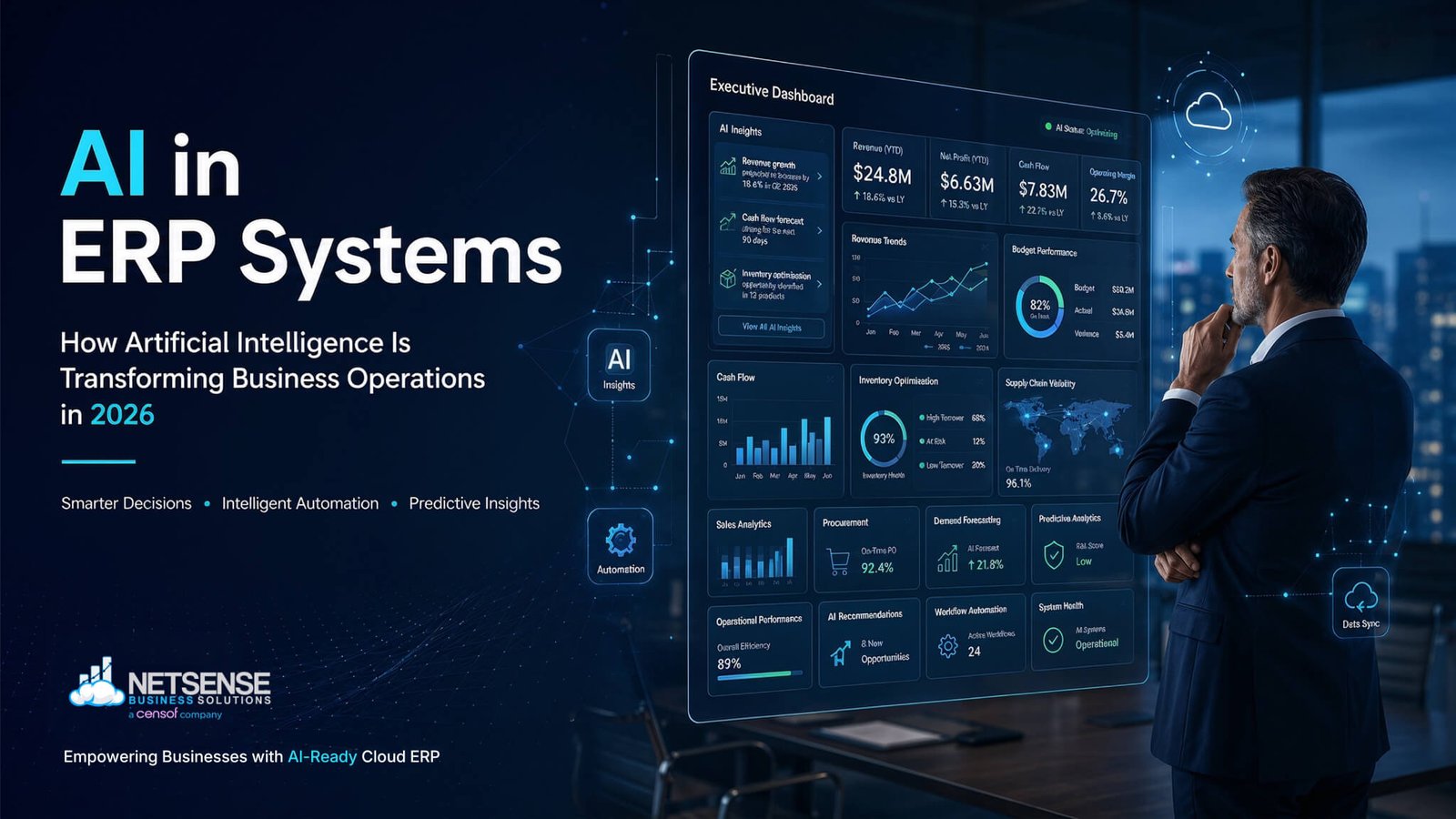
Artificial intelligence (AI) is no longer a futuristic concept—it has become a key capability of modern Enterprise Resource Planning (ERP) systems. As organizations generate larger volumes of operational and financial data, traditional ERP platforms that simply record transactions are no longer enough. Today’s businesses need intelligent systems that can analyze data, identify patterns, automate routine processes, and provide actionable insights in real time.
By combining AI with cloud ERP, organizations can make faster decisions, improve forecasting accuracy, optimize inventory, strengthen financial planning, and increase operational efficiency across departments. Instead of relying solely on historical reports, business leaders can leverage predictive analytics and AI-driven recommendations to proactively respond to changing market conditions.
For CFOs, IT leaders, and operations managers, AI-powered ERP is becoming a strategic advantage rather than an optional technology. It enables teams to reduce manual workloads, improve visibility across the organization, and support data-driven decision-making with greater confidence.
In this guide, we’ll explore how AI is transforming ERP systems in 2026, the key business benefits, real-world use cases across industries, common implementation challenges, and the essential factors to consider when choosing an AI-ready ERP solution for long-term business growth.
Table of contents
- What Is AI in ERP Systems?
- Why AI Is Becoming Essential for Modern ERP Systems
- Key Benefits of AI in ERP Systems
- Real-World AI Use Cases Across Business Functions
- How Generative AI Is Changing ERP
- Industries That Benefit Most from AI ERP
- Common Challenges When Implementing AI in ERP
- How to Choose an AI-Ready ERP Solution
- Why Acumatica Is an AI-Ready ERP Platform
- Why Partner with Netsense Business Solutions
- Frequently Asked Questions (FAQ)
- Conclusion
What Is AI in ERP Systems?
AI in ERP systems refers to the integration of artificial intelligence (AI) technologies into Enterprise Resource Planning (ERP) software to enhance business processes, automate repetitive tasks, and provide intelligent insights from business data. Rather than serving only as a system for recording transactions, AI-powered ERP continuously analyzes operational, financial, and customer data to help organizations make faster and more informed decisions.
Traditional ERP systems have long been essential for managing core business functions such as finance, inventory, procurement, manufacturing, sales, and human resources. However, they primarily focus on storing historical data and generating reports. Modern AI-powered ERP goes a step further by identifying patterns, predicting future outcomes, detecting anomalies, and recommending the next best actions based on real-time information.
For example, instead of simply showing current inventory levels, an AI-enabled ERP system can forecast future demand, recommend optimal reorder quantities, identify potential supply chain disruptions, and alert managers before stock shortages occur. Similarly, finance teams can use AI to predict cash flow, detect unusual transactions, and improve budgeting accuracy, while operations managers can optimize production schedules using predictive insights.
Several AI technologies work together to make ERP systems more intelligent:
Machine Learning (ML)
Machine Learning enables ERP systems to learn from historical business data and continuously improve predictions without requiring manual programming. As more data becomes available, the system becomes increasingly accurate in forecasting demand, identifying purchasing trends, predicting equipment maintenance, and recognizing operational patterns.
Predictive Analytics
Predictive Analytics uses statistical models and AI algorithms to estimate future business outcomes based on historical and real-time data. Businesses can anticipate customer demand, forecast revenue, optimize inventory levels, reduce operational risks, and make proactive decisions instead of reacting to problems after they occur.
Natural Language Processing (NLP)
Natural Language Processing allows users to interact with ERP systems using everyday language rather than complex reports or database queries. Employees can ask questions such as, “Show overdue invoices above RM50,000” or “What were last month’s top-selling products?” and receive immediate answers, making business information more accessible to both technical and non-technical users.
Generative AI
Generative AI is transforming how employees interact with ERP software by generating summaries, reports, recommendations, and business insights in seconds. Instead of manually compiling information from multiple modules, users can receive AI-generated executive summaries, financial analyses, procurement recommendations, or sales performance reports based on real-time business data.
Intelligent Automation
Intelligent Automation combines AI with workflow automation to streamline repetitive and rule-based business processes. Tasks such as invoice processing, purchase order approvals, expense validation, document classification, customer follow-ups, and exception handling can be completed automatically, allowing employees to focus on higher-value strategic activities.
Traditional ERP vs AI-Powered ERP
| Traditional ERP | AI-Powered ERP |
|---|---|
| Records and manages business transactions | Learns from business data and continuously improves recommendations |
| Relies primarily on historical reporting | Delivers predictive insights and forward-looking analytics |
| Requires manual analysis to identify trends | Automatically identifies patterns, risks, and opportunities |
| Supports rule-based workflows | Automates complex processes using AI-driven decision support |
| Provides static dashboards and reports | Delivers intelligent dashboards with real-time recommendations |
| Helps monitor business performance | Helps predict, optimize, and improve business performance |
As organizations continue their digital transformation, AI is rapidly becoming a core capability of modern cloud ERP platforms. Businesses that adopt AI-powered ERP can move beyond basic process automation and gain the intelligence needed to improve efficiency, strengthen decision-making, and remain competitive in an increasingly data-driven business environment.
Quick Definition
AI in ERP refers to the integration of artificial intelligence technologies into Enterprise Resource Planning software to automate business processes, generate predictive insights, improve decision-making, and enhance operational efficiency through intelligent data analysis.
Why AI Is Becoming Essential for Modern ERP Systems
The business environment in 2026 is more dynamic and data-driven than ever before. Organizations are expected to respond quickly to market changes, optimize costs, improve customer experiences, and make informed decisions despite increasing uncertainty. While traditional ERP systems remain essential for managing core business processes, they often struggle to keep pace with the growing complexity of modern operations.
Artificial intelligence addresses these challenges by transforming ERP from a transactional system into an intelligent decision-support platform. Instead of simply collecting and organizing data, AI continuously analyzes information, identifies patterns, predicts future outcomes, and recommends actions that help businesses respond proactively.
Several key business trends are driving the adoption of AI-powered ERP systems.
Exploding Volumes of Business Data
Every business interaction generates valuable data—from sales transactions and inventory movements to customer behavior, supplier performance, production output, and financial records. As organizations grow, the amount of information increases exponentially, making manual analysis increasingly difficult.
AI enables ERP systems to process vast amounts of structured and unstructured data in real time, uncover hidden patterns, and convert complex information into meaningful business insights. This allows decision-makers to focus on strategy instead of spending hours compiling reports.
The Need for Real-Time Decision-Making
Business leaders can no longer rely on reports generated days or weeks after events occur. Market conditions, customer demand, supplier availability, and operational performance can change within hours.
AI-powered ERP continuously monitors business activities and provides real-time alerts, recommendations, and predictive insights. Whether identifying a sudden decline in sales, detecting production bottlenecks, or highlighting cash flow risks, AI helps organizations respond before small issues become major business problems.
Workforce Shortages and Increasing Productivity Demands
Many organizations continue to face labor shortages while simultaneously being expected to achieve higher productivity. Employees are often burdened with repetitive administrative tasks such as invoice processing, data entry, report preparation, and approval workflows.
AI automates many of these routine activities, allowing finance, operations, procurement, and customer service teams to focus on higher-value work such as analysis, planning, innovation, and customer engagement. Rather than replacing employees, AI enhances their productivity by reducing manual workloads and minimizing human error.
Growing Supply Chain Complexity
Global supply chains have become more interconnected and unpredictable due to changing customer demand, supplier disruptions, transportation delays, and economic uncertainty. Managing inventory and procurement using historical reports alone is no longer sufficient.
AI helps organizations anticipate supply chain risks by analyzing purchasing patterns, supplier performance, inventory levels, and market trends. ERP systems can recommend optimal reorder quantities, predict potential shortages, and improve inventory planning, enabling businesses to maintain operational continuity while reducing excess stock.
Pressure to Improve Profitability
Businesses today operate under constant pressure to increase profitability while controlling operating costs. Rising labor expenses, inflation, and competitive pricing require organizations to maximize efficiency across every department.
AI supports this objective by identifying cost-saving opportunities, optimizing resource allocation, improving production planning, reducing waste, and detecting financial anomalies before they become significant issues. With better visibility into business performance, executives can make faster and more confident decisions that directly impact profitability.
Greater Demand for Accurate Forecasting
Forecasting has become a critical capability for finance, operations, and executive teams. Inaccurate demand forecasts, inventory projections, or financial planning can result in stock shortages, excess inventory, cash flow challenges, and missed growth opportunities.
Unlike traditional forecasting methods that rely heavily on historical data, AI-powered ERP combines historical records with real-time business information to produce more accurate predictions. This enables organizations to anticipate market changes, adjust production schedules, improve budgeting, and make proactive strategic decisions with greater confidence.
From Transaction Processing to Intelligent Decision Support
The role of ERP is evolving. Modern organizations no longer expect ERP systems to simply record transactions—they expect them to deliver actionable intelligence that supports faster, smarter, and more strategic decision-making.
By embedding artificial intelligence into everyday business processes, AI-powered ERP enables organizations to move from reactive operations to predictive and data-driven management. As digital transformation accelerates across industries, AI is becoming an essential capability for businesses seeking greater agility, operational resilience, and long-term competitive advantage.
Key Benefits of AI in ERP Systems
Artificial intelligence is transforming ERP from a system that records business activities into a platform that actively supports decision-making and operational improvement. By analyzing large volumes of business data in real time, AI helps organizations identify opportunities, predict future outcomes, and automate complex processes across finance, operations, procurement, manufacturing, and customer service.
Below are the key business benefits organizations can expect from implementing AI-powered ERP systems.
Faster Decision-Making
One of the greatest advantages of AI in ERP is its ability to accelerate decision-making. Traditional ERP systems often require users to manually gather reports, analyze spreadsheets, and interpret historical data before taking action.
AI-powered ERP continuously analyzes real-time information and presents actionable recommendations through intelligent dashboards, alerts, and predictive insights. Decision-makers can quickly identify risks, opportunities, and operational issues without spending hours compiling reports.
For CFOs and operations leaders, this means making faster, more confident decisions based on current business conditions rather than outdated information.
Predictive Analytics and Forecasting
Traditional ERP systems primarily explain what has already happened. AI-powered ERP goes further by helping businesses anticipate what is likely to happen next.
Using machine learning and predictive analytics, AI can forecast customer demand, revenue, cash flow, inventory requirements, production capacity, and purchasing needs. These predictions enable organizations to prepare for future scenarios instead of reacting after problems arise.
More accurate forecasting helps businesses reduce uncertainty, improve planning, and make strategic decisions with greater confidence.
Automated Routine Tasks
Many business processes still involve repetitive manual work, including invoice processing, purchase order approvals, expense verification, document classification, and report generation.
AI automates these routine activities by combining intelligent workflows with business rules and machine learning. Employees spend less time on administrative tasks and more time focusing on analysis, customer relationships, innovation, and strategic initiatives.
Automation also minimizes human error, improves consistency, and accelerates business processes across departments.
Better Financial Planning
Finance teams are expected to deliver accurate forecasts, monitor cash flow, manage budgets, and identify financial risks in increasingly dynamic business environments.
AI enhances financial management by analyzing historical and real-time financial data to identify spending patterns, detect anomalies, predict cash flow fluctuations, and recommend corrective actions before issues impact business performance.
As a result, finance leaders gain greater visibility into financial health and can make more informed budgeting and investment decisions.
Smarter Inventory Management
Maintaining optimal inventory levels remains one of the biggest operational challenges for many organizations. Excess inventory increases carrying costs, while insufficient inventory leads to stockouts, delayed deliveries, and lost revenue.
AI-powered ERP continuously analyzes sales trends, seasonality, supplier lead times, inventory turnover, and demand forecasts to recommend optimal inventory levels. Businesses can improve inventory accuracy, reduce waste, and ensure products are available when customers need them.
This proactive approach helps balance inventory investment with customer service performance.
Improved Supply Chain Visibility
Supply chains have become increasingly complex due to changing customer expectations, global sourcing, logistics disruptions, and supplier uncertainty.
AI provides end-to-end visibility across procurement, inventory, production, warehousing, and distribution by monitoring operational data in real time. It can identify supply chain bottlenecks, predict potential delays, evaluate supplier performance, and recommend alternative sourcing or replenishment strategies before disruptions occur.
Greater visibility enables organizations to build more resilient and responsive supply chains.
Enhanced Customer Experience
Customer expectations continue to rise across every industry. Businesses must respond quickly, deliver products on time, and provide consistent service throughout the customer journey.
AI helps organizations better understand customer behavior by analyzing purchasing history, service interactions, and sales trends. ERP systems can recommend personalized offers, prioritize customer requests, predict future demand, and improve order fulfillment accuracy.
These capabilities enable businesses to strengthen customer relationships while improving overall service quality.
Increased Operational Efficiency
Ultimately, the greatest value of AI in ERP lies in its ability to improve operational efficiency across the entire organization.
Rather than optimizing individual departments in isolation, AI connects data across finance, procurement, manufacturing, sales, inventory, and operations to identify opportunities for continuous improvement. Intelligent recommendations help organizations eliminate process bottlenecks, reduce unnecessary costs, improve resource utilization, and increase productivity.
By replacing reactive management with proactive decision-making, AI enables businesses to operate more efficiently while supporting long-term growth and scalability.
Traditional ERP vs AI-Powered ERP
The following comparison illustrates how AI expands the capabilities of a modern ERP system beyond traditional transaction management.
| Traditional ERP | AI-Powered ERP |
|---|---|
| Generates historical reports | Delivers predictive insights and future forecasts |
| Requires manual data analysis | Provides AI-driven recommendations and automated insights |
| Supports reactive decision-making | Enables proactive and data-driven decisions |
| Displays static dashboards | Offers intelligent dashboards with real-time alerts |
| Relies on manual workflows | Automates repetitive processes using AI |
| Records business transactions | Learns from business data and continuously improves performance |
| Detects issues after they occur | Identifies risks and opportunities before they impact operations |
| Supports operational management | Enhances strategic planning and business optimization |
As organizations continue their digital transformation journey, AI is becoming a defining capability of modern ERP systems. Companies that adopt AI-powered ERP are better equipped to improve productivity, optimize operations, strengthen financial performance, and make faster, more informed business decisions in an increasingly competitive marketplace.
Real-World AI Use Cases Across Business Functions
Artificial intelligence delivers the greatest value when it is embedded into everyday business operations. Rather than functioning as a standalone technology, AI works alongside ERP to help organizations automate routine tasks, improve decision-making, and uncover insights that would otherwise be difficult to identify manually.
The following examples illustrate how AI-powered ERP is transforming key business functions across modern organizations.
Finance
Finance teams manage enormous volumes of transactional data every day. AI helps transform this data into actionable financial intelligence while reducing manual effort and improving accuracy.
Common AI use cases include:
- Predicting cash flow based on historical trends and real-time financial data.
- Detecting unusual transactions that may indicate fraud or accounting errors.
- Automating invoice matching and approval processes.
- Improving budgeting and financial forecasting.
- Identifying overdue payments and recommending collection priorities.
- Generating AI-powered financial summaries for executives.
These capabilities enable CFOs and finance teams to make faster, more informed financial decisions while strengthening overall financial control.
Operations
Operations managers need complete visibility into business performance to maintain efficiency and respond quickly to changing conditions.
AI enhances operational management by:
- Monitoring operational KPIs in real time.
- Identifying production bottlenecks before they affect output.
- Recommending workflow improvements.
- Predicting capacity constraints.
- Optimizing resource allocation across departments.
- Providing intelligent alerts when operational performance deviates from expected targets.
Instead of reacting to operational issues after they occur, managers can proactively resolve problems before they impact customers or profitability.
Procurement
Procurement has evolved from simply purchasing goods to strategically managing supplier relationships, costs, and supply risks.
AI supports procurement teams by:
- Predicting purchasing demand based on sales forecasts.
- Recommending optimal reorder quantities.
- Evaluating supplier performance using historical data.
- Identifying purchasing anomalies and duplicate orders.
- Detecting price fluctuations across suppliers.
- Automating supplier selection based on predefined business criteria.
This helps organizations reduce procurement costs while improving supplier reliability and purchasing efficiency.
Inventory Management
Inventory optimization remains one of the most valuable applications of AI within ERP.
Instead of relying solely on minimum stock levels or historical consumption, AI continuously evaluates multiple variables including:
- Sales trends.
- Seasonal demand.
- Supplier lead times.
- Warehouse capacity.
- Inventory turnover.
- Customer buying behavior.
Based on this analysis, AI can recommend replenishment schedules, identify slow-moving inventory, predict stock shortages, and minimize excess inventory.
The result is lower inventory carrying costs while maintaining high product availability.
Manufacturing
Manufacturers operate in environments where production efficiency, equipment reliability, and quality control directly influence profitability.
AI-powered ERP helps manufacturers by:
- Predicting equipment failures before breakdowns occur.
- Optimizing production schedules based on demand forecasts.
- Improving production planning.
- Detecting quality issues earlier in the manufacturing process.
- Reducing production downtime.
- Optimizing material usage to minimize waste.
By combining production data with predictive analytics, manufacturers can improve overall equipment effectiveness (OEE) and increase operational efficiency.
Sales
Sales teams need accurate information to identify opportunities, prioritize prospects, and forecast revenue.
AI enables ERP systems to:
- Predict future sales performance.
- Identify high-value sales opportunities.
- Recommend cross-selling and upselling opportunities.
- Forecast customer demand more accurately.
- Analyze customer purchasing behavior.
- Prioritize leads based on buying likelihood.
These insights allow sales teams to focus their efforts on the opportunities most likely to generate revenue.
Customer Service
Customer satisfaction increasingly depends on speed, consistency, and proactive support.
AI improves customer service by:
- Automatically categorizing and prioritizing support requests.
- Recommending responses based on previous cases.
- Predicting customer issues before they escalate.
- Providing customer service teams with complete interaction histories.
- Identifying customers at risk of churn.
- Supporting self-service experiences through AI assistants and chatbots integrated with ERP data.
With faster access to relevant information, customer service representatives can resolve issues more efficiently while improving the overall customer experience.
Project Management
Organizations managing multiple projects require continuous visibility into budgets, schedules, resources, and project risks.
AI-powered ERP supports project managers by:
- Predicting project completion dates.
- Identifying projects at risk of delays.
- Forecasting budget overruns.
- Optimizing resource allocation across multiple projects.
- Monitoring project profitability in real time.
- Recommending corrective actions before project performance declines.
This enables project teams to improve planning accuracy, reduce project risks, and deliver successful outcomes more consistently.
Bringing Intelligence Across the Entire Business
The true strength of AI-powered ERP lies in its ability to connect data across every department rather than optimizing individual functions in isolation. Finance, operations, procurement, inventory, manufacturing, sales, customer service, and project management all contribute valuable data that AI can analyze to uncover organization-wide insights.
By breaking down data silos and providing real-time, predictive intelligence, AI helps business leaders make faster decisions, improve collaboration, and continuously optimize business performance. As AI capabilities continue to evolve, ERP systems are becoming not only systems of record but also intelligent platforms that actively guide organizations toward better operational and strategic outcomes.
How Generative AI Is Changing ERP
While machine learning and predictive analytics have already improved how businesses analyze data, Generative AI is fundamentally changing how people interact with ERP systems. Instead of navigating multiple menus, building custom reports, or relying on technical expertise, users can simply ask questions in natural language and receive instant answers, summaries, recommendations, or reports.
This shift is making ERP systems more accessible, intuitive, and productive for business users across finance, operations, procurement, manufacturing, and executive management.
AI Assistants: A New Way to Interact with ERP
Modern ERP platforms are increasingly incorporating AI assistants that act as intelligent business companions. Rather than searching through multiple dashboards or modules, users can interact with the ERP system conversationally.
For example, a finance manager could ask:
“Which customers have invoices overdue by more than 60 days?”
Within seconds, the AI assistant can retrieve the relevant information, summarize key findings, and even recommend the next actions, such as prioritizing collection efforts or sending payment reminders.
Similarly, an operations manager might ask:
“Which products are projected to run out of stock within the next two weeks?”
Instead of manually analyzing inventory reports, the AI assistant provides an immediate answer based on real-time ERP data.
By reducing the time spent searching for information, AI assistants enable employees to focus more on decision-making and less on navigating software.
AI Copilots That Support Better Decision-Making
Beyond answering questions, AI copilots actively assist users throughout their daily work. Rather than replacing employees, these AI-powered assistants provide contextual recommendations, automate repetitive tasks, and surface relevant business insights when they are needed.
For example, an AI copilot can:
- Recommend inventory replenishment based on demand forecasts.
- Highlight unusual spending patterns before month-end closing.
- Suggest suppliers with the best historical delivery performance.
- Identify production schedules that may create capacity constraints.
- Recommend actions to improve cash flow or reduce operational costs.
Instead of merely displaying data, ERP becomes an intelligent advisor that supports faster and more confident decision-making.
Natural Language Queries Replace Complex Reports
One of the most significant innovations introduced by Generative AI is the ability to interact with ERP systems using everyday language.
Traditionally, users needed to understand report structures, filters, database fields, or dashboard navigation to find information. With Generative AI, they can simply type or speak what they need.
Examples include:
- “Show overdue invoices above RM50,000.”
- “Which customers generated the highest revenue this quarter?”
- “Compare inventory turnover across all warehouses.”
- “Which purchase orders are delayed?”
- “Summarize this month’s operating expenses.”
- “What products are expected to experience stock shortages next month?”
The AI interprets the request, retrieves the relevant ERP data, and presents the results in a clear, easy-to-understand format—without requiring users to build reports manually.
This significantly reduces the learning curve for ERP users while improving productivity across the organization.
AI-Generated Reports in Seconds
Preparing business reports often requires gathering information from multiple ERP modules, exporting data into spreadsheets, and manually formatting the results. This process can consume valuable time, particularly for finance and executive teams.
Generative AI simplifies reporting by automatically producing reports based on live business data.
Examples include:
- Monthly financial performance reports.
- Sales performance summaries.
- Inventory status reports.
- Procurement analysis.
- Project profitability reports.
- Executive management dashboards.
Instead of spending hours compiling information, managers can generate comprehensive reports within seconds and focus on interpreting the results rather than preparing them.
Intelligent Business Summaries
Executives often need concise overviews rather than detailed operational reports.
Generative AI can automatically summarize large volumes of business information into clear executive briefings, highlighting the most important trends, risks, and opportunities.
For example, an AI-generated summary might include:
- Revenue increased by 8% compared to the previous month.
- Inventory turnover improved across three distribution centers.
- Cash flow is projected to remain positive over the next quarter.
- Two suppliers are experiencing delivery delays that may affect production.
- Customer demand for Product A has exceeded forecast by 15%.
These summaries allow business leaders to quickly understand organizational performance without reviewing dozens of individual reports.
AI Recommendations That Drive Better Business Outcomes
Generative AI not only explains what is happening but also recommends what businesses should do next.
By combining historical data, real-time operational information, and predictive analytics, AI can provide actionable recommendations such as:
- Increase safety stock for products with rising demand.
- Delay non-essential purchases to improve short-term cash flow.
- Reorder materials from higher-performing suppliers.
- Reschedule production to avoid equipment bottlenecks.
- Prioritize high-value customer orders during periods of limited inventory.
- Investigate unusual expense transactions flagged by anomaly detection.
These recommendations help organizations move beyond reactive management toward proactive, data-driven decision-making.
The Future of ERP Is Conversational and Intelligent
Generative AI is redefining the role of ERP. Instead of functioning solely as a system for recording transactions and generating reports, modern ERP platforms are becoming intelligent business assistants capable of understanding natural language, producing meaningful insights, and guiding users toward better decisions.
For CFOs, IT leaders, and operations managers, this evolution means faster access to critical information, improved productivity, and greater confidence in strategic decision-making. As Generative AI capabilities continue to mature, businesses that adopt AI-ready ERP platforms will be better positioned to improve efficiency, respond to change, and maintain a competitive advantage in an increasingly data-driven economy.
Industries That Benefit Most from AI ERP
Although artificial intelligence can enhance virtually any business process, its impact is especially significant in industries that manage large volumes of operational data, complex workflows, and rapidly changing business conditions. By embedding AI into ERP systems, organizations can automate routine tasks, improve forecasting accuracy, optimize resources, and make faster, data-driven decisions.
The following industries are among those gaining the greatest value from AI-powered ERP solutions.
Manufacturing
Manufacturers operate in highly complex environments where production planning, inventory management, equipment utilization, and quality control must work together seamlessly. AI-powered ERP helps manufacturers move beyond reactive operations by delivering predictive insights across the entire production lifecycle.
Common AI applications include:
- Predicting equipment failures through predictive maintenance.
- Optimizing production schedules based on demand forecasts.
- Improving material requirements planning (MRP).
- Detecting quality issues before they affect finished products.
- Forecasting raw material demand.
- Reducing production downtime and operational waste.
By leveraging AI, manufacturers can increase production efficiency, lower operating costs, and improve on-time delivery performance.
Distribution
Distribution companies must balance inventory availability with transportation efficiency while responding quickly to fluctuating customer demand.
AI-powered ERP enables distributors to:
- Forecast product demand more accurately.
- Optimize warehouse inventory levels.
- Recommend replenishment schedules.
- Identify slow-moving or excess inventory.
- Improve order fulfillment planning.
- Optimize delivery routes and logistics operations.
These capabilities help distributors reduce carrying costs, improve customer satisfaction, and increase supply chain resilience.
Construction
Construction projects involve multiple stakeholders, changing project schedules, material procurement, subcontractor coordination, and strict budget management.
AI enhances construction ERP by:
- Predicting project delays before they occur.
- Forecasting project costs and cash flow.
- Optimizing workforce allocation.
- Monitoring equipment utilization.
- Identifying procurement risks.
- Improving project profitability analysis.
With AI-powered insights, construction firms can improve project execution while minimizing cost overruns and scheduling risks.
Retail
Retail businesses must respond rapidly to changing consumer behavior, seasonal demand, pricing pressures, and inventory fluctuations.
AI-powered ERP helps retailers:
- Forecast customer demand.
- Optimize inventory replenishment.
- Recommend pricing strategies.
- Analyze purchasing behavior.
- Personalize customer experiences.
- Reduce stockouts and overstock situations.
These insights enable retailers to improve sales performance while maintaining efficient inventory management across stores and distribution centers.
Professional Services
Professional service organizations—including consulting firms, engineering companies, accounting firms, and IT service providers—depend on efficient project delivery, resource utilization, and financial visibility.
AI supports these businesses by:
- Forecasting project profitability.
- Optimizing consultant and employee scheduling.
- Predicting resource requirements.
- Automating project reporting.
- Improving budgeting and financial forecasting.
- Identifying projects that may exceed budget or timeline.
AI-powered ERP enables service organizations to improve operational efficiency while maximizing billable utilization and client satisfaction.
Food & Beverage
Food and beverage companies face unique challenges involving shelf life, food safety, demand volatility, production planning, and regulatory compliance.
AI-powered ERP can help organizations:
- Predict seasonal demand.
- Optimize production planning.
- Reduce food waste.
- Improve inventory rotation.
- Monitor supplier performance.
- Strengthen product traceability and quality management.
These capabilities allow businesses to maintain product availability while reducing waste and protecting profit margins.
Healthcare
Healthcare providers and medical organizations manage complex operations involving inventory, procurement, financial management, regulatory compliance, and patient services.
AI-powered ERP supports healthcare organizations by:
- Forecasting medical supply requirements.
- Optimizing inventory for pharmaceuticals and medical equipment.
- Improving procurement planning.
- Monitoring operational costs.
- Supporting regulatory compliance.
- Automating administrative workflows.
As healthcare systems continue their digital transformation, AI helps organizations improve operational efficiency while enabling staff to focus more on patient care.
Logistics
Logistics companies operate in highly dynamic environments where delivery performance, transportation costs, warehouse operations, and fleet utilization directly affect customer satisfaction and profitability.
AI-powered ERP helps logistics providers:
- Predict shipment delays.
- Optimize transportation routes.
- Improve warehouse planning.
- Forecast shipping demand.
- Monitor fleet performance.
- Reduce fuel and operating costs through intelligent planning.
By combining AI with real-time operational data, logistics organizations can improve service reliability while maximizing operational efficiency.
AI ERP Delivers Value Across Every Industry
While these industries represent some of the most common applications of AI-powered ERP, the benefits are not limited to any single sector. Any organization that manages large volumes of business data, complex operational processes, or distributed teams can leverage AI to improve decision-making, automate workflows, and increase efficiency.
As AI capabilities continue to evolve, modern cloud ERP platforms are becoming intelligent business systems that adapt to changing conditions, identify opportunities for improvement, and help organizations remain competitive in an increasingly data-driven economy.
Common Challenges When Implementing AI in ERP
While AI-powered ERP offers significant advantages, successful implementation requires more than simply enabling AI features. Organizations must establish the right foundation in terms of data, technology, processes, and people. Without proper planning, businesses may struggle to realize the full value of their AI investment.
Understanding the following challenges can help organizations prepare for a smoother implementation and achieve better long-term outcomes.
Poor Data Quality
Artificial intelligence is only as effective as the data it analyzes. If business data is incomplete, inconsistent, duplicated, or outdated, AI-generated insights may be inaccurate or misleading.
Common data quality issues include:
- Duplicate customer and supplier records.
- Inconsistent product information.
- Missing financial or operational data.
- Outdated inventory records.
- Poor data governance across departments.
Before implementing AI capabilities, organizations should invest in data cleansing, standardization, and governance to ensure AI models are built on reliable and accurate information.
Legacy Systems and Data Silos
Many organizations still rely on outdated ERP systems, disconnected applications, or spreadsheets that store data in separate silos. These fragmented environments limit AI’s ability to generate comprehensive business insights.
For example, if finance, sales, inventory, and procurement systems are not fully integrated, AI cannot accurately analyze business performance across the organization.
Migrating to a modern cloud ERP platform with integrated business processes creates a stronger foundation for AI by providing a single source of truth for enterprise data.
Change Management
Implementing AI is not just a technology project—it is also an organizational transformation.
Employees may need to adapt to new workflows, automated processes, and different ways of making decisions. Without effective change management, even the most advanced AI capabilities may be underutilized.
Successful organizations typically:
- Communicate clear business objectives.
- Involve stakeholders early in the project.
- Provide structured training programs.
- Encourage collaboration between business and IT teams.
- Continuously monitor user feedback and adoption.
A well-planned change management strategy helps employees understand how AI supports their work rather than replacing it.
User Adoption
Introducing AI-powered features does not automatically guarantee that employees will use them effectively.
Some users may hesitate to trust AI recommendations, while others may continue relying on manual spreadsheets or familiar processes simply because they are comfortable with existing workflows.
Improving user adoption requires:
- Intuitive and user-friendly ERP interfaces.
- Practical training focused on real business scenarios.
- Clear explanations of how AI generates recommendations.
- Executive support that promotes data-driven decision-making.
- Ongoing education as new AI capabilities become available.
The more employees understand and trust AI, the greater the business value organizations can achieve.
Security and Data Privacy Concerns
As AI processes increasing volumes of sensitive business information—including financial records, customer data, supplier information, and operational metrics—security becomes a critical consideration.
Organizations should evaluate whether their ERP platform provides:
- Strong user access controls.
- Role-based security permissions.
- Data encryption during storage and transmission.
- Compliance with relevant security and privacy regulations.
- Regular security updates and monitoring.
Businesses should also establish clear governance policies that define how AI accesses, processes, and protects enterprise data while maintaining regulatory compliance.
Unrealistic Expectations
One of the most common misconceptions is that AI can instantly solve every business challenge after implementation.
In reality, AI delivers the greatest value when supported by high-quality data, well-defined business processes, and realistic implementation goals. Organizations that expect immediate transformation without investing in process improvement or user adoption are often disappointed.
Rather than viewing AI as a replacement for human expertise, businesses should see it as a decision-support capability that enhances productivity, improves forecasting, and automates repetitive work. Human judgment remains essential for interpreting insights, setting business strategy, and making critical decisions.
Building the Right Foundation for AI Success
Organizations that achieve the greatest return on AI-powered ERP investments typically begin with strong business fundamentals. Clean and connected data, modern cloud infrastructure, effective change management, engaged users, and robust security practices all contribute to successful AI adoption.
Instead of treating AI as a standalone initiative, businesses should view it as part of a broader digital transformation strategy. By establishing the right foundation, organizations can unlock the full potential of AI-powered ERP to improve decision-making, increase operational efficiency, and support sustainable long-term growth.
How to Choose an AI-Ready ERP Solution
As AI becomes a standard capability in modern business software, choosing an ERP system is no longer just about finance, inventory, or manufacturing functionality. Organizations should also evaluate whether the platform is designed to support artificial intelligence today—and continue evolving as AI technology advances.
An AI-ready ERP is more than software with a few AI features. It provides the technology foundation, data architecture, and scalability needed to support intelligent automation, predictive analytics, and future AI innovations without requiring major system replacements.
When evaluating ERP solutions, consider the following key criteria.
Cloud-Native Architecture
A cloud-native ERP provides the flexibility and computing power required to support AI-driven capabilities. Unlike legacy on-premises systems, cloud ERP platforms receive continuous updates, making it easier to adopt new AI features without complex upgrades.
Cloud-native architecture also enables:
- Faster innovation and feature releases.
- Real-time access to business data.
- Improved system performance.
- Easier integration with AI services.
- Lower infrastructure and maintenance costs.
As AI technologies continue to evolve, cloud-native ERP platforms are better positioned to keep pace with innovation.
Open APIs and Integration Capabilities
AI generates the greatest value when it can access data from across the business. Therefore, ERP systems should integrate seamlessly with CRM, e-commerce platforms, payroll systems, business intelligence tools, manufacturing equipment, and other enterprise applications.
Look for ERP platforms that provide:
- Open APIs for third-party integrations.
- Standard connectors to business applications.
- Flexible integration frameworks.
- Support for automation platforms and cloud services.
A connected ecosystem allows AI to generate more comprehensive insights by analyzing data from multiple business functions rather than isolated systems.
A Clear AI Roadmap
AI capabilities are advancing rapidly. Organizations should evaluate not only what an ERP system offers today but also how the vendor plans to expand AI functionality in the future.
Key questions to consider include:
- Does the vendor have an ongoing AI development strategy?
- Are new AI features released regularly?
- Is Generative AI part of the product roadmap?
- Will AI capabilities continue to improve without major upgrades?
Choosing an ERP vendor with a long-term AI vision helps protect your technology investment and ensures the platform continues to evolve alongside changing business needs.
Embedded Analytics and Business Intelligence
AI is most effective when supported by accurate and accessible business data.
An AI-ready ERP should include embedded analytics that allow users to monitor performance, identify trends, and make informed decisions without relying on separate reporting tools.
Look for capabilities such as:
- Interactive dashboards.
- Real-time KPIs.
- Drill-down reporting.
- Predictive analytics.
- Self-service reporting.
- Executive performance dashboards.
Embedded analytics provide the data foundation that enables AI to deliver meaningful recommendations and actionable insights.
Mobile Accessibility
Business decisions are no longer made exclusively from the office. Executives, managers, sales teams, and field employees increasingly need access to ERP information from anywhere.
A modern AI-ready ERP should provide secure mobile access that allows users to:
- Approve transactions remotely.
- Monitor KPIs in real time.
- Review operational dashboards.
- Receive AI-generated alerts.
- Access reports from any device.
Mobile capabilities help organizations respond more quickly to business events while supporting hybrid and remote work environments.
Scalability for Future Growth
Business requirements change over time. An ERP platform should be able to support organizational growth without requiring costly system replacements.
Evaluate whether the ERP can scale to accommodate:
- Additional users.
- New business entities.
- Multiple subsidiaries.
- International operations.
- Higher transaction volumes.
- Expanding product lines.
- Future AI capabilities.
Scalable ERP platforms enable businesses to grow while maintaining consistent performance and operational efficiency.
Enterprise-Grade Security
AI relies on access to sensitive financial, operational, customer, and supplier data. Protecting this information should be a top priority when selecting an ERP platform.
Look for enterprise security features such as:
- Role-based access control.
- Multi-factor authentication (MFA).
- Data encryption.
- Audit trails.
- Continuous security monitoring.
- Compliance with international security standards.
Strong security not only protects business data but also builds confidence in AI-generated insights and automated decision-making.
Industry-Specific Capabilities
Every industry has unique operational requirements. A generic ERP system may require significant customization before it can effectively support industry-specific processes.
When evaluating AI-ready ERP solutions, consider whether the platform offers capabilities tailored to your industry, such as:
- Manufacturing planning and production control.
- Distribution and warehouse management.
- Construction project accounting.
- Field service management.
- Professional services automation.
- Retail inventory optimization.
Industry-specific functionality allows AI to generate more relevant insights because it understands the unique workflows, KPIs, and operational challenges of your business.
AI Readiness Is a Long-Term Investment
Selecting an AI-ready ERP is not simply about choosing software with the latest technology. It is about investing in a platform that can continuously adapt as your business grows and as artificial intelligence becomes more deeply integrated into everyday operations.
Organizations should evaluate ERP solutions based on their ability to combine cloud technology, integrated data, advanced analytics, scalability, security, and continuous innovation. By choosing an AI-ready platform today, businesses can build a stronger foundation for digital transformation, improve operational agility, and remain competitive in an increasingly AI-driven business landscape.
Why Acumatica Is an AI-Ready ERP Platform
As organizations evaluate ERP solutions for the future, one question becomes increasingly important: Is the platform built to support the next generation of AI capabilities?
While many ERP vendors are introducing AI features, organizations should look beyond marketing claims and assess whether the platform provides the underlying architecture needed to support continuous AI innovation.
Acumatica is one example of a modern cloud ERP platform designed with these principles in mind. Its cloud-native architecture, open ecosystem, and commitment to continuous product innovation make it well-positioned to support businesses as AI becomes an increasingly important part of enterprise operations.
Cloud-Native Foundation
Unlike traditional on-premises ERP systems that often require complex upgrades, Acumatica is built as a cloud-native platform. This enables organizations to access new capabilities—including AI-driven innovations—through regular product updates without disruptive system replacements.
A cloud-native architecture also provides:
- Real-time access to business information.
- Greater scalability as businesses grow.
- Reduced IT infrastructure requirements.
- Faster deployment of new features.
- Improved accessibility across locations and devices.
This flexible foundation allows businesses to adopt emerging technologies more efficiently as their digital transformation evolves.
Real-Time Business Data
Artificial intelligence depends on timely, accurate, and connected business data.
Acumatica provides a centralized platform where financial, operational, inventory, sales, purchasing, manufacturing, and project information is continuously updated in real time. Instead of relying on disconnected systems or manually consolidated reports, organizations gain a unified view of business performance.
With access to real-time data, AI models can deliver more accurate forecasts, identify emerging trends earlier, and provide recommendations based on current business conditions rather than outdated information.
Open Architecture for Innovation
Modern businesses rarely rely on a single software application. CRM systems, e-commerce platforms, payroll solutions, business intelligence tools, and industry-specific applications all generate valuable business data.
Acumatica’s open architecture and API-first approach make it easier to integrate with third-party applications and emerging technologies. This connected ecosystem creates a richer data environment that supports more meaningful AI analysis and enables organizations to extend ERP capabilities as business requirements evolve.
For growing businesses, flexibility is an important advantage because future technology needs may differ significantly from today’s requirements.
Embedded Analytics and Business Intelligence
AI performs best when supported by strong analytics capabilities.
Acumatica includes embedded dashboards, customizable reports, key performance indicators (KPIs), and business intelligence tools that help organizations monitor operations in real time. Decision-makers can analyze financial performance, inventory trends, project profitability, manufacturing efficiency, and operational metrics from a single platform.
These analytics provide the reliable business context that enables AI to generate more relevant recommendations and actionable insights.
Built for an AI-Driven Future
Rather than treating AI as a separate add-on, modern ERP platforms increasingly embed intelligent capabilities directly into everyday business processes.
Acumatica continues to expand its AI strategy by introducing features designed to improve user productivity, automate repetitive work, simplify data analysis, and help employees interact with ERP using more intuitive experiences. As AI technologies continue to evolve, businesses using modern cloud ERP platforms will be better positioned to take advantage of new innovations without rebuilding their core business systems.
Continuous Innovation
Technology evolves quickly, and ERP systems must evolve with it.
Acumatica follows a continuous innovation model, delivering regular product enhancements that help customers benefit from improvements in usability, security, analytics, automation, and emerging technologies. This ongoing development approach allows organizations to modernize gradually rather than facing disruptive, large-scale upgrade projects every few years.
For businesses pursuing long-term digital transformation, continuous innovation helps ensure their ERP platform remains aligned with changing business and technology requirements.
A Platform That Supports Long-Term Growth
Choosing an ERP system is a long-term strategic investment. Beyond supporting today’s operational needs, organizations should select a platform that can adapt to future business growth and technological advancements.
With its cloud-native architecture, real-time data management, open integration framework, embedded analytics, and commitment to continuous innovation, Acumatica provides a strong foundation for organizations looking to embrace AI as part of their long-term digital transformation strategy.
Rather than viewing AI as a standalone feature, businesses should evaluate whether their ERP platform is designed to continuously evolve alongside new technologies. An AI-ready ERP creates the flexibility needed to improve decision-making, streamline operations, and remain competitive in an increasingly intelligent business landscape.
Why Partner with Netsense Business Solutions
Implementing an AI-ready ERP is not just about selecting the right software—it also requires the right implementation partner. A successful ERP project depends on understanding business processes, aligning technology with operational goals, and ensuring users are equipped to maximize the platform’s capabilities.
At Netsense Business Solutions, we help organizations across Malaysia successfully adopt modern cloud ERP solutions that support operational excellence and long-term digital transformation. Our approach goes beyond software implementation by focusing on delivering measurable business outcomes.
ERP Consulting
Every business has unique operational challenges, strategic priorities, and growth objectives. Our ERP consultants work closely with stakeholders to understand your business requirements and recommend solutions that align with your long-term goals.
Rather than offering a one-size-fits-all approach, we help organizations evaluate existing processes, identify improvement opportunities, and develop an ERP strategy that supports sustainable growth.
Business Process Assessment
Successful ERP implementation begins with understanding how your business operates today.
Our consultants conduct business process assessments to analyze workflows across finance, procurement, inventory, manufacturing, sales, and operations. This helps identify inefficiencies, eliminate redundant processes, and ensure the ERP solution is configured to support best practices rather than simply replicating outdated workflows.
The objective is to help organizations streamline operations before technology is implemented.
ERP Implementation
A successful ERP implementation requires careful planning, structured project management, and close collaboration between business users and technical teams.
Netsense provides end-to-end implementation services, including:
- Solution design and planning.
- System configuration.
- Data migration.
- Business process optimization.
- System integration.
- User acceptance testing (UAT).
- Go-live support.
Our implementation methodology is designed to minimize business disruption while helping organizations achieve a smooth transition to a modern cloud ERP platform.
User Training and Knowledge Transfer
Technology delivers value only when employees know how to use it effectively.
We provide structured user training and knowledge transfer programs to help finance teams, operations managers, sales teams, and executives confidently adopt their new ERP system. By improving user adoption, organizations can maximize productivity, accelerate return on investment, and ensure long-term success.
Local Expertise with Malaysia-Based Support
Choosing a local implementation partner provides significant advantages throughout your ERP journey.
Based in Malaysia, Netsense understands the operational requirements, regulatory considerations, and business practices of local organizations. Our team provides responsive support throughout implementation and beyond, ensuring customers have access to experienced consultants whenever they need assistance.
Whether your organization operates in manufacturing, distribution, construction, professional services, or other industries, our consultants work closely with your team to deliver practical solutions tailored to your business environment.
Your Long-Term Digital Transformation Partner
ERP implementation is not the end of the journey—it is the foundation for continuous business improvement.
As your business evolves, new opportunities emerge to automate processes, improve reporting, integrate additional applications, and adopt emerging technologies such as artificial intelligence. Netsense partners with customers beyond go-live, helping them continuously optimize their ERP environment and leverage new capabilities that drive operational excellence.
Our goal is to help organizations build a scalable digital foundation that supports long-term growth, smarter decision-making, and sustainable business success.
Discover AI-Ready ERP Solutions with Netsense
If your organization is exploring how AI can improve financial management, operations, inventory, manufacturing, or overall business performance, choosing the right ERP platform is only part of the equation. Working with an experienced implementation partner ensures your technology investment delivers measurable business value.
Netsense Business Solutions is an authorized Acumatica Cloud ERP partner in Malaysia, helping businesses modernize operations with scalable, cloud-based ERP solutions designed for today’s challenges and tomorrow’s opportunities.
Ready to build an AI-ready business?
Contact Netsense Business Solutions today to schedule a consultation and discover how Acumatica Cloud ERP can help your organization automate processes, gain real-time business visibility, and make smarter, data-driven decisions for sustainable growth.
Frequently Asked Questions (FAQ)
What is AI in ERP systems?
AI in ERP systems refers to the integration of artificial intelligence technologies—such as machine learning, predictive analytics, natural language processing (NLP), and Generative AI—into Enterprise Resource Planning software. AI enhances ERP by automating routine tasks, analyzing business data, predicting future outcomes, and providing actionable insights that help organizations make faster and more informed decisions.
How does AI improve ERP systems?
AI improves ERP systems by transforming them from transaction-processing tools into intelligent decision-support platforms. It can automate repetitive workflows, generate predictive forecasts, detect anomalies, optimize inventory, improve financial planning, enhance supply chain visibility, and provide real-time business recommendations based on continuously updated data.
Is AI-powered ERP suitable for small and medium-sized businesses (SMEs)?
Yes. Modern cloud ERP solutions have made AI capabilities more accessible for SMEs. Instead of requiring significant investments in infrastructure or specialized IT resources, businesses can leverage AI-powered ERP to improve operational efficiency, automate manual processes, strengthen financial management, and support business growth while keeping technology costs manageable.
Which industries benefit the most from AI ERP?
AI-powered ERP delivers value across many industries, particularly those managing complex operations and large volumes of business data. Common industries include:
- Manufacturing
- Distribution
- Construction
- Retail
- Professional Services
- Food & Beverage
- Healthcare
- Logistics
Each industry can use AI to improve forecasting, optimize resources, automate workflows, and make faster operational decisions.
Does AI replace ERP users?
No. AI is designed to assist ERP users rather than replace them. It automates repetitive and data-intensive tasks while providing intelligent recommendations that support better decision-making. Human expertise remains essential for evaluating business priorities, interpreting AI-generated insights, and making strategic decisions.
Can AI predict inventory demand?
Yes. AI uses historical sales data, seasonal trends, supplier lead times, market patterns, and real-time operational information to forecast future inventory demand. These predictions help businesses optimize stock levels, reduce excess inventory, minimize stock shortages, and improve overall supply chain performance.
What is Generative AI in ERP?
Generative AI enables ERP users to interact with business systems using natural language. Instead of manually building reports or searching through dashboards, users can ask questions such as “Show overdue invoices above RM50,000” or “Summarize this month’s sales performance.” The AI interprets the request, analyzes ERP data, and generates reports, summaries, recommendations, or insights within seconds.
Is Acumatica an AI-ready ERP platform?
Yes. Acumatica is a modern cloud ERP platform designed to support continuous innovation, including artificial intelligence capabilities. Its cloud-native architecture, open APIs, real-time data management, embedded analytics, and flexible integration framework provide a strong foundation for organizations looking to adopt AI as part of their long-term digital transformation strategy.
How secure is AI in ERP systems?
The security of AI in ERP depends on the ERP platform and the organization’s governance practices. Modern cloud ERP solutions typically include enterprise-grade security features such as role-based access control, multi-factor authentication (MFA), data encryption, audit trails, and continuous security monitoring. Businesses should also establish strong data governance policies to ensure AI processes sensitive information securely and complies with relevant regulations.
How do I choose the right AI-ready ERP solution?
When evaluating an AI-ready ERP solution, organizations should consider several key factors, including:
- Cloud-native architecture
- Open APIs and integration capabilities
- A clear AI innovation roadmap
- Embedded analytics and business intelligence
- Mobile accessibility
- Scalability for future growth
- Enterprise-grade security
- Industry-specific functionality
- The experience and expertise of the implementation partner
Choosing an ERP platform that combines these capabilities will help organizations maximize the long-term value of AI while supporting future business growth and digital transformation.
Conclusion
Artificial intelligence is redefining the role of ERP in modern business. Rather than serving solely as a system for recording transactions and generating historical reports, today’s ERP platforms are becoming intelligent business solutions that help organizations analyze data, automate routine processes, predict future outcomes, and make faster, more informed decisions.
For CFOs, IT leaders, and operations managers, AI-powered ERP offers far more than operational efficiency. It provides greater visibility across the business, improves forecasting accuracy, strengthens financial planning, optimizes inventory and supply chains, and enables teams to respond proactively to changing market conditions. As AI capabilities continue to evolve, organizations that adopt AI-ready ERP platforms today will be better positioned to improve agility, increase productivity, and maintain a competitive advantage in the years ahead.
However, successful digital transformation is not only about adopting new technology—it is also about choosing an ERP platform that can continuously evolve alongside your business. A modern cloud ERP should provide the flexibility, scalability, and intelligence needed to support long-term growth while empowering employees with actionable insights rather than simply storing business data.
Discover AI-Ready ERP Solutions with Netsense
If your organization is evaluating how artificial intelligence can improve business performance, now is the time to invest in an ERP platform built for the future.
Netsense Business Solutions helps organizations across Malaysia implement Acumatica Cloud ERP—a modern, AI-ready ERP platform designed to improve business visibility, automate critical processes, and support smarter, data-driven decision-making. From ERP consulting and implementation to user training and long-term optimization, our team works closely with businesses to ensure they maximize the value of their digital transformation investment.
Ready to explore AI-ready ERP for your business?
Contact Netsense Business Solutions today to schedule a consultation and discover how Acumatica Cloud ERP can help your organization operate more efficiently, make better decisions, and prepare for the future of intelligent business.